
(Credit: Melinda Nagy/Shutterstock)
The world is running out of safe hours to be outside, and older adults are losing them fastest
In A Nutshell
- In parts of the world, peak summer heat is already so extreme that even resting in the shade can trigger dangerous heat stress, a threshold scientists call “unlivable.”
- About 24.5 percent of the global population lives in areas where peak heat is already considered unlivable for adults over 65, compared to 1.1 percent for younger adults.
- Over the past 75 years, heat-restricted hours have roughly doubled for younger adults and grown by 50 percent for older adults, with older adults accumulating those hours far faster.
- 2024 produced worse heat livability limitations than any El Niño year on record, even though most of the year was not in a strong El Niño pattern, pointing to long-term warming as the driver.
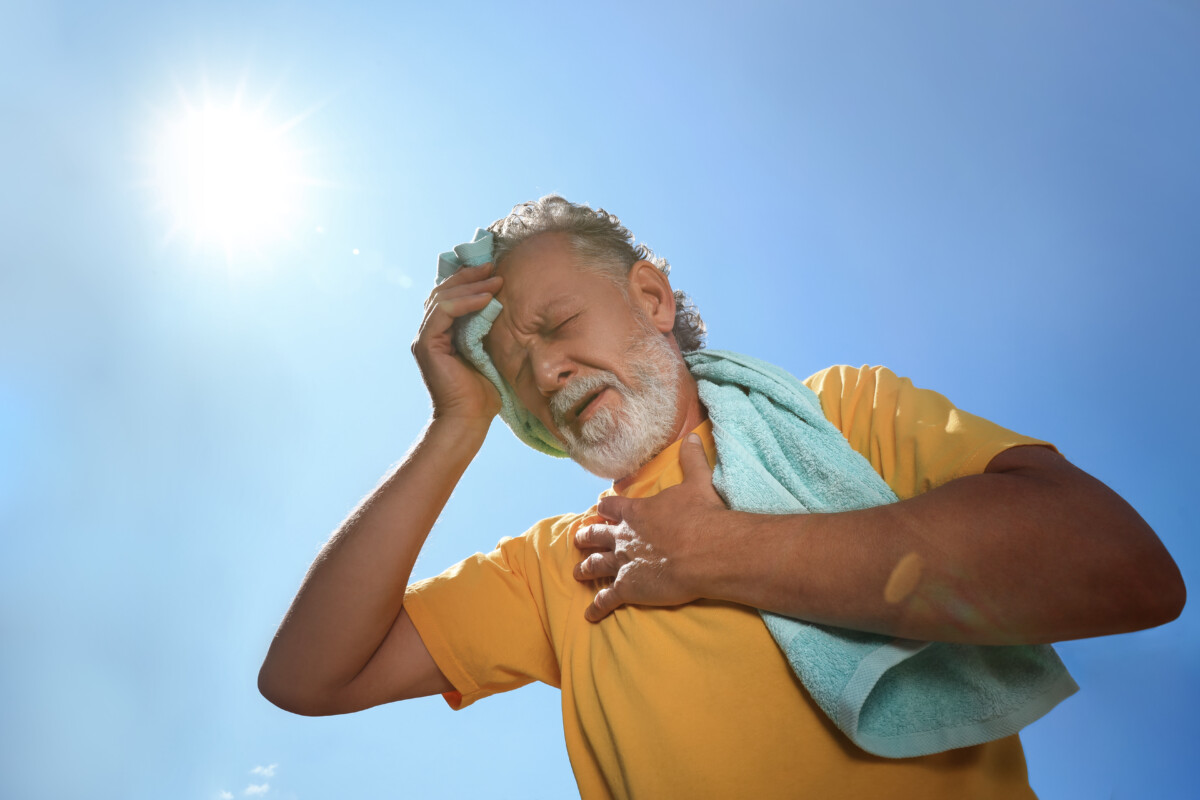
During the hottest hours of the year in some regions, even resting in the shade can push the body toward dangerous heat stress. No bench offers safety. No slow walk to a neighbor’s house. No errand that can be run without risking a body temperature that climbs and keeps climbing. A new study tracking 75 years of global climate data confirms this threshold has already been crossed, across more of the world than most people realize.
Published in Environmental Research: Health, the study is the first large-scale historical look at what researchers call “livability,” a measure of how much physical activity a person can safely sustain outdoors before the body’s cooling system gets overwhelmed. When heat and humidity are severe enough, the body cannot shed enough heat to keep up, even at rest. Researchers label those conditions “unlivable.” Their maps show these conditions already appear across parts of the tropics and subtropics, and the situation is worsening.
About 1.1 percent of the global population now lives where conditions reach “unlivable” levels during peak heat hours for a healthy younger adult. For adults over 65, the picture is far more urgent: an estimated 24.5 percent of the world’s population already lives in areas where peak summer heat is considered unlivable for older people.
What Scientists Mean by “Unlivable” Extreme Heat
Rather than relying on standard metrics like the heat index, which only estimates how hot conditions feel, the research team used a biophysical model called HEAT-Lim. It calculates how much heat a human body can actually shed under a given set of conditions, factoring in air temperature, humidity, air movement, age, and sweat limits, then determines the maximum activity level that is safe.
Activity is measured in METs, or metabolic equivalents. Sitting still is 1 MET. A brisk walk runs about 3.3 METs. When heat pushes the safe ceiling below that, even a walk to the mailbox becomes a health risk. Below 1.5 METs, even resting can cause the body to gain heat faster than it can shed it, creating a risk of heat stroke. That is the “unlivable” threshold.
Researchers fed HEAT-Lim hourly temperature and humidity readings for land areas worldwide from 1950 through 2024, modeling two groups: healthy adults ages 18 to 40 and healthy adults over 65. Both were assessed in shaded conditions with a light breeze. Direct sunlight would make things considerably worse.

75 Years of Data, One Clear Direction
During the most recent 30 years of data, parts of South and Southwest Asia have already crossed the unlivable threshold for healthy younger adults at peak heat hours. In Bahrain, Qatar, the United Arab Emirates, and parts of Pakistan and eastern India, sitting in the shade with a light breeze is not enough to prevent the kind of core temperature rise that leads to heat stroke. These are not projections. They are documented conditions from recent decades.
For older adults, unlivable conditions are far more widespread, spanning large portions of tropical South America, Sub-Saharan Africa, Southwest and South Asia, and parts of Australia and North America.
Between 1950 and 2024, heat-restricted hours increased for both age groups across tropical and subtropical regions. Average annual hours of outdoor heat limitation for younger adults roughly doubled, from about 25 in the 1950s to around 50 today. For older adults, those hours climbed from about 600 to 900 per year, more than 10 percent of all hours in a year. Older adults are accumulating restricted hours far faster than younger adults.
Among individual years, 2024 stood out sharply. Heat-related livability limitations that year surpassed every previous El Niño year on record, even though most of 2024 was not in a strong El Niño pattern. Researchers treated that as a signal that long-term warming has pushed baseline conditions beyond what natural climate cycles can account for.
Older Adults Are Losing Months of Safe Outdoor Time
Age shapes the body’s response to heat more than most people appreciate. Older adults sweat less and less efficiently, making them more reliant on air movement to stay cool. In dry heat especially, that biological gap becomes dangerous.
Among the hardest-hit countries for older adults are Cambodia, Bangladesh, Pakistan, Thailand, Qatar, and the United Arab Emirates, where residents face between 2,000 and 2,800 hours of severe heat limitation per year, roughly a quarter to a third of all hours in a year. When population is factored in, the numbers become staggering. India alone accounts for roughly 100 billion people-hours of annual heat limitations for younger adults and over one trillion for older adults. Those figures represent cumulative exposure across the entire population, multiplying the number of people in a given area by the number of hours per year they face restricted conditions, and they reflect the overlap of severe heat with some of the most densely populated lowland regions on Earth.
Wealth Buys Options, but Not Always Safety
Economic wealth and dangerous heat are not opposites. Qatar, Bahrain, Kuwait, and the UAE, all wealthy nations by global standards, rank among the most heat-constrained countries for younger adults. Qatar’s annual severe heat limitation roughly doubled between the early and recent study periods, from about 400 hours per year to over 800.
What wealth does offer is escape. In richer countries, people can retreat to air conditioning when outdoor conditions turn dangerous. In poorer nations, agricultural and construction workers often cannot. Burkina Faso and Benin face roughly the same number of annual heat-limited hours as Bahrain, but their populations have far fewer ways to manage it. Even within wealthy nations, the most vulnerable are left exposed: several hundred migrant worker deaths in Qatar between 2009 and 2019 were linked to occupational heat exposure.
As the authors wrote, “Hot areas are only becoming less livable as the globe warms, and climate model projections confirm that this historical trend is expected to continue.” With the global share of people over 65 rising and heat-stressed populations in Sub-Saharan Africa and South Asia expected to grow rapidly, the number of people living where outdoor rest itself is dangerous will only increase unless emissions are curbed and adaptation efforts scale to match the pace of warming.
Disclaimer: This article is based on a peer-reviewed study and is intended for general informational purposes only. Findings reflect modeled estimates under specific assumptions and should not be interpreted as applying uniformly to all locations, individuals, or times of year. Readers with health concerns related to heat exposure should consult a qualified medical professional.
Paper Notes
Limitations
HEAT-Lim assessed conditions in the shade with a light breeze of about 2.2 miles per hour and no direct solar radiation, a setup the researchers describe as conservative. Real-world outdoor exposure often involves direct sunlight and radiative heat from nearby surfaces, which would make livability conditions worse. Average body morphology for women in each age group was assumed, along with full hydration and light clothing. ERA5-Land, the underlying climate dataset, is a global reanalysis product rather than direct weather station observations and may over- or underestimate local temperatures, particularly where station coverage is sparse. One regional study cited by the authors found ERA5-Land can underestimate temperatures in parts of southeastern China by about 0.9°C. Population data were held static at 2020 levels, which may underestimate exposure in high-growth regions. HDI, used as a proxy for social vulnerability, does not capture all aspects of heat risk or within-country variation. Children and people with health conditions affecting thermoregulation were not modeled.
Funding and Disclosures
Vanos and Guzman-Echavarria received funding from the National Science Foundation (grant #CMMI-2045663). Baldwin and Staudmyer were supported by the NOAA Climate Program Office through funds from the Inflation Reduction Act Forward Looking Projections initiative (Grant Number NA23OAR4310599). Jay received support from Australia’s National Health and Medical Research Council (Investigator Grant 2021/GNT2009507). Parsons and Wolff acknowledge funding from Lyda Hill Philanthropies. ERA5-Land data are produced by the European Centre for Medium-Range Weather Forecasts as part of the Copernicus Climate Change Service; neither the European Commission nor ECMWF is responsible for how the data were applied. Authors declared no competing interests.
Publication Details
Title: Intensifying global heat threatens livability for younger and older adults Authors: L.A. Parsons, J.W. Baldwin, G. Guzman-Echavarria, O. Jay, P. Kalmus, H. Staudmyer, J.K. Vanos, N.H. Wolff Journal: Environmental Research: Health, Volume 4, 2026, Article 015013 DOI: 10.1088/2752-5309/ae3c3a Published: March 10, 2026 Open Access: Yes, Creative Commons Attribution 4.0


