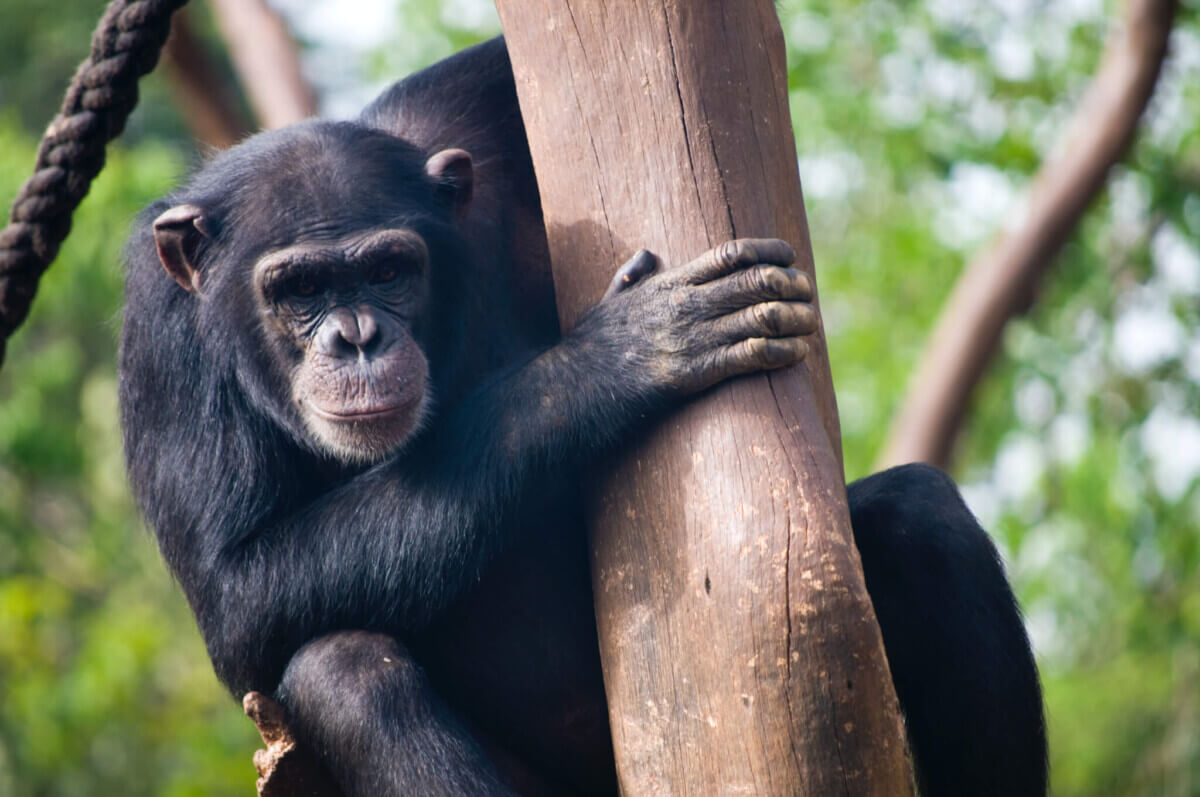
Photo by Sheku Koroma on Pexels
In A Nutshell
- A captive chimpanzee in Japan named Ayumu repeatedly pried floorboards off a walkway and used them as percussion instruments, a behavior never before documented in the species.
- His performances followed a consistent structure, moving from drumming to dragging to throwing, that resembles the build-up and climax pattern of chimpanzee long-distance calls known as pant-hoots.
- Ayumu drummed with a steady, even beat, and his tool-assisted rhythm was more consistent than when he drummed with his bare hands and feet alone.
- Researchers say his spontaneous behavior, paired with visible signs of positive emotion during performances, may offer clues about the ancient roots of human music.
Nobody taught Ayumu to make a drum. Nobody taught him to keep a beat. Yet for more than two years, the 23-year-old chimpanzee living at a research center in Japan has been prying wooden floorboards off a walkway, repurposing them as percussion instruments, and staging structured, multi-part rhythmic performances. He is, as far as researchers know, part of a rare documented case of a chimpanzee repurposing objects as instruments and using them in extended, organized displays, and what he does with that instrument may offer clues about how human music evolved.
Where music came from is one of the more genuinely open questions in human evolutionary science. One leading theory holds that rhythmic sound-making grew out of older, emotion-driven vocal behaviors common across primates, a kind of ancient shared root between calling out and playing music. Ayumu’s behavior, spontaneous and untrained, offers a behavioral case that, for the first time, offers a behavioral case that brings together tool use, rhythm, and emotional expression in a way rarely documented in non-human animals.
Researchers at Kyoto University’s Center for the Evolutionary Origins of Human Behavior documented his performances over more than two years and published their findings in the Annals of the New York Academy of Sciences.
How Ayumu Invented His Own Chimpanzee Drumming Tool
Observations ran from February 2023 to March 2025. Whenever Ayumu’s displays could be heard, researchers filmed the sessions. Over the study period, they captured 89 distinct sequences across 37 observation days.
At least twice, Ayumu was filmed removing floorboards from the corridor walkway himself, meeting the scientific definition of tool-making. No other chimpanzee in the group consistently did the same. He had prior experience with electronic keyboards and touch panels at the center, but had never received any training in drumming or rhythm production. He arrived at this behavior entirely on his own.
Each recorded sequence was broken down into its parts: tool-assisted drumming, bodily drumming against a wire fence, object dragging, object rocking, walkway running, and object throwing. Two trained observers coded the footage independently and reached a strong reliability score. Statistical analyses then asked a simple question: was the order in which Ayumu moved through those behaviors random, or did it follow a pattern?

What Researchers Found in Ayumu’s Chimpanzee Drumming Displays
Ayumu’s sequences were not random. Two transitions occurred far more often than chance would predict: drumming consistently led to dragging, and dragging consistently led to throwing. That progression, from slow heavy percussion to rapid scraping to a climactic throw, resembles the introduction-development-climax structure of the pant-hoot, the chimpanzee’s signature long-distance call. In wild chimpanzees, object throwing is typically associated with the vocal peak of a pant-hoot, and the same pattern appeared here. Ayumu’s sequence closely resembled what pant-hoots do vocally.
His rhythm also held up under scrutiny. Analysis of the timing between drum hits showed that Ayumu favored a steady, even beat rather than random or erratic intervals. A regular beat is one of the most consistently documented features of human music across every culture ever studied. His sequences ran between two and fourteen distinct components each, with the whole performance sometimes lasting several minutes, far longer than the few seconds of drumming typically observed in wild chimpanzees.
When Ayumu drummed with the fabricated floorboard rather than his bare hands and feet, his rhythm was measurably more consistent. Studies of human drummers have found similar patterns. Tapping with sticks produces a more stable rhythm than tapping with fingers alone.
A Drummer Who Grins While He Plays
Perhaps the most unexpected detail was what was happening on Ayumu’s face. During many sessions, he displayed what primatologists call a play face, a relaxed open-mouthed expression associated with positive, non-aggressive arousal. On a handful of occasions, he also showed a silent bared teeth expression, typically linked to friendly, tension-reducing social signals. Neither expression had previously been documented during pant-hoot displays.
Researchers noted that “Ayumu’s drumming suggests not only a display, but also the experience of intrinsically positive emotions associated with the production of sounds, similar to human musical performance.” Research on human music across cultures has found that musical performance frequently expresses high-arousal, positive emotional states. Ayumu’s face during his performances fits that same profile.
Ayumu is the alpha male of his group of 11 adult chimpanzees, a social position researchers note may have contributed to his repeated use of loud, conspicuous drumming as a display. No other chimpanzee in the group adopted the same behavior consistently throughout the study.
Human music across cultures often features a steady beat, percussion, repetition, and a build toward a climax. Ayumu’s performances, spontaneous and untrained, overlap with several of those features at once. Those parallels to pant-hoot vocalizations, along with the positive emotional expressions observed during performance, offer qualified support for the idea that music may have roots in primate vocal expression long predating our species. Ayumu did not set out to prove a point about evolutionary biology. He pulled up a few floorboards, kept the beat, and grinned. Researchers are still working out what that means.
Paper Notes
Limitations
This study is observational and based on a single individual, so its findings cannot be generalized to chimpanzees as a species. Some behavioral transitions occurred too rarely to support firm conclusions, and researchers acknowledge that additional data could shift their interpretation. Sound intensity was not analyzed, leaving open the question of whether tool use made Ayumu’s displays acoustically more effective. Captive conditions differ substantially from wild environments, where predator pressure and fewer resonant objects may suppress or prevent similar behaviors, and it remains unknown whether comparable displays occur in free-ranging populations.
Funding and Disclosures
This research was supported by Japanese government scientific grants: a Grant-in-Aid for Transformative Research Areas (A) (Publicly Offered Research) 25H01934, a Grant-in-Aid for Scientific Research (B) 24K03237, and a Grant-in-Aid for Challenging Research (Exploratory) 23K18478, all awarded to lead author Yuko Hattori. No competing interests were declared by the authors.
Publication Details
This study was authored by Yuko Hattori, Pavel Voinov, and Makiko Uchikoshi, all of the Center for the Evolutionary Origins of Human Behavior at Kyoto University, Kyoto, Japan. Makiko Uchikoshi holds a secondary affiliation with the Japan Monkey Centre in Inuyama, Japan. Yuko Hattori served as corresponding author. The paper is titled “Combinatorial Instrumental Sound-Making in a Captive Chimpanzee: Evolution of Vocal Externalization” and was published in the Annals of the New York Academy of Sciences in 2026. DOI: https://doi.org/10.1111/nyas.70239


