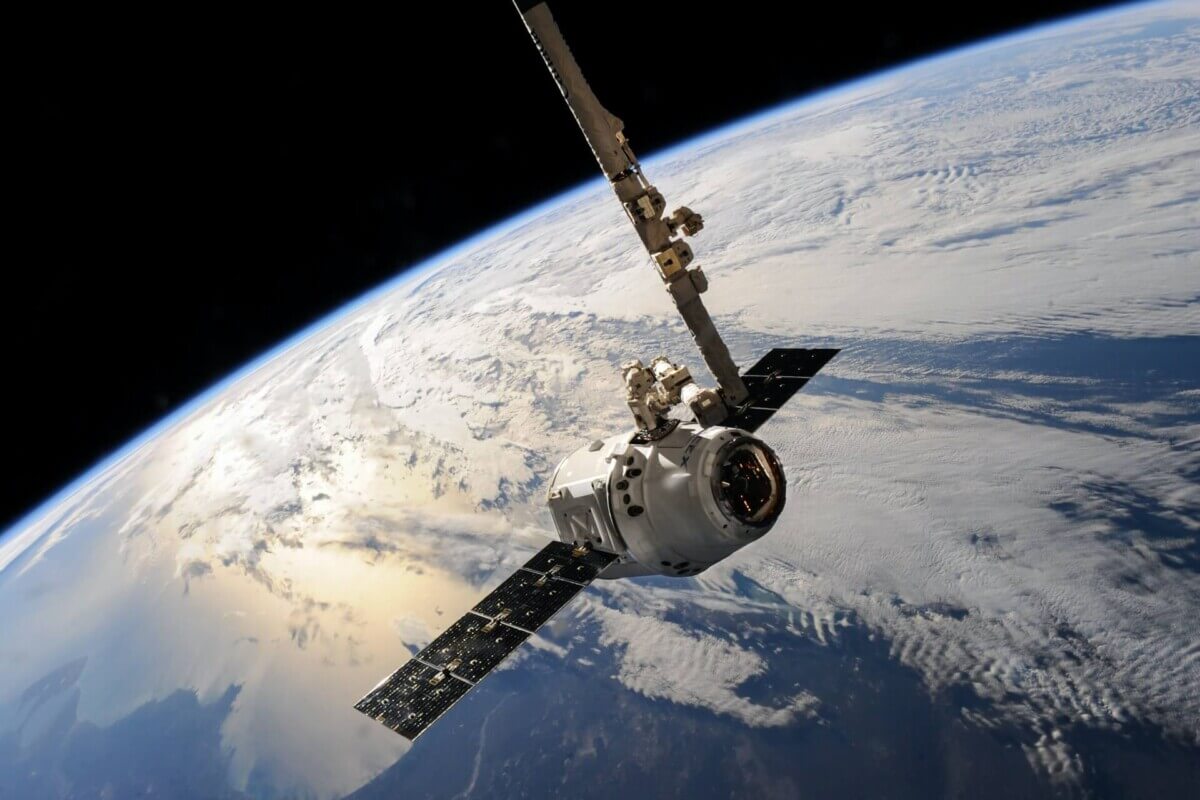
(Credit: SpaceX from Pexels)
Satellite Internet Has An Exhaust Problem Nobody Is Regulating
In A Nutshell
- By 2024, rockets launching satellite megaconstellations were burning more fuel than all other rocket missions combined, releasing unregulated soot and chemicals into the upper atmosphere.
- Rocket soot absorbs sunlight with a warming effect more than 500 times greater per unit of mass than soot from ground-level sources like cars and power plants.
- Megaconstellation rockets contribute only about 9% of rocket-caused ozone depletion today, but that share is expected to grow as satellite replacement rates accelerate.
- No international standard currently requires companies to measure or limit these upper-atmosphere emissions, and the study’s models were already underestimating real-world launch activity by 12% to 16%.
The race to blanket the globe in high-speed internet has turned low Earth orbit into one of the busiest construction zones in history, and all those rockets are leaving something behind.
A new study published in the journal Earth’s Future finds that satellite megaconstellations, the massive networks of thousands of small satellites being launched by companies like SpaceX, have grown so quickly that by 2024, their rockets burned more fuel than all other types of rocket missions combined. Researchers used a detailed inventory of launches and re-entries from 2020 to 2022, then modeled how those emissions could grow through 2029, and what they found raises fresh questions about an industry whose upper-atmosphere emissions remain largely unregulated and poorly monitored.
Every time a rocket launches or a used satellite falls back through the atmosphere and burns up, it releases a cocktail of chemicals and particles into layers that regulate the planet’s temperature and protect life on the surface from harmful radiation.
Thousands of Satellites, Tons of Rocket Soot
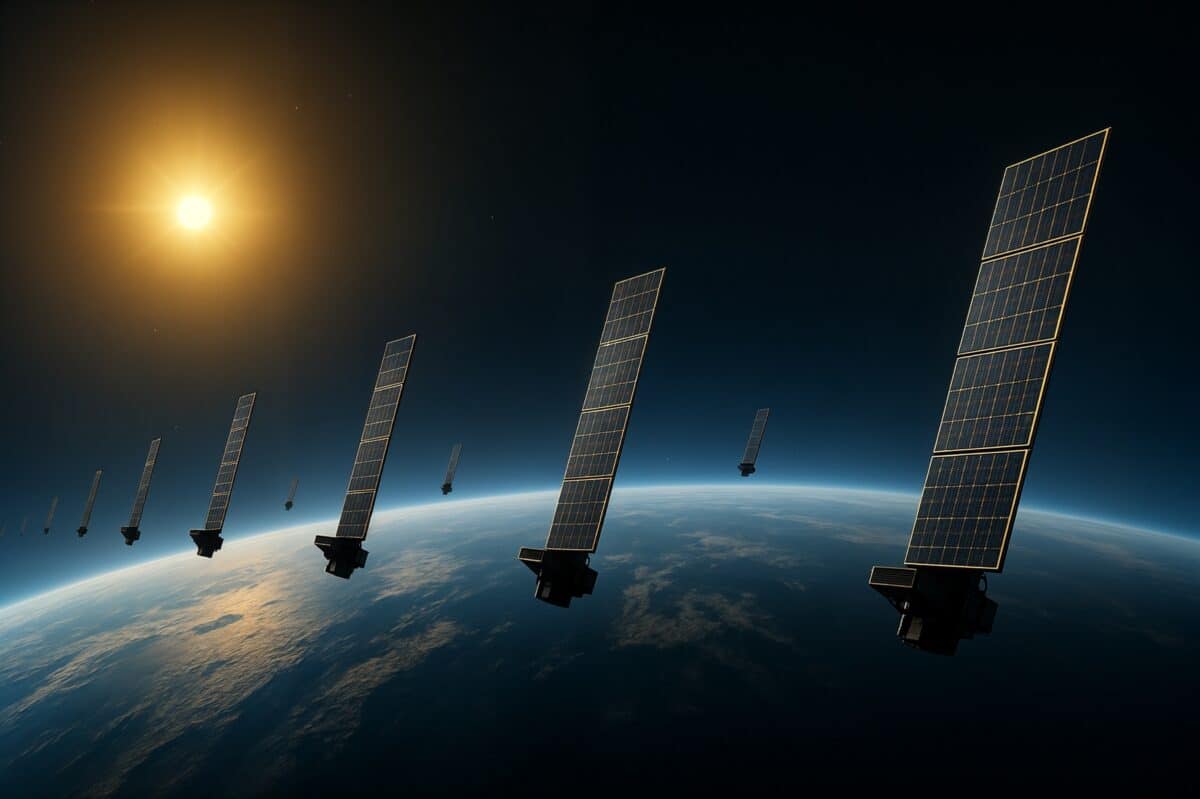
Researchers estimate that at least 65,000 more megaconstellation satellites are expected in low Earth orbit over the next ten years, from providers including China’s Guowang and Amazon’s Leo. That’s on top of the roughly 22,500 objects already tracked in low orbit today.
To launch all those satellites, rockets burn enormous quantities of kerosene, the same basic fuel used in jet engines, though highly refined. When kerosene burns, it produces soot, also called black carbon. On the ground, soot from cars and power plants is a well-known climate problem. But soot released high in the upper atmosphere behaves very differently.
Soot from rockets absorbs sunlight with a warming effect more than 500 times greater per unit of mass than soot released at Earth’s surface. Upper-atmosphere soot can linger for years without being washed away by rain, sitting right where it can intercept sunlight before it even reaches the lower atmosphere.
Warming Above, Cooling Below
That effect plays out in two competing ways the study’s authors compare to an accidental experiment in what scientists call “solar geoengineering,” deliberate attempts to reflect sunlight away from Earth to cool the planet.
Soot absorbs incoming sunlight, warming the upper atmosphere. Across all rocket missions over the decade studied, that warming effect, measured as the net change in energy reaching Earth, came in at 6.47 milliwatts per square meter, with megaconstellation missions responsible for 56% of it. But as the upper atmosphere warms and adjusts, it reflects more energy back to space, producing a nearly equal cooling influence on the lower atmosphere and Earth’s energy balance. Megaconstellation missions accounted for 42% of that offsetting effect.
Researchers describe this push-and-pull as operating “like small-scale stratospheric aerosol injection experiments without forethought for potential unintended consequences.” Rockets may already be inadvertently tinkering with the planet’s energy balance, without a clear international framework for measuring or limiting these upper-atmosphere emissions, and with major scientific uncertainties still unresolved.
A Small but Growing Ozone Problem
Rocket emissions are also affecting the ozone layer, the part of the upper atmosphere that blocks dangerous ultraviolet radiation. Ozone damage from all rocket missions combined is still quite small, estimated at about 0.02% of total global ozone by 2029, compared to roughly 2% loss from chemicals regulated under the Montreal Protocol.
Megaconstellation rockets account for only about 9% of rocket-caused ozone depletion, because they almost exclusively burn kerosene, which does not release the chlorine compounds most destructive to ozone. But satellites in megaconstellations are designed to be replaced roughly every five years, meaning burn-up re-entries will accelerate. Each re-entry releases its own byproducts, including metal particles, that can affect ozone chemistry in ways not yet fully understood.
How Researchers Built and Checked Their Model
Researchers built their analysis on a global inventory of actual rocket launches and re-entry events from 2020 to 2022, the first years in which megaconstellation launches became dominant. Using those real-world numbers, they projected forward to 2029 based on how fast launches and re-entries were growing during that window, about 28% per year for megaconstellation missions and somewhat slower for other mission types.
Those numbers fed into a large-scale computer simulation covering the atmosphere from ground level to about 50 miles up. To check their work, the team compared model predictions against actual measurements from a 2023 high-altitude aircraft campaign called SABRE, which flew through a Falcon 9 rocket exhaust plume about 41 to 45 minutes after launch. Results showed that some ozone-related emissions may be underestimated, though the authors note other uncertainties could push results in different directions.
When the team compared their projected launch numbers for 2023 and 2024 against what actually happened, they found they had underestimated fuel burn by about 12% to 16%, meaning real-world emissions were already outpacing their models.
No international standard requires measurement of these upper-atmosphere pollutants, and no regulation compels companies to study the atmospheric effects before launching the next batch of satellites. That gap, the researchers say, cannot persist indefinitely. Whether satellite internet becomes a household convenience or a household name in climate policy may depend on how quickly anyone decides to look up.
Disclaimer: This article is based on a single peer-reviewed modeling study and reflects findings at the time of publication. Projections about future emissions and atmospheric effects carry uncertainty, and the authors note that key measurements needed to validate the models are still lacking. If you are interested in learning more about atmospheric science or space industry regulation, consult peer-reviewed literature and official environmental agencies for the most current information.
Paper Notes
Limitations
The authors acknowledge several important limitations. The atmospheric model operates at relatively coarse geographic resolution, roughly 400 by 500 kilometers per grid cell, which may not capture the localized behavior of rocket exhaust plumes. Not all particle types produced during satellite re-entry are represented, and some chemical processes relevant to ozone depletion, specifically secondary ozone loss caused by changes in atmospheric circulation, are not fully captured. The emission inventory was built for 2020 to 2022, and projections beyond that period carry growing uncertainty given the unpredictable pace of space industry growth. Measurements from the SABRE aircraft campaign suggest the inventory may underestimate certain pollutants released at higher altitudes, meaning some findings could be conservative. Key physical properties of particles produced during satellite re-entry, including their size and interactions with other atmospheric particles, are not well characterized, and laboratory studies are urgently needed.
Funding and Disclosures
This research was supported by the European Research Council under the European Union’s Horizon 2020 research and innovation programme, through the Starting Grant awarded to Eloise A. Marais, UpTrop, Grant 851854. The authors also acknowledge use of the UCL Myriad High Performance Computing Facility and associated support services. The paper is published as open access under the Creative Commons Attribution License. The authors declare no conflicts of interest relevant to this study.
Publication Details
Paper Title: Radiative Forcing and Ozone Depletion of a Decade of Satellite Megaconstellation Missions | Authors: Connor R. Barker, Eloise A. Marais, Eric Y.P. Tan, Sebastian D. Eastham, Glenn S. Diskin, Joshua P. DiGangi, Yonghoon Choi, Andrew W. Rollins, Eleanor Waxman, T. Paul Bui, Charles K. Gatebe, Jonathan Dean-Day, and Rajesh Poudyal | Institutional Affiliations: Department of Geography, University College London; Department of Physics and Astronomy, University College London; Department of Aeronautics, Imperial College London (Brahmal Vasudevar Institute for Sustainable Aviation); NASA Langley Research Center; Analytical Mechanical Associates; NOAA Chemical Sciences Laboratory; CIRES, University of Colorado Boulder; NASA Ames Research Center; Bay Area Environmental Research Institute | Journal: Earth’s Future | DOI: https://doi.org/10.1029/2025EF007229 | Received: September 24, 2025 | Accepted: April 11, 2026


