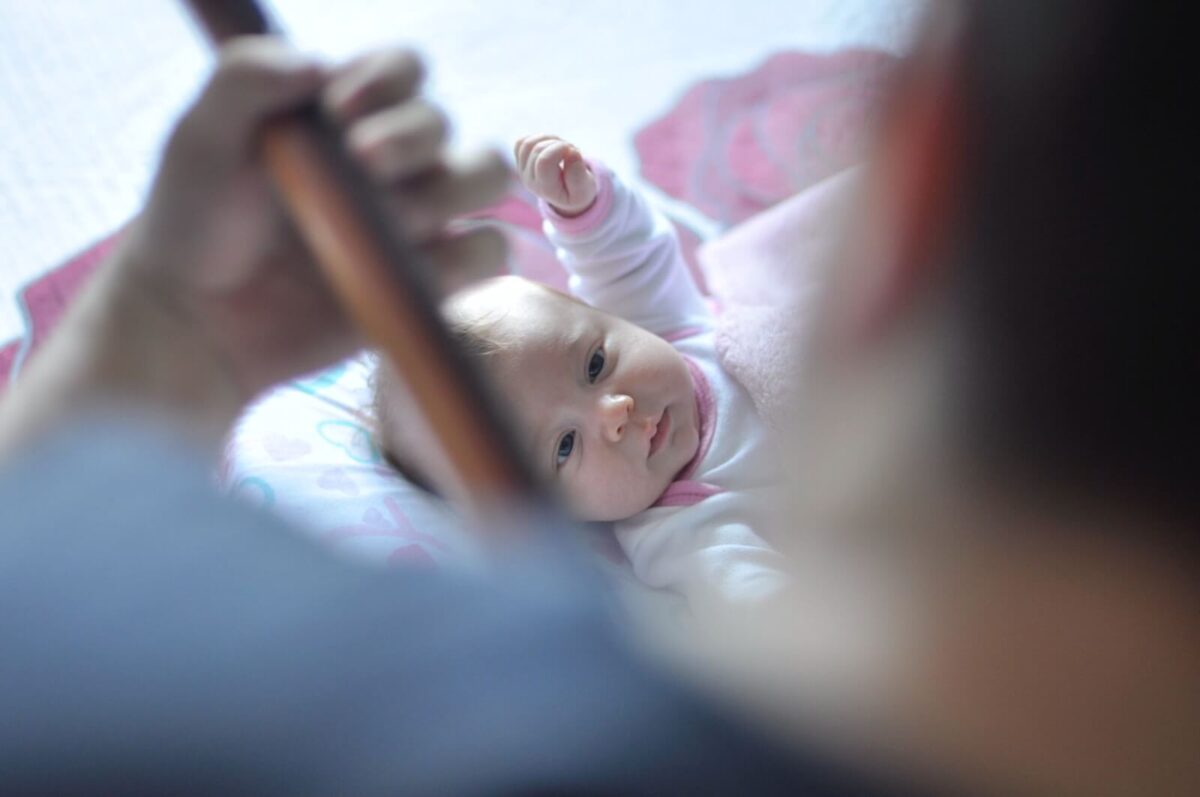
(Credit: Photo by Giu Vicente from Unsplash)
In A Nutshell
- Newborns can predict musical beats within the first two days of life, but show no brain response to melodic patterns
- 49 sleeping babies listened to Bach piano pieces while scientists measured their brain waves using EEG technology
- The womb environment may prime babies for rhythm: heartbeats and footsteps come through clearly, but pitch details are muffled
- Rhythm develops first, with melody tracking emerging later through exposure to speech, music, and environmental sounds
Two-day-old babies can already sense when a musical beat is off, but their brains show little sign of tracking melodies. That’s the main finding from research that recorded brain activity in 49 sleeping newborns while classical piano music played through tiny earphones. Scientists discovered that babies enter the world ready to groove to a rhythm, but learning to appreciate a tune takes time.
The study helps explain why parents instinctively rock, bounce, and sway with fussy infants: babies appear especially tuned to rhythm. It also raises intriguing questions about how musical abilities develop and why timing, not pitch, dominates the infant brain from day one.
Researchers played Johann Sebastian Bach piano pieces to newborns at a hospital in Budapest while measuring their brain waves. Some babies heard the original compositions. Others heard scrambled versions where the notes and timing were randomly shuffled. When listening to real music with its natural rhythm, the babies’ brains actively predicted when notes would arrive. When the structure disappeared, so did that brain activity. But whether the music was structured or chaotic, the babies showed no clear brain signatures of melodic prediction.
“Tracking rhythmic statistical regularities is a capacity present at birth, whilst melodic tracking might not be,” the research team reports in PLOS Biology. In other words, babies appear capable of following a beat before they can follow a tune.
Why Rhythm Develops Before Melody
The finding makes sense when you consider what babies experience before birth. Inside the womb, sounds are muffled. High-frequency details that create melodies get filtered out, but low-frequency rhythms (a mother’s heartbeat, her footsteps, the cadence of her voice) come through clearly. Fetuses spend nine months bathed in biological rhythms, which may help explain why newborn brains appear primed to detect timing patterns.
The physical structures needed for processing pitch also take time to mature. Adult brains can distinguish subtle frequency differences and weave multiple notes into melodic patterns. Newborn brains can hear that notes are different, but they can’t yet predict what note comes next based on melody. That’s a more sophisticated skill that likely develops with exposure.
Scientists tested 49 healthy newborns, each less than two days old, fitting them with electrode caps while they slept. The babies heard 10 Bach compositions and four scrambled control pieces. When researchers analyzed the brain recordings, they found clear differences. During structured music, brain waves spiked about a quarter-second after rhythmically unexpected notes arrived. That spike only happened with real music, proving babies weren’t just reacting to sounds, they were anticipating them.
The researchers used a computer model to calculate how surprising each note should be based on what came before. Sure enough, the babies’ brain responses matched the model’s predictions for timing. But for melody? No significant tracking emerged.

What This Means for Parents and Baby Musicians
Parents don’t need to worry about choosing the perfect lullaby melodies. At least in the first days of life, babies care more about the rocking motion and rhythmic “shh-shh-shh” than the tune itself. That instinct to bounce a crying baby? Science says you’re onto something.
This research also connects to how babies learn language. Before understanding words, infants must figure out where one word ends and another begins, which syllables typically go together, and how rhythm creates meaning. A good sense of timing provides the foundation for these language skills. Studies show that musical exposure in premature babies strengthens brain networks involved in both music and language processing.
The researchers compared their newborn data to earlier studies on adults and monkeys listening to the same Bach pieces. Adult humans showed strong brain responses to both rhythmic and melodic surprises. Monkeys showed responses to rhythm but not melody. Newborns landed in the middle: rhythm yes, melody not yet. Over months and years of hearing speech, music, and environmental sounds, babies’ brains gradually build the neural wiring to track melodies the way they already track beats.
Interestingly, the brain response that tracked rhythm in newborns resembles a pattern seen in older infants during auditory processing. It appeared only during structured music, confirming that babies weren’t simply startled by unexpected sounds. They were running predictions and updating them in real time, the same process adults use when tapping along to a song.
The study doesn’t mean babies can’t process melodies at all. It means melody doesn’t automatically drive predictions the way rhythm does from birth. Given exposure and time, babies rapidly develop pitch-based skills. By adulthood, most people balance rhythm and melody processing seamlessly. But rhythm gets a head start, and that early advantage may explain why nearly every culture’s infant-directed speech and music emphasizes rhythmic patterns.
Paper Notes
Study Limitations
The research involved sleeping newborns, which may have affected how they processed musical information compared to being awake. The musical pieces were complex Western classical compositions that may have been harder to process than simpler melodies. Each melody played for an average of 158 seconds, which might not have given enough time for slower learning of melodic patterns. The 49-baby sample size was reasonable for infant brain research but showed substantial individual variation that couldn’t be fully explained by factors like gestational age. The study used only Western classical music and doesn’t address how newborns might respond to music from other cultural traditions with different rhythmic and melodic structures.
Funding and Disclosures
Roberta Bianco received funding from the European Union (Marie Skłodowska-Curie Actions, PHYLOMUSIC, grant 101064334). Giacomo Novembre and Felix Bigand received funding from the European Research Council (MUSICOM, grant 948186). Trinh Nguyen received funding from the European Union (Marie Skłodowska-Curie Actions, SYNCON, grant 101105726). Brigitta Tóth, Gábor P. Háden, and István Winkler received funding from the Hungarian National Research Development and Innovation Office (grants ANN131305, FK139135, and K147135, respectively). The Brain and Machines Flagship Programme of the Italian Institute of Technology provided additional support. The authors declared no competing interests.
Publication Details
Authors: Roberta Bianco (University of Pisa, Italy; Italian Institute of Technology, Rome, Italy), Brigitta Tóth (HUN-REN Research Centre for Natural Sciences, Budapest, Hungary), Felix Bigand (Italian Institute of Technology, Rome, Italy), Trinh Nguyen (Italian Institute of Technology, Rome, Italy; University of Heidelberg, Germany), István Sziller (Szent Imre University Teaching Hospital, Budapest, Hungary), Gábor P. Háden (HUN-REN Research Centre for Natural Sciences, Budapest, Hungary), István Winkler (HUN-REN Research Centre for Natural Sciences, Budapest, Hungary), Giacomo Novembre (Italian Institute of Technology, Rome, Italy) | Journal: PLOS Biology | Title: “Human newborns form musical predictions based on rhythmic but not melodic structure” | DOI: 10.1371/journal.pbio.3003600 | Publication Date: February 5, 2026 | Study Design: Electroencephalography (EEG) study with 49 full-term newborns (0-2 days old) exposed to classical monophonic piano music and control stimuli with disrupted musical structure


