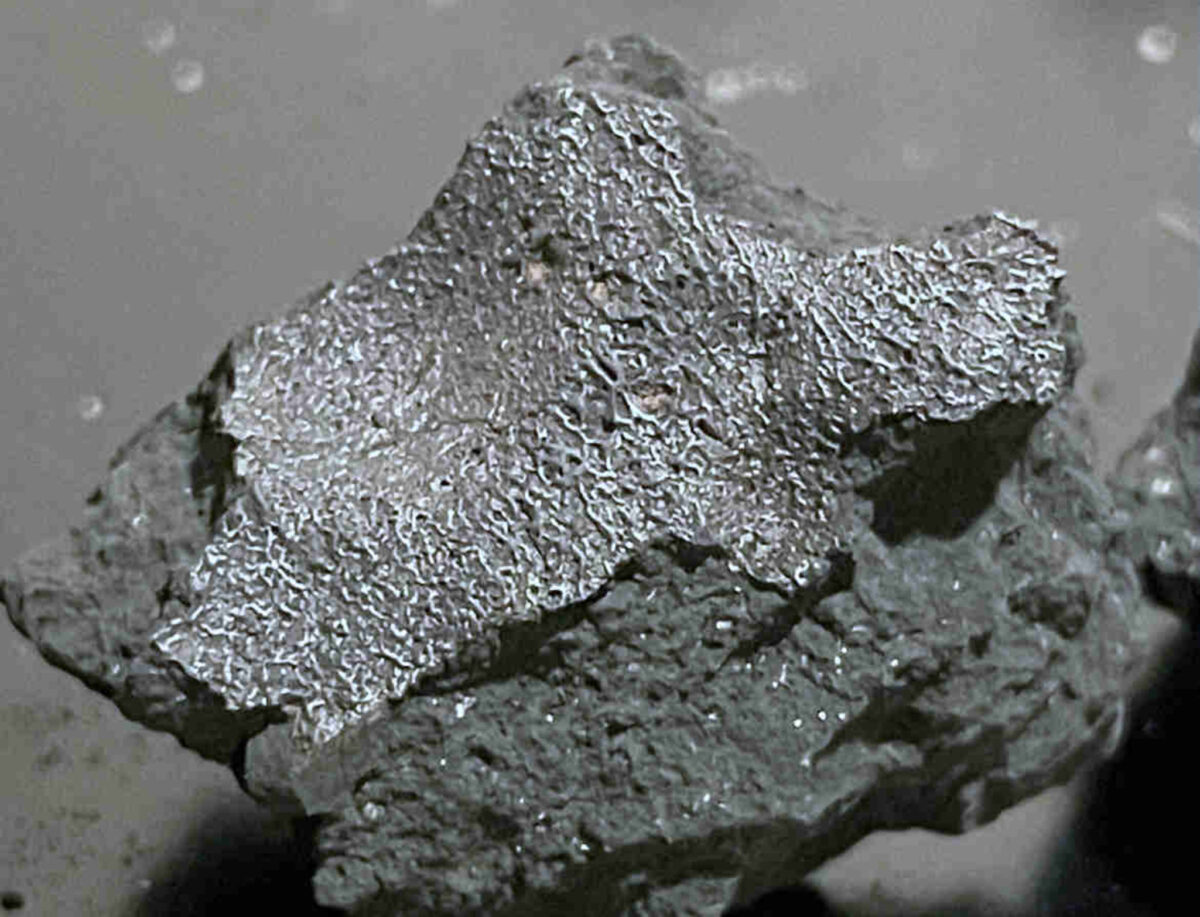
Fragment of the Hillsborough meteorite, broken on impact, with fusion crust from passing at high speed through the Earth’s atmosphere. (Credit: SETI Institute)
Rock From Space Packed With Evidence That Asteroids Planted Seeds Of Life
In a Nutshell
- A meteorite that punched through a New Jersey home in July 2024 is the first witnessed fall of its kind to show geochemical evidence of ancient saltwater brines inside its parent asteroid.
- Sodium packed into cracks in the rock’s mineral crystals points to salty fluids that once flowed through the asteroid, not to contamination picked up on Earth.
- The meteorite is rich in amino acids, the building blocks of proteins, which appear to have formed through water-driven chemistry inside the parent body.
On a July afternoon in 2024, a homeowner in Hillsborough, New Jersey, heard a thunderous crash. Walking into the master bedroom, they found a hole punched through the ceiling, black debris scattered across the bed and carpet, and a sharp rotten-egg smell hanging in the air. A rock from space had just made an unannounced house call.
What fell through that roof turned out to be more than an unusual insurance claim. Scientists have identified the space rock, now named the Hillsborough meteorite, as a rare and remarkably well-preserved piece of a primitive asteroid. Locked inside it is something never before confirmed in this kind of space rock: evidence of ancient saltwater, and with it amino acids, the building blocks of life.
Published in the journal Science Advances, the discovery points to liquid water once flowing through the interior of the parent asteroid this meteorite came from, driving the kind of chemistry that may have helped seed life on early Earth. For researchers who study how life began, that is a big deal.
A Fireball Over the New York Area
Just after 11 a.m. local time on July 16, 2024, a fireball blazed across the sky over the New York metropolitan area. Sixty people reported it to the American Meteor Society, doorbell cameras caught it, and specialized sky-watching cameras tracked its path. Its boom rattled windows across New York, New Jersey, Connecticut, Rhode Island, and Pennsylvania.
Scientists traced the fireball’s route using camera footage and radar, following it roughly east to west over Staten Island toward New Jersey. Weather radar, the same kind used to track storms, picked up smaller fragments falling near Newark Airport, though none of those pieces were ever recovered.
Recovered fragments totaled about 1.35 kilograms, roughly 3 pounds. Based on the energy released during the fireball, researchers calculated that the original rock weighed around 53 kilograms, about the size of a large carry-on suitcase, before it hit the atmosphere.
Quick thinking by the homeowners mattered enormously. They handled the pieces with disposable gloves and aluminum foil and sealed them in glass jars, so the meteorite was never rained on, never sat in soil, and never spent long exposed to Earth’s environment. In the language of researchers, it was pristine.
Ancient Saltwater Trapped in the New Jersey Meteorite
Hillsborough belongs to a class of space rock rich in water and carbon-based compounds. These are among the most common water-rich primitive meteorites found on Earth, and scientists have long suspected they helped deliver organic material to the young planet. One thing had never been confirmed in this class, though: signs that saltwater once moved through them.
Brines are salty solutions that can stay liquid even at very low temperatures. On the dwarf planet Ceres, researchers have spotted bright white patches in craters thought to be salt left behind when briny fluids evaporated or froze. Whether the same thing happened inside smaller asteroids had been an open question.
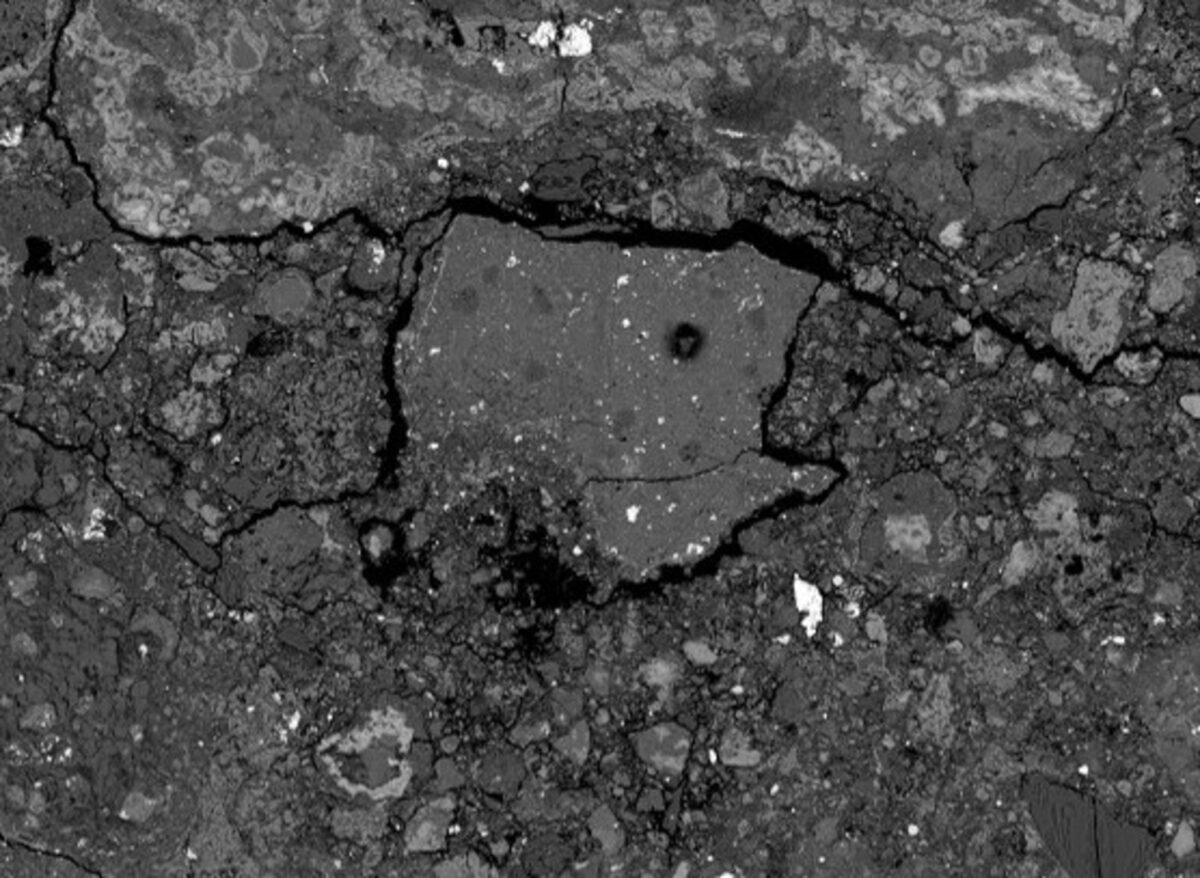
Inside Hillsborough, the answer appears to be yes. Embedded in the rock are small fragments of older, wetter material from the same parent asteroid, mixed in during ancient collisions. These fragments are heavily enriched in sodium, a telltale sign of brine activity, with sodium lodged inside the cracks of mineral crystals as an unidentified glassy material. Researchers ruled out contamination from handling or weathering on Earth, pointing instead to salty fluids that flowed through the asteroid long before the rock ever reached a New Jersey bedroom.

(A) The daytime meteor with wake in an enhanced single video frame from Northford, CT. (B) The impact site in Hillsborough (roof tile width, 14 cm). (C) View of the impact site from inside. (D) Meteorite fragment with fusion crust. (Credits: (A) M. Kirschner and M. Hankey, American Meteor Society; [(B) to (D)] A. Gordon.)
Life’s Ingredients, Made in Space
Beyond salt chemistry, Hillsborough is rich in amino acids, the molecular units that link together to form proteins. Amino acids have turned up in other meteorites before, so their presence is not new. What stands out is the particular mix found in Hillsborough and the conditions under which it appears to have formed.
Lab analysis revealed an amino acid distribution resembling that of Murchison, one of the most-studied meteorites ever recovered. Several of them are rare on Earth but common in space rocks, strong evidence that they are truly extraterrestrial rather than picked up after landing. Their pattern points to chemical reactions that occurred within the parent asteroid during an early period of water activity.
Some earthly contamination did slip in. Fibers from carpet and building materials left chemical fingerprints in the samples, and the team carefully subtracted them. Once those were stripped out, a rich inventory of space-born organic molecules remained. Compared with less altered meteorites of the same type, Hillsborough also carried organic compounds that had lost oxygen over time, a change the researchers tie to the brine chemistry reshaping the rock from within.
Scientists also pieced together a rough travel log. Measurements of elements created when rock is bombarded by cosmic rays in space indicate the meteorite traveled on its own for roughly 200,000 years before reaching Earth, after a much longer stretch buried in the surface of a larger asteroid. Clues from the fireball’s approach angle hint that its home may be a family of water-bearing asteroids in the outer asteroid belt, possibly linked to a large one called 24 Themis.
Why the New Jersey Meteorite Matters for the Origins of Life
Any search for life’s origins keeps circling one question: where did the raw ingredients come from? Early Earth was a violent, mostly barren place, and one leading idea holds that carbon-rich asteroids delivered a chemical starter kit of amino acids, organic molecules, and water that set the stage for biology.
Hillsborough adds a new chapter to that idea. It shows the chemistry behind life’s building blocks was not confined to a few special asteroids but was also at work inside this common class of space rock, driven by liquid water and shaped by brine, then preserved in a rock that eventually punched through a bedroom ceiling. The delivery of these molecules by such asteroids, the authors write, “could have been an important source of the prebiotic organic inventory that led to the emergence of life on Earth.”
A space rock through the roof is, by most measures, an inconvenience. This one also arrived as a message from the early solar system, and scientists are still reading it.
Paper Notes
Limitations
Despite the fast, careful recovery, some earthly contamination reached the samples. Fibers of Nylon-6, common in carpets and building materials, showed up in the amino acid measurements, along with biologically common protein amino acids likely originating on Earth, and the detected acetic acid also showed signs of possible terrestrial contamination. The team identified and corrected these, but their presence warranted cautious interpretation. Some cosmic-ray exposure calculations could not be fully resolved without more information about how the rock was shielded within its parent body, and the exact asteroid family the meteorite came from could not be determined from the available orbital data.
Funding and Disclosures
The work drew on a range of support, including NASA grants to several investigators, the Science and Technology Facilities Council in the UK, the Japan Society for the Promotion of Science, the German Research Foundation, and the Swiss National Science Foundation, among others. Sandia National Laboratories’ contribution was backed by the U.S. Department of Energy’s National Nuclear Security Administration, and Lawrence Livermore National Laboratory’s work was performed under the auspices of the U.S. Department of Energy. The authors declare no competing interests. Meteorite samples are available for research from the American Museum of Natural History.
Publication Details
Paper Title: “Meteor over New York City: Brines in a primitive CM asteroid”
Authors: Peter Jenniskens, Michael E. Zolensky, Austin Gordon, Jamie Gordon, Mike Hankey, Elizabeth A. Silber, Miro Ronac Giannone, Jangmi Han, Loan Le, Marc D. Fries, Karen Ziegler, Queenie H. S. Chan, Diptimayee Behera, Jonathan S. Watson, Mark A. Sephton, James Brakeley, Bianka Munday, Yoko Kebukawa, Zack Gainsforth, Masanori Suzuki, Gregory A. Brennecka, Jan H. Render, Henner Busemann, Daniela Krietsch, Colin Maden, Kees C. Welten, Kunihiko Nishiizumi, Marc W. Caffee, Takahiro Hiroi, Stefan Ruchti, Philippe Schmitt-Kopplin, Jasmine Hertzog, Vincent Carré, Daniel P. Glavin, Jason P. Dworkin, Hannah L. McLain, Angel Mojarro, José Aponte, Denise Buckner, Nanako O. Ogawa, Yoshinori Takano, Naohiko Ohkouchi, Sonia M. Tikoo, Ji-In Jung, Eva M. Riveros, Jon M. Friedrich, and Denton S. Ebel.
Journal: Science Advances, Vol. 12, Issue 29.
Published: July 15, 2026.


