
Ryugu Asteroid (Credit: Japan Aerospace Exploration Agency (JAXA))
Scientists Cracked Open An Asteroid Rock And Found A Magnetic Memory From Before Earth Existed
In A Nutshell
- Scientists tested 28 microscopic particles from asteroid Ryugu and found 23 carried stable magnetic signals dating to the earliest period of solar system history.
- A single rock split into two pieces, each pointing in a different magnetic direction, proved the signals formed before the material solidified and could not be contamination.
- The magnetic signals were preserved by tiny crystals that grew inside a long-destroyed parent asteroid during a period of ancient water-driven chemical activity.
- Key questions remain, including whether the recorded field came from the solar nebula or the early solar wind, and how to best calibrate the measurement method for this type of material.
For years, scientists argued over whether tiny rocks from a distant asteroid were carrying genuine magnetic signals from the dawn of the solar system, or simply picking up contamination during their journey to Earth. A new study, the largest of its kind, has answered that question. Most of the particles do carry real signals, and those signals appear to be magnetic fingerprints frozen in place very early in solar system history, before Earth or any other rocky planet had finished forming.
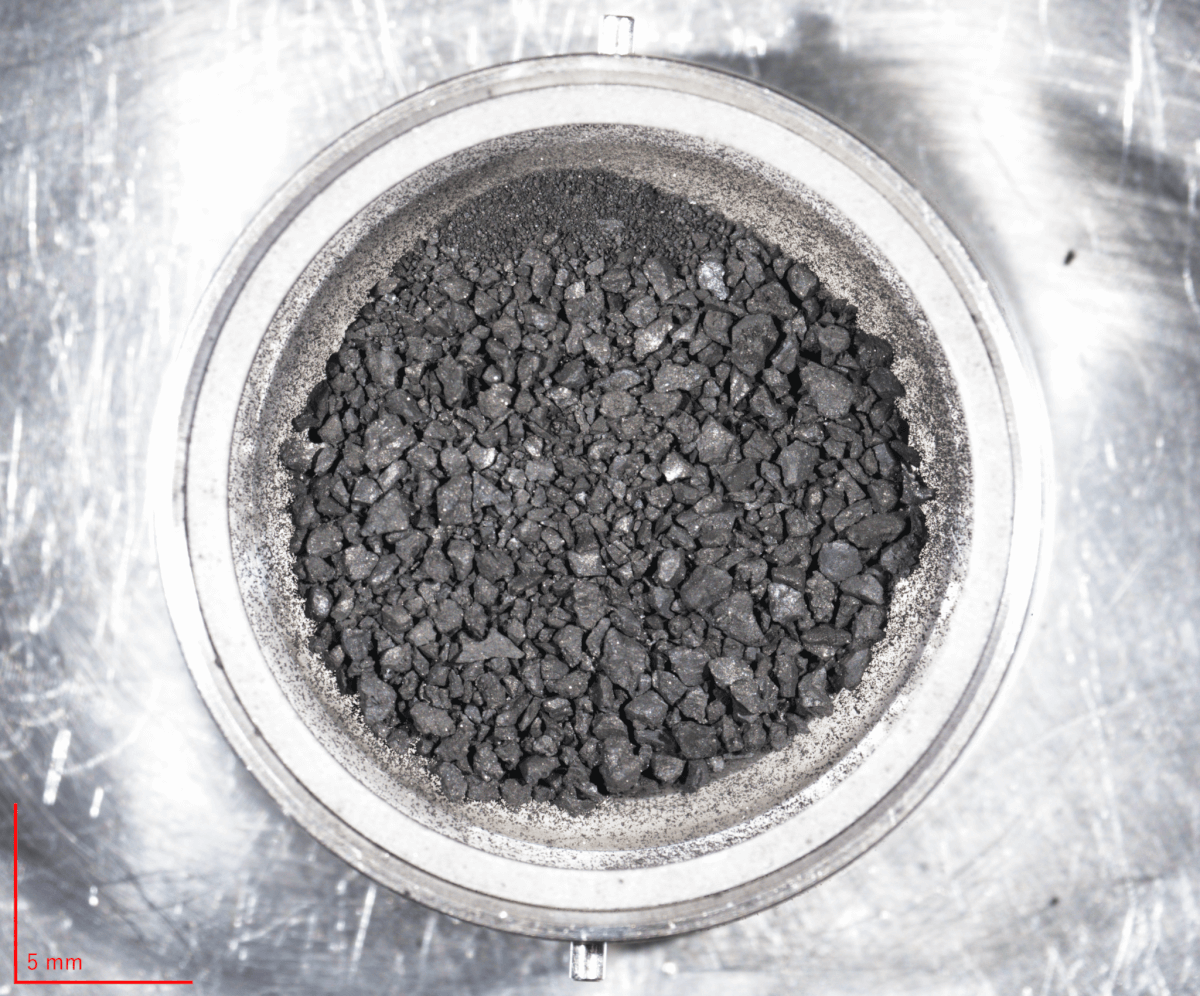
Asteroid Ryugu is a near-Earth asteroid whose orbit crosses Earth’s path, roughly one kilometer wide, and was the target of Japan Aerospace Exploration Agency’s (JAXA) Hayabusa2 spacecraft. In 2019, the mission landed on Ryugu twice and collected surface material, returning it to Earth in December 2020. Unlike meteorites that fall through the atmosphere and can pick up magnetic interference along the way, the Ryugu samples arrived in a sealed container with their magnetic history largely intact.
A team of Japanese researchers measured the magnetic properties of 28 Ryugu particles and found that 23 carried stable magnetic signals. Published in the Journal of Geophysical Research: Planets, the results resolve a years-long scientific disagreement and offer new clarity on the magnetic conditions that shaped how the early solar system’s planets formed.
Why Scientists Couldn’t Agree on Ryugu’s Magnetic Signals
Before this study, only seven Ryugu particles had ever been tested for magnetic signals, and the results were deeply contradictory. One research group concluded the particles held no genuine magnetic record, attributing any signals to contamination introduced during handling or transport. A separate team found evidence for real signals in three different particles. With just seven samples total, neither side could make a convincing case.
Lead author Masahiko Sato and colleagues at multiple Japanese universities and JAXA set out to resolve that disagreement by expanding the dataset fourfold. Using a SQUID magnetometer, an instrument so sensitive it can detect magnetic signals in materials smaller than a grain of sand, the team measured each particle inside a magnetically shielded lab. Nineteen of the 23 newly analyzed particles, those not previously exposed to any other lab procedures, showed stable magnetic signals, making the contamination interpretation very difficult to sustain.

A Single Particle Split in Two Settled the Argument
The most convincing evidence came from a pair of particles that had originally been a single piece of rock. When that fragment was split before testing, the two halves showed magnetic signals pointing in different directions. For two pieces of the same rock to carry differing magnetic orientations, the magnetization had to have occurred before the rock fully solidified, when different interior regions were still free to record different field directions. The researchers concluded that contamination introduced after collection is inconsistent with that observation.
Magnetic field strength estimates ranged from 16.3 to 174 microteslas across the 10 particles that met the study’s quality criteria. Earth’s current magnetic field, for comparison, measures roughly 25 to 65 microteslas. The wide spread among Ryugu’s particles most likely reflects the shattered-and-recemented interior structure common in asteroid rocks. When fragments inside a single particle carry differing magnetic orientations, they partially cancel each other out, pulling the overall reading below the true ancient field strength.
How Ancient Water Preserved Asteroid Ryugu’s Magnetic Record
Ryugu’s particles are rich in a mineral called framboidal magnetite, tiny clustered magnetic crystals that grew inside Ryugu’s original parent body, a larger icy object that broke apart long ago. Related isotopic research places that crystal growth roughly 3.1 to 6.8 million years after the solar system’s first solid materials formed, during a period when water was chemically reacting with rock inside Ryugu’s parent body in a process scientists call aqueous alteration.
As those magnetite crystals grew, they locked in the local magnetic field at the moment of crystallization. Crystals of this type can hold a magnetic record for billions of years without losing fidelity, making each particle a frozen snapshot of magnetic conditions from very early in solar system history. Later heating events, the researchers note, were never intense enough to erase those signals.
What Ryugu’s Rocks Tell Us About the Early Solar System
Magnetic fields in the early solar nebula, the vast spinning cloud of gas and dust that eventually became the Sun and planets, likely influenced how material moved and clumped together during planet formation. Measuring the strength of that ancient field directly has long been considered nearly impossible, because the nebula itself dispersed billions of years ago. Primitive asteroids like Ryugu, objects that formed early and were never significantly heated or reworked, preserve a record of those original conditions.
A particularly reliable measurement technique applied to one particle returned a field strength of roughly 56.9 microteslas, consistent with the dataset’s broader average of 86.2 microteslas. Agreement across different methods applied to the same material confirms these are genuine ancient records.
Several important questions remain open. Scientists have not yet determined whether the magnetic field recorded in these particles came from the solar nebula itself or from the early solar wind, two distinct sources with different implications for how the young solar system evolved. The wide range of field strength readings across particles, from 16.3 to 174 microteslas, is likely explained by fragmented internal structure, where differently oriented magnetic domains within a single particle partially cancel each other out, but that relationship has not been confirmed. And the method used to estimate field strength still requires calibration specific to the type of magnetization present in Ryugu’s minerals.
Ryugu’s returned samples weighed just a few grams in total. But the magnetic memory locked inside most of them dates back to the earliest chapter of solar system history, and scientists, after years of disagreement, now agree on what that memory is telling them.
Paper Notes
Limitations
Only 10 of the 28 analyzed particles met the strict criteria for high-confidence magnetic field strength estimates. The measurement method used carries an inherent factor-of-two uncertainty under the best conditions, and that uncertainty may be larger if the magnetization is of chemical rather than thermal origin, a distinction requiring further calibration using Ryugu materials specifically. The relationship between each particle’s fragmented internal structure and the wide range of measured field strengths remains unconfirmed and is flagged as a priority for future work. The study cannot yet determine whether the recorded magnetic field reflects the solar nebula or the early solar wind, and the ratio between chemical and thermal remanence for framboidal magnetite has not yet been quantitatively established.
Funding and Disclosures
Lead author Masahiko Sato was supported by a JSPS KAKENHI grant (JP21H01140) and by the Hypervelocity Impact Facility at the Institute of Space and Astronautical Science (ISAS), Japan Aerospace Exploration Agency (JAXA). Data from the study are archived at the UTokyo Repository. Authors declare no conflicts of interest.
Publication Details
Authors: Masahiko Sato, Yuki Kimura, Tadahiro Hatakeyama, Tomoki Nakamura, Satoshi Okuzumi, Sei-ichiro Watanabe, Seiji Sugita, Satoshi Tanaka, Shogo Tachibana, Hisayoshi Yurimoto, Takaaki Noguchi, Ryuji Okazaki, Hikaru Yabuta, Hiroshi Naraoka, Kanako Sakamoto, Toru Yada, Masahiro Nishimura, Aiko Nakato, Akiko Miyazaki, Kasumi Yogata, Masanao Abe, Tatsuaki Okada, Tomohiro Usui, Makoto Yoshikawa, Takanao Saiki, Fuyuto Terui, Satoru Nakazawa, and Yuichi Tsuda. Paper title: “Characteristics of Natural Remanence Records in Fine-Grained Particles Returned From Asteroid Ryugu.” Journal: Journal of Geophysical Research: Planets, Volume 131, 2026. DOI: https://doi.org/10.1029/2025JE009265. Received June 16, 2025; accepted January 13, 2026.


