
Photo by Jonny Kennaugh on Unsplash
In A Nutshell
- A review of 87 studies across 19 countries found bicycling was more often linked to better mood, fewer depressive symptoms, sharper thinking, and stronger social connections than not.
- Outdoor, multi-session programs consistently produced the best mental health results; single, indoor lab sessions were far more mixed.
- Every study that examined social well-being reported positive effects, making the social side of cycling one of the most reliable findings in the research.
- Major gaps remain: only 5% of studies reported participants’ race or ethnicity, and most research was done in labs rather than real-world settings, so how broadly these benefits apply is still an open question.
Grabbing a bike and heading out for a ride may be an underrated way to support mental well-being, and a broad new scientific review suggests the benefits may go beyond a simple post-workout mood lift.
A study published in the journal Frontiers in Sports and Active Living reviewed 87 research studies across 19 countries to examine bicycling’s relationship to the mind. Riding a bike, whether outside on trails and roads or indoors on a stationary machine, was more often linked with better mood, fewer depressive symptoms, stronger social connection, and improved thinking skills, though results varied by setting, intensity, duration, and population. Riders who went outside and kept at it over multiple weeks tended to fare better than those in one-off lab sessions.
Bicycling has long been praised for its physical perks: better heart health, weight management, and disease prevention. But this review zeroes in on something less talked about, what happens in the brain and emotional life of the rider. As interest in the connection between physical movement and mental health grows, researchers are beginning to treat bicycling not just as exercise, but as a practical and adaptable tool for well-being that can work for many people when bikes, safe spaces, and support are available.
How Researchers Mapped the Bicycling and Mental Health Evidence
Researchers from institutions including the University of Oklahoma and Loma Linda University conducted a broad mapping of existing scientific literature, designed to identify trends, themes, and gaps rather than to test a single hypothesis. Their search turned up 1,653 studies published between 2004 and 2024. After applying strict eligibility requirements, such as ensuring bicycling was the primary activity being studied and that the study measured at least one mental, emotional, social, or thinking-related outcome, 87 studies made the final cut. Those studies collectively spanned 19 countries, covering a wide range of people including children, older adults, and those living with conditions such as Parkinson’s disease, Alzheimer’s disease, depression, and cancer.
One notable finding from the review’s approach: most of the included studies involved only one or two riding sessions. Sixty-two percent of studies were acute in design, meaning they captured a single moment or session, while 33% covered multiple sessions over up to twelve weeks. Only a small fraction looked at bicycling programs lasting more than three months. That skew toward brief, lab-based studies limits how much the existing science can actually tell us. It also helps explain why the results were so mixed: a single spin on a stationary bike in a lab is a pretty different experience from six weeks of weekend rides through a park.
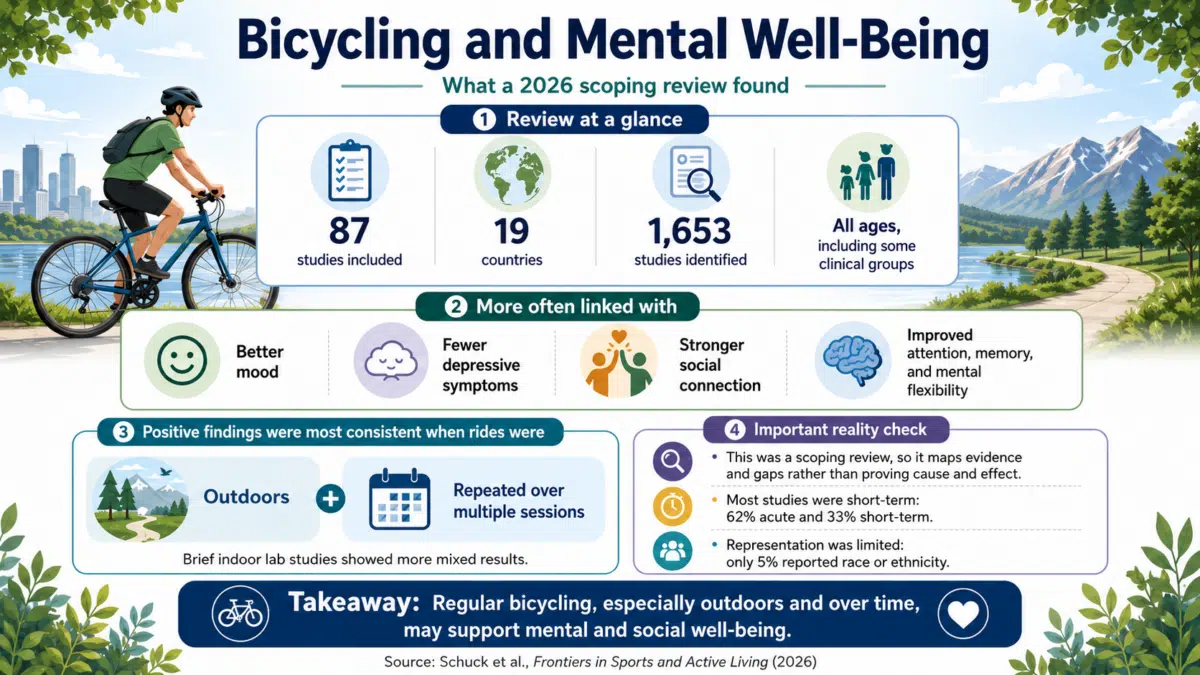
Bicycling Was Linked to Better Mood, Sharper Thinking, and Stronger Social Bonds
Multi-session outdoor programs, such as mountain biking interventions, appeared particularly effective at building psychological benefits like resilience and a sense of connection to one’s environment. Single-session indoor cycling studies, which made up the bulk of the research, produced more mixed results on emotional and cognitive measures. On the thinking side, studies found benefits in areas like attention, memory, and mental flexibility, the ability to shift focus between tasks. Every study that looked at social well-being reported positive effects, suggesting that getting on a bike with or around other people may be one of the more reliable upsides.
Bicycling’s benefits likely come from multiple directions at once. Riding outdoors combines physical exertion with fresh air, nature exposure, and often social interaction, elements that individually carry well-known mental health benefits. Structured bicycling programs can also give participants a meaningful routine and a sense of accomplishment, which researchers note may independently support emotional well-being. In short, it may not just be the pedaling that helps.
Who Has and Hasn’t Been Studied in Bicycling Research
One of the most telling findings from the review was not what bicycling does, but who has and hasn’t been studied. Sample sizes across the 87 studies ranged from just 7 participants to 1,148. Roughly 30% of the studies focused on people living with clinical conditions, including neurological diseases, psychiatric conditions, and intellectual or developmental disabilities, suggesting researchers have recognized bicycling’s potential therapeutic value.
A significant gap exists in demographic representation, though. Only 5% of the studies reported participants’ race or ethnicity at all. Just 2% of studies included non-binary participants. Existing research has largely been conducted on a narrow slice of the population, making it difficult to know whether the documented benefits translate across communities with different backgrounds, needs, and access to bicycling.
Most studies were conducted indoors in laboratory settings, which, while scientifically controlled, may not reflect how most people actually ride bikes. Researchers call for more work in real-world, community-based settings, the kinds of environments where bicycling programs are most likely to be put to use as public health tools. Until that research exists, it is hard to say with confidence how well the lab findings hold up on actual streets and trails.
For now, the evidence points in a hopeful direction: regular bicycling, especially outdoors and over time, may support mental and social well-being for many people. But realizing that potential will require studying a much broader slice of the population, in the kinds of places where people actually ride.
Disclaimer: This article is based on a scoping review of existing research and does not constitute medical advice. Bicycling is not a clinically proven treatment for depression, anxiety, or any other mental health condition. Consult a qualified healthcare provider before making changes to a mental health or exercise plan.
Paper Notes
Limitations
Reviewers acknowledge several limitations in the body of literature they examined. Most studies involved only one or two sessions, which limits conclusions about long-term mental health effects. Most interventions were conducted indoors on stationary bicycles in lab settings, which may not reflect real-world cycling experiences. Sample sizes varied widely, and only a small fraction of studies reported participants’ race or ethnicity, making it difficult to assess whether findings generalize across diverse populations. Studies were restricted to those published in English, which may have excluded relevant international research. Gray literature and other reviews were also excluded, meaning some relevant findings may not have been captured.
Funding and Disclosures
Funding for this work was supported in part by a REI Cooperative Action Fund grant (2024). Two authors, Lauren Schuck and Esther Walker, are employees of Outride, a nonprofit organization funded in part by Specialized Bicycle Components. Authors affirm that Specialized and all other funders had no role in study design, data collection, analysis or interpretation, manuscript preparation, or the decision to submit for publication. Author Sean M. Wilson was an editorial board member of Frontiers at the time of submission; this had no impact on peer review or the final decision. All other authors declare no competing interests.
Publication Details
Authors: Lauren Schuck, Brandie Reisman, Esther Walker, Seth Wiafe, Sean M. Wilson, and Cian L. Brown | Institutional Affiliations: Outride (Morgan Hill, CA); Department of Educational Psychology, The University of Oklahoma (Norman, OK); School of Public Health, Loma Linda University (Loma Linda, CA); School of Medicine, Loma Linda University (Loma Linda, CA) | Journal: Frontiers in Sports and Active Living, Volume 8 | Article Title: “A scoping review of bicycling interventions’ impacts on psychological, social, affective, and cognitive well-being” | DOI: 10.3389/fspor.2026.1807791 | Published: May 19, 2026 | Article Type: Scoping Review


