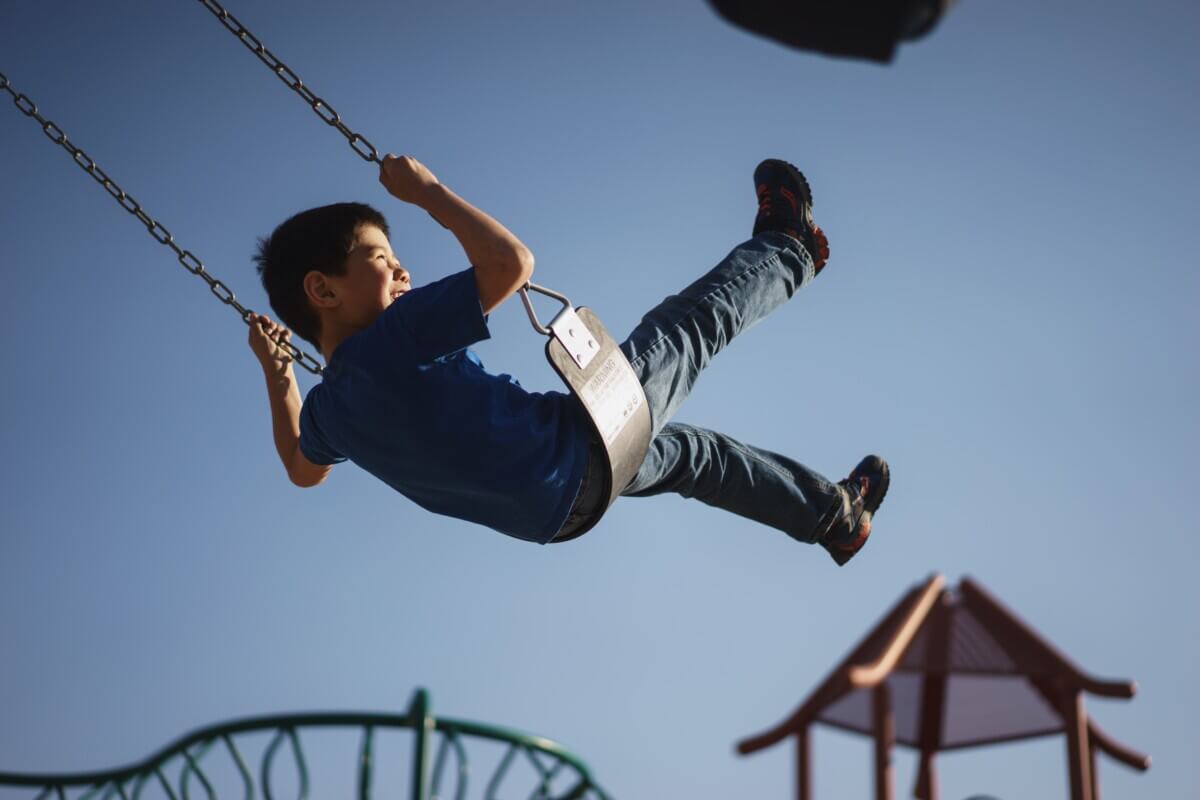
(Photo by Myles Tan on Unsplash)
In A Nutshell
- A study of 424 children found that kids who took more physical risks on a virtual playground made faster decisions when crossing simulated streets, without getting into more accidents.
- Researchers measured “risk willingness” by how fast children moved, how often they visited narrow elevated pillars, and how much time they spent at height in a VR playground.
- Norwegian children scored significantly higher on risk willingness than Canadian peers, reflecting cultural differences in how much independence and outdoor freedom kids are given.
- The findings suggest that letting children experience manageable risk during play may help build the kind of quick, real-world judgment that keeps them safer as they grow up.
Letting children take manageable physical risks in play may help them practice the kind of judgment they need in risky situations, a new virtual reality study suggests. A study of 424 children from Norway and Canada found that kids who were bolder on a virtual playground, climbing higher, moving faster, and venturing onto narrow platforms, made faster decisions when navigating simulated traffic, without racking up more collisions or near-misses. Low-stakes wobbles and slips during childhood play may be part of how kids learn to read risk.
For years, parents and policymakers in many Western countries have steadily removed risk from childhood. Playgrounds have been softened, supervision has intensified, and the freedom to roam and explore has largely disappeared from children’s daily lives. A growing body of research is pushing back against that trend, and this new study, published in the Journal of Environmental Psychology, offers unusually concrete VR-based evidence that runs counter to a deeply held cultural assumption: that risk-taking in children is something to be minimized at every turn.
A Virtual Playground, A Virtual Street
Data collection ran from January to May of 2023, with children drawn from four public elementary schools in Norway and one urban elementary school in British Columbia, Canada. Each child wore a VR headset and physically moved through two simulated environments.
In the playground scenario, children had three minutes to freely explore a virtual structure with balance beams, vertical pillars, and four height levels, the highest reaching about 1.5 meters off the ground. Three narrow freestanding pillars, roughly 12 centimeters across, were also included; stepping onto them made falling much more likely. Researchers tracked how fast children moved, how often they visited those riskier pillars, and how much time they spent in elevated zones, combining these behaviors into a single “risk willingness index.” Children who fell were returned to the starting point and could keep exploring.
In the traffic scenario, children physically walked up to a curb and decided when to cross a virtual bicycle lane and, in a second environment, a road with both cars and bicycles. Traffic density gradually thinned over time. Researchers measured how long children took before stepping off the curb, how many times they were struck by a virtual vehicle, and how many times they came dangerously close to being hit.

Norway vs. Canada: A Cultural Divide on Childhood Risk
One of the study’s most telling findings had nothing to do with individual children and everything to do with where they grew up. Norwegian children scored significantly higher on the risk willingness index than their Canadian peers, even after accounting for age and sex. Norwegian children, despite being slightly younger on average, were bolder in the playground, spending more time at height, visiting the narrow pillars more frequently, and moving faster through the structure. This tracks with well-documented cultural differences between the two countries. Norway’s national education policies strongly support children’s outdoor independence, and Norwegian parents and teachers tend to be more comfortable with children taking physical risks than adults in many other nations. Canadian children typically grow up in more cautious environments with fewer opportunities to play freely outdoors.
Worth noting: the Canadian school selected for the study was not a typical one. It actively encouraged outdoor risky play, giving students dedicated time outside each week with access to logs, lumber, tires, and tools. The researchers argue that a more typical Canadian sample might have shown an even wider gap when compared to Norwegian children.
Riskier Play, Faster Thinking on the Street
Children with higher risk willingness scores moved through the street-crossing decisions significantly faster, but they did not have more collisions or dangerous close calls than children who were more cautious on the playground.
Specifically, a child at the high end of the risk willingness scale was predicted to spend about 68 seconds less evaluating traffic across the six crossing trials than a peer at the low end, the difference between a child who freezes at a curb and one who reads the situation quickly and moves with confidence.
Researchers suggest this reflects something important about how children may build judgment over time. When kids repeatedly engage with physical risk in play, falling, recovering, recalibrating, and trying again, they may be training their brains to read environmental information faster and more accurately. The cross-sectional design means the study cannot prove that risky play directly caused the faster traffic decisions, but the association is notable.
Falling in the playground scenario was more common among children with higher risk willingness. For every one-unit increase in the risk willingness score, the odds of falling in the playground went up by 78%. The researchers frame that as a feature, not a flaw: failing in a low-stakes virtual setting may teach children something useful without putting them in real danger.
As the researchers put it, “early play environments scaffold later real-world risk management.” Keeping children completely safe, it turns out, might be one of the less safe things adults can do.
Disclaimer: This article is based on a published peer-reviewed study and is intended for informational purposes only. It does not constitute medical, parenting, or safety advice. The study used virtual reality simulations, not real-world environments, and its findings reflect associations rather than proven cause-and-effect relationships. Parents and caregivers should use their own judgment when making decisions about children’s play environments and physical activity.
Paper Notes
Limitations
The study’s authors acknowledge several important constraints. While the VR environments used have been previously validated as meaningfully connected to real-world behavior, virtual simulations cannot fully replicate the sensory and social complexity of real-life environments. Eighty-five percent of children described the VR environments as realistic, which gives the researchers confidence in the results, but it remains a simulation. The traffic task included only one trial per difficulty level, which limits what can be concluded about individual patterns over time. The study did not include children who use wheelchairs or other mobility aids, narrowing the applicability of the findings. The Canadian sample was drawn from a single school that is atypical in its active promotion of outdoor risky play, meaning those children likely had more exposure to risk than a typical Canadian child, and a more representative Canadian sample would probably show an even larger cultural gap compared to Norwegian children.
Funding and Disclosures
All phases of the study were supported by the Research Council of Norway, reference number 324155. Mariana Brussoni is partially supported by a salary award from the British Columbia Children’s Hospital Research Institute. Informed consent was obtained from parents or guardians of all participating children, and assent was obtained from the children themselves. Ethical approval was granted by the Norwegian Agency for Shared Services in Education and Research (ref. no. 784782) and the University of British Columbia Children’s and Women’s Health Centre of British Columbia (ref. no. H22-03451). No conflicts of interest are disclosed.
Publication Details
Authors: Mariana Brussoni, Ellen Beate Hansen Sandseter, Ole Johan Sando, Rasmus Kleppe, Megan Zeni, and Anita Bundy. Brussoni and Zeni are affiliated with the University of British Columbia and BC Children’s Hospital Research Institute. Sandseter, Sando, and Kleppe are affiliated with Queen Maud University College of Early Childhood Education in Trondheim, Norway. Bundy is affiliated with the Department of Occupational Therapy at Colorado State University. | Journal: Journal of Environmental Psychology, Volume 112, 2026, Article 103062 | Paper Title: “The developmental importance of risky play: A cross-national virtual reality study” | DOI: https://doi.org/10.1016/j.jenvp.2026.103062 | Published: Available online May 2, 2026


