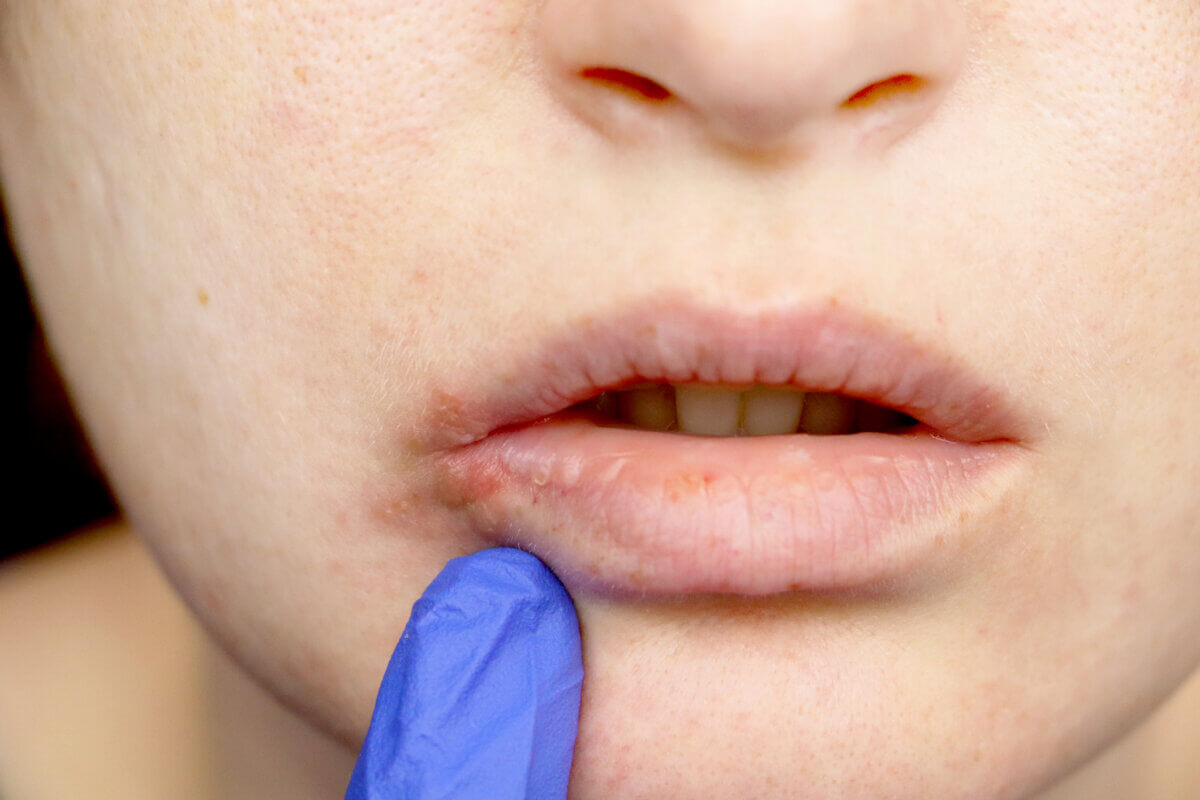
Herpes on the lips: a woman with a cold and the herpes virus is examined by a dermatologist and infectious disease specialist. (Credit: © Alona Siniehina | Dreamstime.com)
The Cold Sore Virus Steals Your Cell’s Machinery. Scientists Just Found Its Weakness.
In A Nutshell
- The cold sore virus doesn’t just hide in your cells, it physically takes over, stealing the proteins your DNA needs to function and cramming human genetic material into a corner while it runs the show.
- Scientists watched this happen in real time using microscopes powerful enough to resolve objects thousands of times smaller than the width of a human hair, catching the virus in the act at one, three, and eight hours after infection.
- The more proteins the virus stole, the more human DNA collapsed. When researchers used a mutant virus that couldn’t steal those proteins, the DNA stayed relaxed and spread out, proving the theft was the cause.
- One drug, beta-lapachone, completely stopped the virus from expressing its genes or replicating in lab cell experiments when given before infection, pointing toward a possible new direction for antiviral research.
The cold sore virus is more than a nuisance that shows up at the worst possible time. Once it gets inside a human cell, it takes over like an occupying army: physically reshaping the cell’s DNA, stealing its workforce, and shoving human genetic material into a cramped corner. A study published in Nature Communications reveals this hostile takeover in striking detail and points toward a possible new way to stop it.
The research team found that herpes simplex virus type 1, or HSV-1, doesn’t just quietly slip into cells and start copying itself. It grabs the proteins cells need to read and organize their own genetic code, stripping away the workers human DNA depends on. Without those workers, human DNA collapses in on itself. The virus carves out two zones inside the cell’s command center, the nucleus: a busy viral factory and a silent, crumpled mass of sidelined human genetic material. The team also found that a drug blocking one of those stolen proteins shut down HSV-1 infection in lab experiments.

What Happens to Your Cells When the Cold Sore Virus Gets In
To see exactly what happens inside an infected cell, the researchers used a set of advanced microscopy methods that can resolve objects just tens of billionths of a meter apart, thousands of times smaller than the width of a human hair. They infected human lung cells with HSV-1 and examined them at one, three, and eight hours after infection, time points that correspond to the three phases of the virus’s active life cycle.
What they saw was immediate and severe. As early as one hour after infection, human DNA began condensing. By eight hours, the genetic material had been squeezed to the edges of the nucleus, leaving roughly 70 percent of the nuclear interior as DNA-free space. That open area was not empty. Viral factories had taken it over, copying viral genetic material and churning out new viral proteins.
The team labeled human DNA with a chemical tag before infection so they could track it separately from viral DNA. They also tracked several proteins to figure out why human genetic material was being compacted so aggressively.
The answer came down to a protein called RNA polymerase II, the molecular machine responsible for reading genes and producing the messenger molecules cells use to build proteins. In healthy cells, this protein is scattered throughout the nucleus, actively reading thousands of human genes. As HSV-1 infection progressed, the researchers watched RNA polymerase II get pulled away from human DNA and drawn into the viral factories.
By three hours after infection, about 53 percent of the active form of this protein had relocated to the viral zones. By eight hours, that figure had climbed to 72 percent. Inside those viral factories, the protein formed larger, denser clusters packed with more molecules than normal, a sign of intense viral gene-reading activity. The clusters left behind on human DNA became smaller, sparser, and farther apart.
The connection between this protein theft and DNA compaction was not a coincidence. When the researchers infected cells with a mutant version of HSV-1 that produces a non-functional form of a viral protein called ICP4, which is needed to pull RNA polymerase II away from human genes, neither the protein theft nor the DNA compaction occurred. The human genetic material stayed relaxed and spread out, even eight hours into infection. The team confirmed this by infecting special cells that could supply the missing ICP4 protein, which restored both the hijacking and the compaction.
Chemical experiments supported the connection further. When the team used a drug called actinomycin D to shut down gene-reading activity in uninfected cells, human DNA compacted in a pattern very similar to what HSV-1 produces. The virus achieves through protein theft what the drug achieves through direct blockage: silencing the reading of human genes by removing the machinery needed to do it.

How the Virus Steals the Proteins Your DNA Needs to Function
RNA polymerase II was not the only target. The researchers found that a protein called cohesin, which acts like a ring-shaped clamp holding loops of DNA together, was also dragged into the viral factories. About 34 percent of cohesin clusters had relocated to viral zones by three hours, growing to nearly 60 percent by eight hours.
Using their microscopy tools, the team measured the physical distances between newly copied viral DNA and both RNA polymerase II and cohesin inside the viral factories. Nearly 60 percent of active RNA polymerase II clusters sat close enough to a viral genome at eight hours to be actively reading viral genes. Cohesin showed a different pattern: up to 88 percent of cohesin clusters were near a viral genome by eight hours, but only about 24 percent of viral genomes had cohesin nearby. The virus appears to selectively load cohesin onto some copies of itself, but not all.
To understand how this protein theft reshapes the three-dimensional folding of human chromosomes, the team used a technique that maps physical contacts between distant stretches of DNA. At the broadest level, human chromosomes held their large-scale organization into active and inactive zones even under this extreme compaction. Each chromosome stayed in roughly its own neighborhood. But the finer structures, the loops and domains that regulate which genes interact with each other, were disrupted by eight hours. Many existing loops disappeared, and new, often larger ones formed.
The team also detected specific physical contacts between the viral genome and the human genome, and these were not random. The virus preferentially touched gene-rich, active regions of human chromosomes. Regions of human DNA that made the most contact with viral DNA were enriched for genes that remained active, or even became more active, during infection. Some of those genes encode parts of the RNA polymerase II machinery itself. The virus maintains contact with the very human genes it needs to keep running to fuel its own reproduction.
A Drug That Blocked the Cold Sore Virus Completely in Lab Tests
The study’s most immediately practical finding involves an enzyme called topoisomerase I, or TOP1, which relieves the tangles and tension that build up in DNA during gene reading. The researchers found that TOP1, like RNA polymerase II and cohesin, gets pulled into viral factories during infection.
When they treated cells with a TOP1-blocking drug called beta-lapachone before infection, the virus could not express its genes or replicate its DNA. These experiments were conducted in cell culture, not in people, and the drug has not been tested as an antiviral in living organisms. Applied after infection had already begun, the drug still dropped viral activity sharply, though the effect was strongest when treatment came first. The researchers confirmed the drug was not simply killing the cells at the concentrations used.
The team also found that blocking TOP1 caused both TOP1 and RNA polymerase II to detach from human DNA, which led to DNA compaction similar to what the virus itself causes. TOP1 plays a central role in keeping DNA open and readable, a role the virus exploits. When that role is blocked, the virus cannot commandeer the cellular machinery it depends on.
This study does more than catalog what a common virus does to human cells. By using a viral infection as a kind of natural experiment, the researchers revealed how gene-reading machinery shapes the physical structure of our DNA. The fact that stealing RNA polymerase II and TOP1 causes human chromosomes to collapse, while the broadest organizational features remain intact, shows that the act of reading genes is itself a force that keeps DNA open and organized at fine scales.
HSV-1 infects an estimated majority of the global adult population, according to epidemiological studies cited by the researchers, making it one of the most widespread viral infections in the world. The identification of TOP1 as a potential antiviral target offers a direction for future drug development. The virus has evolved to exploit the very proteins that keep human cells running, but that dependence may also be its weakness.
Disclaimer: This article is for general informational purposes only and does not constitute medical advice. If you have questions about herpes simplex virus infections or treatment options, please consult a qualified healthcare provider.
Paper Notes
Limitations
The study was conducted primarily in A549 human lung cells, with some experiments replicated in human fibroblasts. Results from cell lines may not fully reflect what occurs in the diverse cell types HSV-1 infects in living people, including skin cells and neurons where dormant infection is established. The DNA-contact-mapping experiments capture population-level averages rather than single-cell resolution, which may mask cell-to-cell variability. The labeling of newly replicated viral DNA involved a one-hour incorporation window, meaning not all viral genomes present in the nucleus were labeled in those experiments, potentially underestimating associations with host proteins. The gene-expression data reflects both changes in gene reading and destruction of messenger molecules caused by a viral enzyme known as vhs, making it difficult to fully separate these two effects. The drug beta-lapachone was tested only in cell culture, and its effectiveness and safety as an antiviral in living organisms remain unknown.
Funding and Disclosures
The authors declare no competing interests. The study received funding from multiple sources, including the Innovative Team Program of Guangzhou Regenerative Medicine and Health Guangdong Laboratory; the National Natural Science Foundation of China; the Science and Technology Program of Guangzhou; the Guangdong Foreign Young Talent Program; the Spanish Ministry of Science and Innovation; AGAUR (Generalitat de Catalunya); the Spanish Ministry of Science and Innovation through the Centro de Excelencia Severo Ochoa; and the European Social Fund. Open-access funding was provided by the National Natural Science Foundation of China and the Spanish Ministry of Economy, Industry and Competitiveness.
Publication Details
Title: Herpes simplex virus type 1 reshapes host chromatin architecture via transcription machinery hijacking | Authors: Esther González-Almela, Alvaro Castells-Garcia, François Le Dily, Manuel Fernández Merino, Davide Carnevali, Pol Cusco, Luciano Di Croce, and Maria Pia Cosma. Esther González-Almela and Alvaro Castells-Garcia contributed equally to this work. | Affiliations: Medical Research Institute, Guangdong Provincial People’s Hospital (Guangdong Academy of Medical Sciences), Southern Medical University, Guangzhou, China; Centre for Genomic Regulation (CRG), The Barcelona Institute of Science and Technology, Barcelona, Spain; ICREA, Barcelona, Spain; Universitat Pompeu Fabra (UPF), Barcelona, Spain. | Journal: Nature Communications (June 19, 2025), 16:5313 | DOI: 10.1038/s41467-025-60534-6 | Received: December 5, 2023. Accepted: May 27, 2025. | Corresponding author: Maria Pia Cosma ([email protected])


