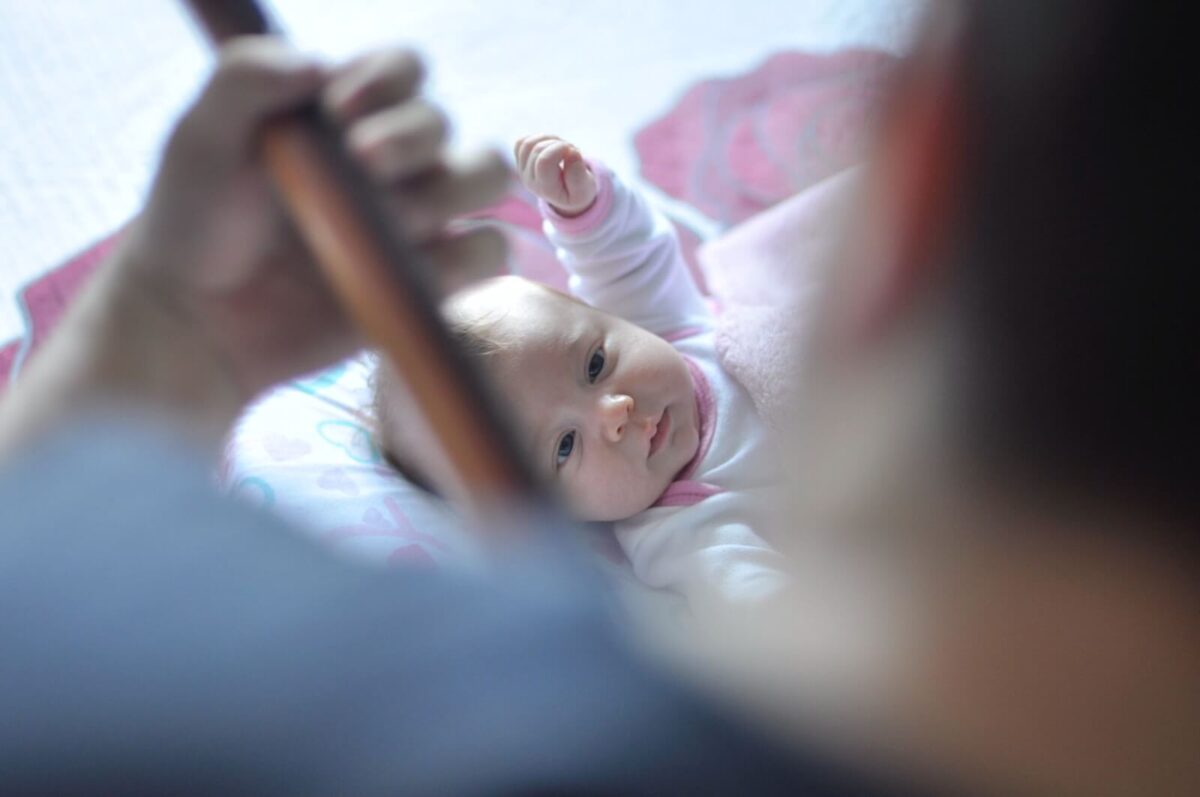
(Credit: Photo by Giu Vicente from Unsplash)
In a Nutshell
- At just three months old, babies’ brains already respond more strongly to real music than to scrambled sound, showing that music registers long before a baby can act on it.
- Only twelve-month-olds actually move more when real music plays, mostly with upper-body motions like rocking, swaying, and clapping-style arm movements.
- No age group moved in time with the beat, so true rhythmic coordination, the foundation of dancing, develops well after a baby’s first birthday.
Long before a toddler bobs to a nursery rhyme, a much quieter response is already underway. At three months old, an age when many babies still wobble trying to hold up their heads, the infant brain is locking onto music, tracking its patterns and reacting to its structure. Getting the body to answer back with real coordinated movement, though, takes most of a first year, and moving in time with the beat does not show up at all.
A study in the journal eLife followed 79 infants at three, six, and twelve months as they listened to children’s songs, watching both what happened in their brains and what happened in their bodies. Researchers recorded electrical activity with sensors on the scalp and filmed full-body motion with cameras, catching head bobs, arm swings, and wiggles. A gap emerged between what a baby’s brain picks up and what a baby’s body does about it.
For anyone who has bounced an infant to a song and wondered whether any of it registers, the answer is yes, and earlier than expected. A rough link between hearing and moving is present from the start. Turning that link into anything resembling dancing is a slower, later story.
How the Study Tested the Way Babies Respond to Music
Researchers initially recruited 98 full-term infants. After exclusions for fussiness and technical problems, analyses included 79 infants: 26 aged three months, 26 aged six months, and 27 aged twelve months, plus 26 adults for comparison.
Each infant sat in a highchair facing a screen of slowly blooming flowers, a calm visual meant to hold attention without stealing it. Speakers played two children’s songs, a Hungarian playsong and a Spanish one, in four forms: the original, a scrambled version with notes reshuffled and timing randomized, a version pitched higher, and a version with the bass pitched lower. Every version ran the same length at the same volume, so any difference in response traced back to musical structure or pitch rather than loudness or duration.
Scalp sensors logged brain signals while three cameras filmed from different angles. Caregivers sat behind the babies wearing noise-canceling headphones so their reactions would not leak through. To handle the flood of footage, an automated tracking system marked 18 body parts on each infant and sorted the motion into ten movement types, among them front-to-back rocking, side swaying, a clapping-like arm motion, leg kicks, and whole-body wiggles.
What Babies’ Brains Do When Music Plays
Across every age group, real music produced stronger brain signals than scrambled sound. Even three-month-olds showed it. Those signals also sharpened with age, arriving faster and stronger, and by twelve months they carried an extra layer that edged closer to the adult pattern. A baby’s music-processing wiring, in other words, is running early and tunes up over time.
One age group broke from the pack. Six-month-olds reacted more strongly to high-pitched music than to low-pitched music, a spike absent in the younger babies, the older ones, and the adults. Researchers propose that six months may be a sensitive stretch when infants tune sharply to the high, singsong tones caregivers use when they talk and sing. By a year, that heightened pull seems to settle, possibly as babies start taking in a wider world, though the team frames this as a hypothesis rather than a settled fact.

When Babies’ Bodies Catch Up to the Music
Movement lagged well behind. Only the twelve-month-olds clearly moved more to real music than to scrambled sound, driven mostly by upper-body actions like rocking, swaying, clapping-style arm motions, and arm pedaling. Younger babies moved plenty, but their motion had no particular tie to whether real music or scrambled noise was playing.
Across all ages, music could still predict when a baby moved. A shift in the music’s intensity was followed within a fraction of a second by a shift in movement, holding steady at three, six, and twelve months. That points to a raw connection between hearing and moving that is present from the beginning, even before it shows up as obviously more motion.
High-pitched music predicted the timing of movement better than low-pitched music at every age, even though the total amount of movement stayed the same across both. Researchers reason that high-pitched music may grab attention in a way that nudges when a baby moves without making it move more.
Most telling was a finding that never arrived. At no age did a baby’s spontaneous movements line up with the beat. Babies do move in repeating patterns of their own, but those rhythms did not match the music’s rhythm, and matching the beat, the researchers note, likely keeps developing well past a baby’s first birthday.
Why Babies Respond to Music Before They Can Dance
Putting the two halves together, a portrait of uneven development takes shape. A basic hearing-to-moving link appears to run early, even in the youngest babies. At the same time, the brain’s knack for pulling patterns out of music outpaces the body’s ability to turn those patterns into coordinated, music-driven motion. By twelve months, babies move more and in more varied ways, yet none of them move on the beat, and that kind of rhythmic timing likely takes years more to arrive.
For parents who sing at bedtime or bounce a baby through a favorite song, the takeaway is plain: something real registers in that small brain even when the baby seems to just sit there. Music lands early. The dancing waits its turn.
Paper Notes
Limitations
Because every infant was tested seated in a highchair, a position that may favor upper-body motion over the legs, results could look different if babies were tested standing or in other settings. The scrambling procedure also shuffled timing and pitch at the same time, so the study cannot separate whether the stronger responses came from rhythm, melody, or both together. Its cross-sectional design, meaning different babies were tested at each age rather than the same babies tracked over time, limits what can be said about how any one child develops. And because the work stopped at twelve months, it leaves open what happens in the second year and beyond, when more coordinated movement is expected to appear.
Funding and Disclosures
Funding came from the European Research Council (grant reference 10.3030/948186), the Austrian Science Fund (grant reference 10.55776/W1262), and the Brain and Machines Flagship Programme of the Italian Institute of Technology. Additional support came from Horizon Europe’s Marie Skłodowska-Curie Actions (grant references 10.3030/101105726 and 10.3030/101064334). The authors declared no competing interests.
Publication Details
Paper Title: “Development of auditory and spontaneous movement responses to music over the first postnatal year.”
Authors: Trinh Nguyen, Félix Bigand, Susanne Reisner, Atesh Koul, Roberta Bianco, Gabriela Markova, Stefanie Hoehl, and Giacomo Novembre. Their institutional affiliations include the Neuroscience of Perception and Action Lab at the Italian Institute of Technology (Rome, Italy); the Department of Developmental and Educational Psychology at the University of Vienna (Vienna, Austria); the Department of Developmental and Biological Psychology at Heidelberg University (Heidelberg, Germany); the Doctoral School Cognition, Behavior and Neuroscience at the University of Vienna; the Department of Translational Research and New Technologies in Medicine and Surgery at the University of Pisa (Pisa, Italy); and the Institute for Early Life Care at Paracelsus Medical University (Salzburg, Austria).
Journal: eLife


