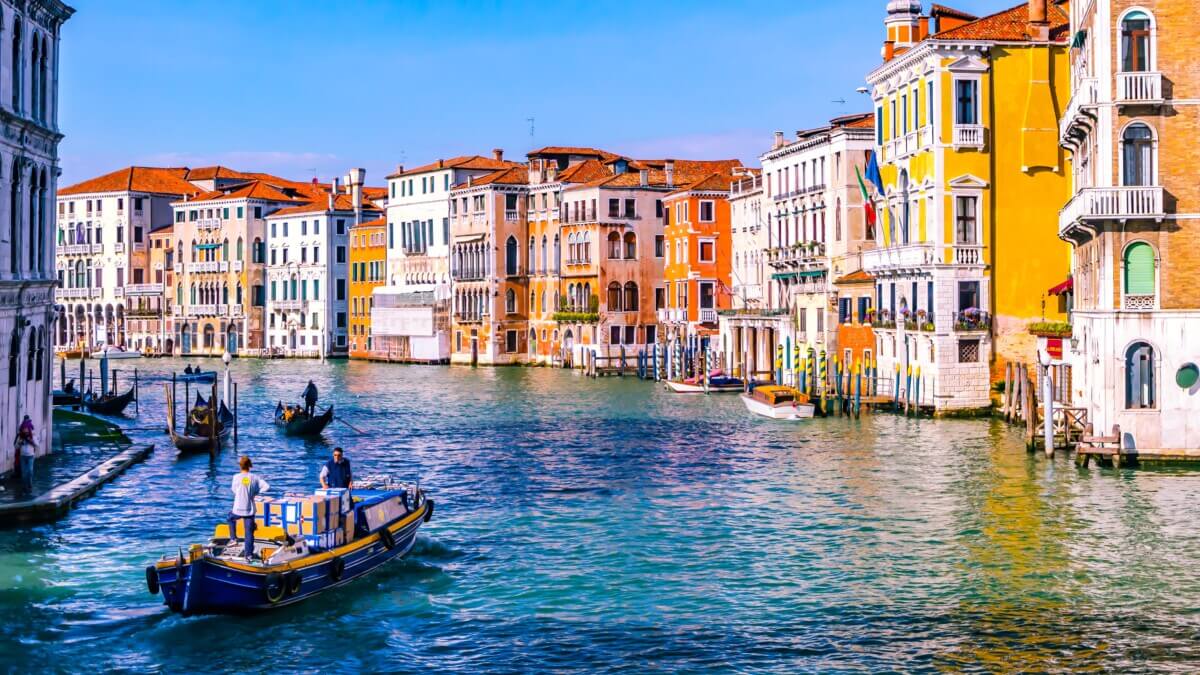
Photo by Heidi Kaden on Unsplash
Venice Has Four Futures. None of Them Are Easy.
In A Nutshell
- Venice’s current flood barrier system, MoSE, will likely become too difficult to sustain before this century ends as sea levels rise and required closures increase in frequency and duration.
- A new study lays out four possible futures for the city: keeping the lagoon open with added defenses, walling off the city center, sealing the lagoon permanently, or retreating and relocating select monuments inland.
- Every option demands giving something up, whether that is the lagoon ecosystem, Venice’s physical connection to the water, or the city itself.
- Even under the best-case emissions scenario, major decisions and construction must begin within decades; the engineering lead times alone could be 30 to 50 years.
A city that draws more than 22 million visitors a year is slowly running out of ways to save itself. A new study maps out the painful choices ahead for Venice and its lagoon as sea levels climb. Under current climate policies, the city’s existing flood defenses will likely hit a hard wall before this century ends. What comes after involves trade-offs so severe that Venice, as the world knows it, may cease to exist in any recognizable form.
Published in Scientific Reports, the research lays out a branching set of adaptation pathways and forces an uncomfortable question: which parts of Venice are its people willing to lose? The lagoon ecosystem that shaped the city’s identity? Its physical connection to the water? The residents themselves? Every strategy that could follow demands sacrificing something irreplaceable, and the window for those decisions is narrower than most people realize.
Under a very high emissions scenario and a potential Antarctic ice-sheet collapse, even large-scale engineering solutions may eventually fail. At that point, potentially in the 22nd century under the most extreme conditions, the final pathway would be dismantling select monuments and relocating them inland while the rest of the city slips beneath the waves.
Venice Is Already on Borrowed Time
Venice has been sinking and flooding for more than 150 years. Of the 28 most extreme flooding events, those submerging more than 60 percent of the city, 18 have occurred in the last 23 years. Global sea-level rise and local land sinking have left more than half of Venice sitting less than about four feet above average sea level, with tides swinging roughly three feet in either direction.
Since 2022, mobile flood barriers known as MoSE have kept the worst flooding at bay, rising to block storm surges at the three inlets connecting the lagoon to the open sea. MoSE has demonstrably protected the city, but its effectiveness has an expiration date built into the physics of rising oceans.
As seas rise, MoSE will need to close more frequently. Port operations stop during closures, water quality worsens without regular tidal exchange, and the risk of mechanical failure climbs. Researchers estimate that if closures exceed two to six months per year, corresponding to roughly 1.5 to 2.5 feet of sea-level rise since the start of the century, the strategy becomes increasingly difficult to sustain.
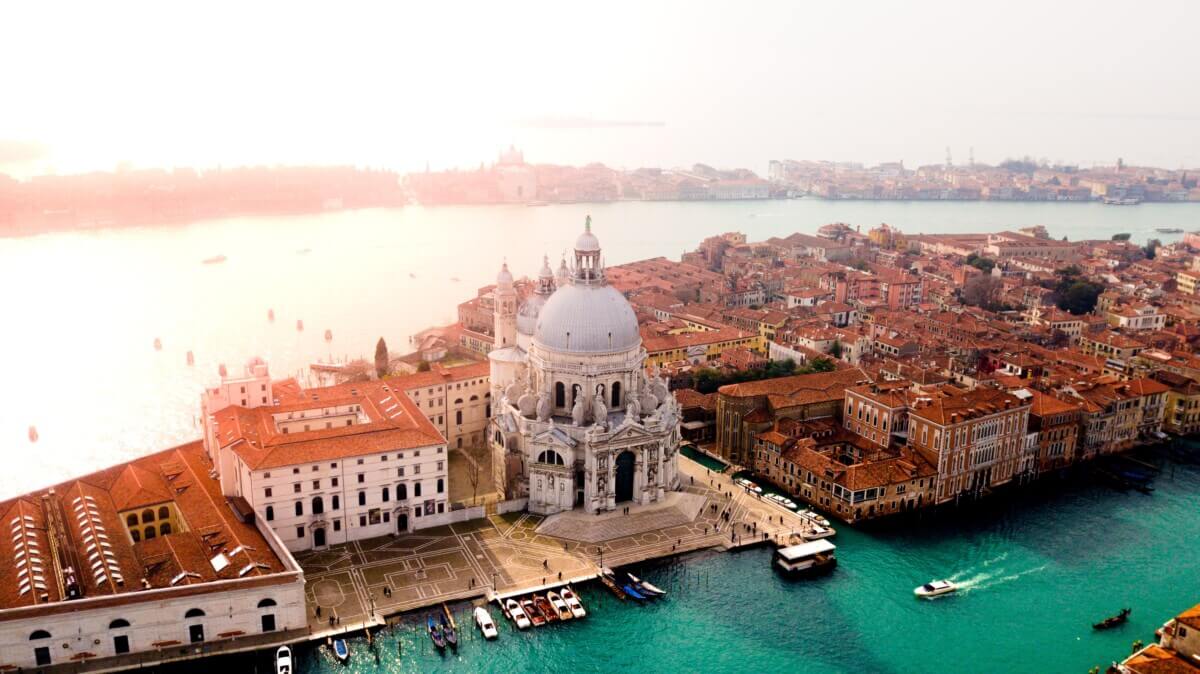
Rising Seas and Venice’s Four Possible Futures
Led by Piero Lionello of the University of Salento and 14 co-authors from across Europe, the team mapped out four broad strategies. Each one saves something Venice holds dear while giving up something else.
The least disruptive path keeps the lagoon open, building on what MoSE already does. Engineers could inject seawater deep underground to physically lift the city’s foundations by roughly a foot over a decade. Raising pavements and installing barriers around landmarks like St. Mark’s Basilica could extend that window further, but only for the most prized monuments, not the neighborhoods around them.
A step further involves ring-diking, walling off the historic city center so it becomes a fortified island. The lagoon outside stays connected to the open sea, but Venice’s ancient relationship with the water would be severed. The approach also carries a serious vulnerability: if even one section of wall gives way during a major storm, the city could fill with several meters of water faster than residents could get out.
Engineers could also seal the lagoon entirely with permanent dams, turning it into a coastal lake. That would shield the city’s buildings against far greater sea-level rise, at costs running into the tens of billions of euros. But the lagoon ecosystem, the living saltwater environment that shaped Venetian culture for more than a thousand years, would be gone for good.
At the far end sits retreat: dismantling select monuments and rebuilding them on higher ground inland, then walking away from the rest. It has been done before at small scale, most famously with Egypt’s Abu Simbel temples in the 1960s, but nothing close to Venice’s scale has ever been attempted. Costs could reach into the tens of billions of euros, not counting compensation for the tens of thousands of residents who would lose their homes.
Venice’s Narrowing Window for Action
Central to the study is a framework of adaptation tipping points, moments when one strategy can no longer meet its goals and a switch becomes unavoidable. Researchers estimate the first major shift away from the open lagoon approach will occur when sea-level rise reaches roughly 2.5 to 5.7 feet. Even under a very high emissions scenario, that transition is unlikely before the 2070s; under a low emissions path, it remains unlikely until the 22nd century.
Those timelines are deceptive. Large-scale projects require lead times of 30 to 50 years. The flood that triggered MoSE’s development struck in 1966; the legal framework followed in 1973; the system didn’t become operational until 2022. A similar gap applied to any successor strategy means the window for beginning a transition is already approaching.
Venice’s population has fallen from 170,000 in the early 1950s to fewer than 50,000 in 2024. Rapid emissions cuts could still avoid the most disruptive outcomes. But abandonment may not require reaching any technical limit. If economic pressure, shrinking population, and cultural decline erode the will to keep fighting the sea, that quieter retreat, driven not by catastrophic flooding but by a slow draining of purpose, may prove the most realistic threat of all.
Paper Notes
Limitations
This study does not perform a cost-benefit analysis, which the authors state is neither feasible nor appropriate given the irreplaceable nature of Venice’s monumental and cultural heritage and the multidimensional values that cannot be expressed in monetary terms. Indicative cost estimates are used comparatively to illustrate feasibility thresholds rather than to determine optimal choices. The analysis does not account for lead times in its pathway diagrams, though it acknowledges these may be multidecadal. The study focuses on sea-level rise as the primary driver and does not comprehensively model interactions with other environmental changes, such as warming, changes in storminess, or non-indigenous species impacts, though these are discussed qualitatively. Protection of the polders surrounding the lagoon requires analysis within a broader regional coastal adaptation strategy, which is beyond the study’s scope. Land subsidence projections assume continued effective regulation of groundwater use. The digital terrain model used is based on surveys from the 1990s and carries a systematic negative error of approximately 25 to 30 centimeters due to subsequent subsidence and sea-level rise, which the authors consider too small to affect the analysis.
Funding and Disclosures
Carlo Giupponi received financial support from the Fondazione Eni Enrico Mattei through the Adapt@Ve Programme. Valeria Di Fant was supported by the European Union’s Horizon 2020 research and innovation programme through the Pathways2Resilience project (Grant Agreement No. 101093942). Ulysse Pasquier, Robert J. Nicholls, and Athanasios T. Vafeidis received support from the Horizon Europe project CoCliCo (Coastal Climate Core Services). The authors declare no competing interests.
Publication Details
The paper is titled “Long-term adaptation pathways for Venice and its lagoon under sea-level rise,” published in Scientific Reports (2026), volume 16, article number 9438. DOI: 10.1038/s41598-026-39108-z. Lead author: Piero Lionello, Department of Biological and Environmental Sciences and Technologies, University of Salento, Lecce, Italy. Co-authors: Valeria Di Fant (Deltares and Utrecht University), Ulysse Pasquier (University of East Anglia), Luigi Tosi (CNR-IGG), Gonéri Le Cozannet (BRGM), Robert J. Nicholls (University of East Anglia and University of Southampton), Wolfgang Cramer (IMBE, Aix Marseille Université), Roger Cremades (University of Leeds), Carlo Giupponi (Ca’ Foscari University of Venice and Fondazione Eni Enrico Mattei), Jochen Hinkel (Global Climate Forum), Adriano Sfriso (Ca’ Foscari University of Venice), Pietro Teatini (University of Padova), Athanasios T. Vafeidis (Christian-Albrechts University Kiel), Georg Umgiesser (CNR-ISMAR and Klaipeda University), and Marjolijn Haasnoot (Deltares and Utrecht University).


