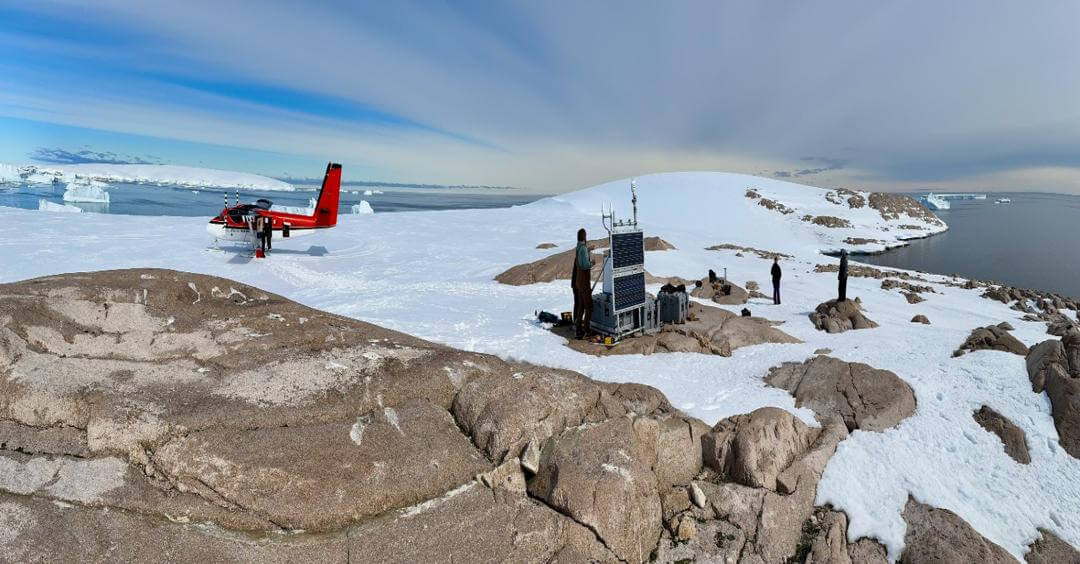
The ANET-POLENET team on Antarctica's Backer Islands (Credit: McGill University)
MONTREAL, Quebec — As climate change raises global temperatures, a massive chunk of Antarctica’s ice sheet is expected to melt and raise sea levels in the coming decades. Considering that Antarctica’s ice sheet is the most enormous ice mass on Earth, the rising sea levels would be catastrophic for island nations and populations living near coastlines.
Fortunately, not all hope is lost. A new study published in Scientific Advances suggests Earth’s natural forces could significantly reduce ice loss, but only if humans reduce carbon emissions.
“With nearly 700 million people living in coastal areas and the potential cost of sea-level rise reaching trillions of dollars by the end of the century, understanding the domino effect of Antarctic ice melt is crucial,” says lead author Natalya Gomez, an associate professor in McGill University’s Department of Earth and Planetary Sciences and Canada Research Chair in Ice sheet-Sea level interactions, in a media release.
While the damages caused by climate change have made rising sea levels inevitable, minimizing carbon outputs is expected to reduce damage faced in coastal communities.
Ice melts when its weight decreases. This causes the land under it to expand like a sponge, a phenomenon known as post-glacial uplift. On one hand, post-glacial uplift helps stop ice mass loss. The land expansion lifts the ice up, acting as nature’s break in the flow of ice from land to ocean. However, the current study found that the post-glacial uplift would not be enough to slow down the rapidly thawing ice if carbon emissions continue.
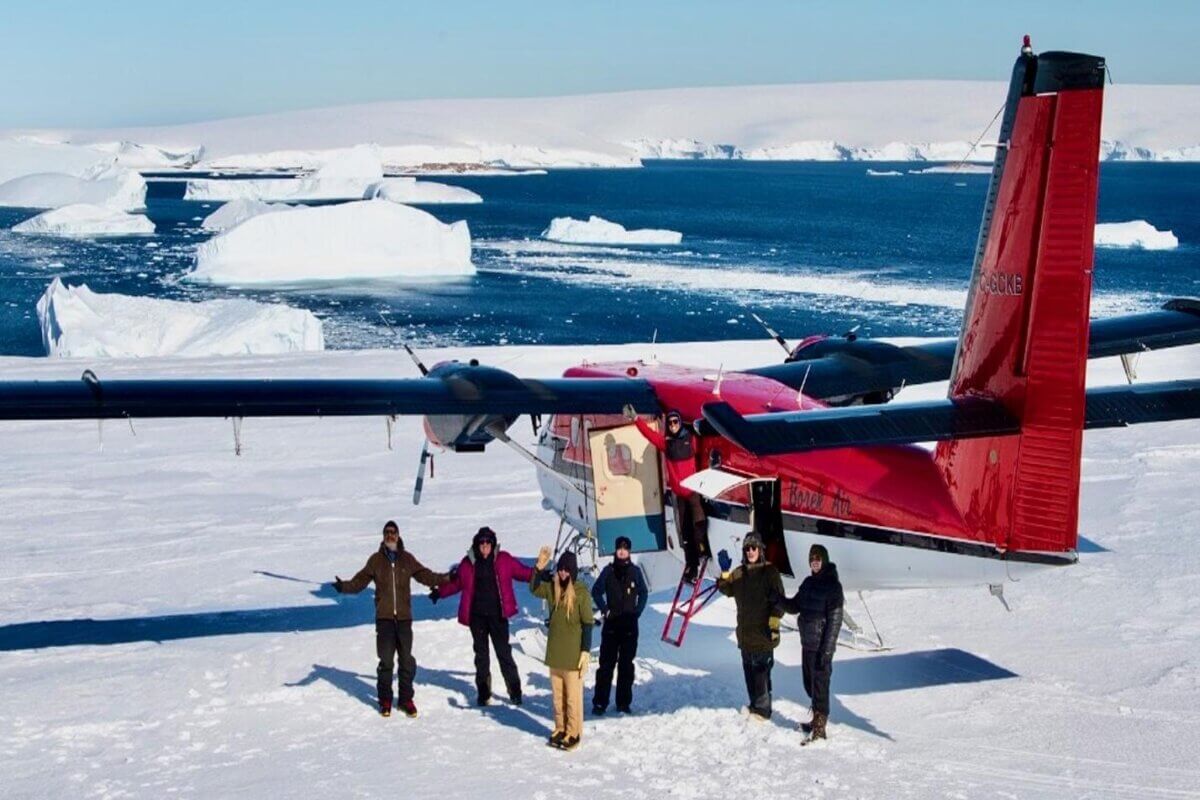
The study authors created a 3D model of Earth’s interior to study how Antarctica’s ice sheet interacts with the land and how carbon emissions influence that relationship. The model included geophysical field measurements from the U.S. ANET-POLENET project, which records any changes in land shifts across Antarctica.
“Our 3-D model peels back Earth’s layers like an onion, revealing dramatic variations in thickness and consistency of the mantle below. This knowledge helps us better predict how different areas will respond to melting,” says study co-author Maryam Yousefi, a geodesist at Natural Resources Canada.
According to the researchers, this is the first model to study in detail the dynamics between Antarctica’s ice sheet and the earth underneath.
The results show that post-glacial uplift decreases Antarctica’s contribution to sea levels by 40%. The study also found that if carbon emissions continue at their current pace, the post-glacial uplift effect would not be enough to slow down rising sea levels.
“Our findings show that while some sea level rise is inevitable, swift and substantive action to lower emissions could prevent some of the most destructive impacts of climate change, particularly for coastal communities,” Gomez says.
The study highlights the immediate need to lower carbon outputs in daily life and on a more industrial scale. With climate change being inevitable, the new model helps better predict what to expect in the next few decades, which can shape future environmental policies. This includes the growing dangers towards island nations, which contribute to the least carbon emissions globally.
Paper Summary
Methodology
The researchers used computer models to simulate how Antarctica’s ice sheets might change over the next 500 years under different climate scenarios. They combined two types of models:
- An ice sheet model that simulates how ice flows and melts.
- A model of how the Earth’s crust rebounds when ice melts (called glacial isostatic adjustment or GIA).
Importantly, they used a very detailed 3D model of the Earth’s structure beneath Antarctica based on seismic data. This allowed them to account for how different regions might rebound at different rates when ice melts.
They ran simulations with different climate scenarios (low, medium, and high greenhouse gas emissions) and different assumptions about how ice shelves might break up. Then they looked at how these factors affected projections of sea level rise from Antarctic ice loss.
Key Results
- Including the detailed 3D Earth structure in the models reduced projections of sea level rise by up to 40% in low-emission scenarios. This is because faster rebound in some areas helps stabilize the ice sheet.
- However, in high-emission scenarios, the ice loss happens too quickly for the rebound effect to matter much. In these cases, the continuing rebound after ice is gone actually increases sea level rise slightly by pushing more water into the oceans.
- The effects vary a lot between East and West Antarctica due to differences in the underlying Earth structure.
- Sea level rise from Antarctic ice loss is projected to be higher than average in many tropical and subtropical coastal areas.
Study Limitations
The models don’t include effects from ice loss in other parts of the world or ocean warming. There’s still uncertainty in the exact structure of the Earth beneath Antarctica.
The ice sheet model may not capture all the complex physics of how ice shelves break up. The study also looks 500 years into the future, which involves a lot of uncertainty.
Discussion & Takeaways
The structure of the Earth beneath ice sheets matters for projecting future sea level rise, especially in lower emission scenarios. Reducing greenhouse gas emissions gives the Earth more time to rebound and potentially stabilize parts of the Antarctic ice sheet.
Different regions of Antarctica behave very differently, so detailed 3D models are important. Many tropical and subtropical coastal areas may face higher than average sea level rise from Antarctic ice loss.
Funding & Disclosures
The research was funded by various government agencies and foundations, including the Natural Sciences and Engineering Research Council of Canada, the Canada Research Chairs program, the U.S. National Science Foundation, and the Hitz Family Foundation. The authors declared no competing interests.


