
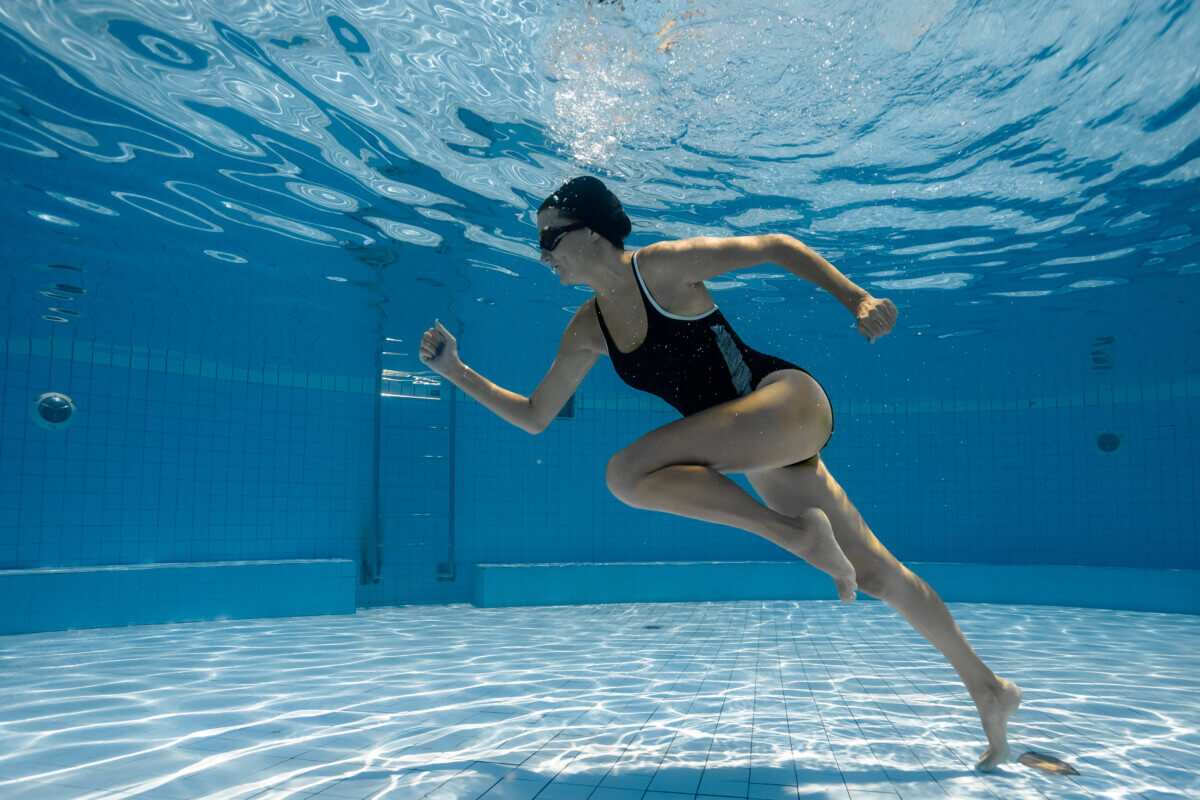
(© Andrey Armyagov - stock.adobe.com)
In A Nutshell
- A new rat study found that swimming produced bigger, stronger hearts than running, even when both exercise types were matched for intensity and duration.
- Rats that swam showed greater heart muscle mass, wider heart cells, and significantly more force output from isolated heart muscle tissue than both runners and sedentary rats.
- Swimming appears to release a molecular brake on heart growth that running does not, through a pathway involving a protein called PTEN and several genetic regulators.
- Both exercise types improved overall cardiovascular fitness equally, so running is not without benefit: but for the heart muscle itself, swimming had a clear advantage in this study.
Running is one of the most familiar forms of exercise for heart health. But a new study in lab rats found that swimming may actually do more for the heart, and on several measures, the gap between the two was wider than expected.
Researchers at the Federal University of São Paulo published their findings in Scientific Reports after comparing the two exercise types under identical lab conditions. Swimming produced bigger hearts and stronger heart-muscle performance, while running at the same effort level did not trigger the same degree of cardiac growth. Both improved overall fitness, but when it came to the heart itself, swimming had the edge.
Not all heart growth works the same way. When the heart enlarges due to disease, such as chronic high blood pressure, that growth is often harmful. But when the heart grows in response to exercise, the enlargement is considered healthy, preserving or even boosting the organ’s ability to contract and relax. Knowing which exercises drive this beneficial remodeling could eventually inform how doctors think about physical activity.
Swimming Outperforms Running on Heart Size and Muscle Strength
Researchers divided male lab rats into three groups of 24: a sedentary group, a running group training on a motorized treadmill, and a swimming group exercising in a heated water tank. Both exercise groups worked out five days a week, 60 minutes per day, for eight weeks at roughly 75 percent of their maximum oxygen capacity.
Rats in both exercise groups improved their peak oxygen consumption by more than 5 percent, while the untrained group declined. Both exercise types equally boosted an enzyme in muscle tissue that reflects improved energy production at the cellular level, and at the whole-body fitness level, running and swimming were comparable.
Where things diverged was inside the chest. Only the swimming group showed a meaningful increase in heart mass relative to body weight and in the mass of the left ventricle, the chamber responsible for pumping blood to the rest of the body. Heart muscle cells in the swimming group were wider and their internal structures larger, both signs of healthy cardiac growth. Running group hearts looked statistically similar to those of sedentary rats on these measures.
Ultrasound imaging showed swimming produced a pattern in which the heart’s chambers grew larger in diameter, an adaptation tied to the high blood-volume demands of water immersion. Neither exercise type impaired the heart’s ability to fill or pump blood at rest. But when researchers tested isolated strips of heart muscle directly, swimming-trained rats developed significantly more force, and both the rate of force buildup and relaxation were greater than in the running and untrained groups.
Swimming’s Molecular Advantage Traced to a Key Growth Pathway
To understand why swimming outperformed running at the cellular level, the team examined signaling proteins known to drive healthy heart growth. One standout finding involved a protein called PTEN, which acts as a brake on a growth-promoting pathway. Only in the swimming group was PTEN significantly reduced, meaning the brake was released, allowing a downstream chain of signals to help heart cells build new structural components. Both exercise types activated some of these shared signals, but swimming pushed them further.
Part of the reason may come down to tiny genetic regulators called microRNAs, which act like dimmer switches for gene activity. Swimming drove significantly higher levels of five of these microRNAs compared to running, and two of them are known to suppress PTEN directly. In other words, swimming may be turning down the very brake that holds back heart growth. Notably, blood levels of IGF-1, a growth factor often assumed to be the main driver of exercise-related heart growth, were unchanged in all three groups. That points researchers toward mechanisms inside heart tissue rather than a simple hormonal explanation.
Why Water May Give the Heart a Bigger Workout
Researchers offered a biomechanical reason for their findings. Because rats are four-legged animals, both running and swimming engage all four limbs, which is why both produced comparable fitness gains. But immersion in water changes the pressure around the body, increasing the volume of blood returning to the heart with each beat. That volume challenge appears to be a more powerful trigger for cardiac growth than the pressure demands of treadmill running.
For now, the human takeaway should clearly stay modest. Both swimming and running clearly improve cardiovascular fitness, and this rat study shows that swimming may be a stronger trigger for heart-muscle remodeling under these specific lab conditions. Still, the results fit with earlier athlete research showing different endurance sports can produce different patterns of heart remodeling, and the molecular blueprint here could eventually help researchers design therapies that mimic the heart-protective effects of exercise for people who are unable to work out at all.
Disclaimer: This study was conducted in male lab rats and has not been tested in humans. Animal research provides valuable biological insights but does not directly translate to human health recommendations. Consult a qualified healthcare provider before making changes to your exercise routine.
Paper Notes
Limitations
This study was conducted exclusively in male lab rats, so the findings may not directly apply to female animals or to humans. Researchers did not measure heart muscle cell length, which would have provided a more complete picture of structural changes. Heart function was assessed at rest rather than during exercise stress, meaning some functional adaptations may have gone undetected. The running protocol used a specific intensity and duration that may not represent all treadmill training programs, and more demanding running regimens might produce different cardiac outcomes.
Funding and Disclosures
This study was supported by the São Paulo Research Foundation (FAPESP), grant numbers 2013/20011-7, 2014/08273-9, and 15/11028-9, and by the National Council for Scientific and Technological Development (CNPq), grant number 300199/2025-2. Authors declared no competing interests.
Publication Details
Title: Swimming is superior to running in inducing physiological cardiac hypertrophy and enhancing myocardial performance | Authors: Amanda Yoshizaki, Ednei Luiz Antonio, Luis Dos Santos, Mariana Teixeira dos Santos, Flavia Leticia Martins, Regiane Santos Feliciano, Jose Antonio Silva Junior, Brunno Lemes de Melo, Danilo Sales Bocalini, Paulo José Ferreira Tucci, Adriana Castello Costa Girardi, and Andrey Jorge Serra | Affiliations: Cardiology Division, Federal University of São Paulo; Purdue University College of Veterinary Medicine; Laboratory of Genetics and Molecular Cardiology, University of São Paulo Medical School, Heart Institute (InCor); Nove de Julho University; Physical Education and Sports Center, Federal University of Espirito Santo | Journal: Scientific Reports (2026), 16:6592 | DOI: https://doi.org/10.1038/s41598-026-36818-2


