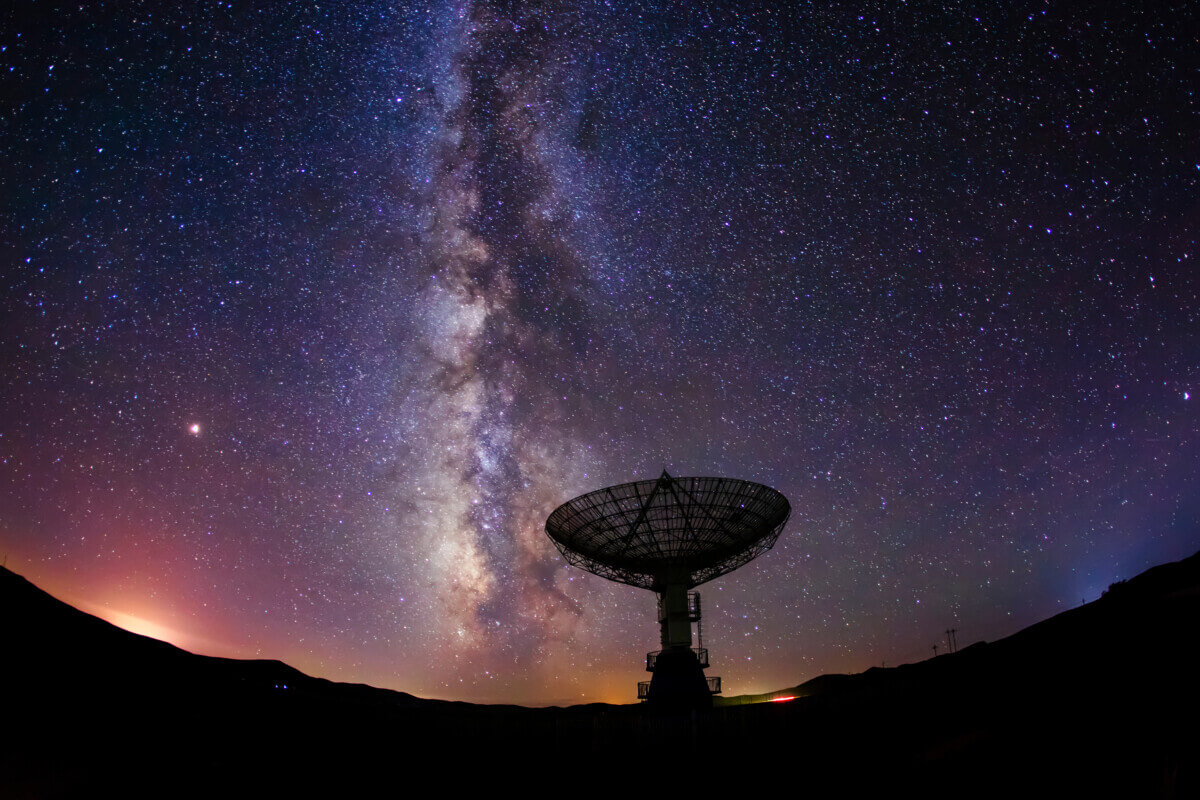
Illustration of a radio telescope satellite pointed at the stars in space. (© zhengzaishanchu - stock.adobe.com)
Solar storms around distant stars may be erasing alien radio signals before we ever hear them
In A Nutshell
- Stellar winds and solar storms around distant stars may be distorting alien radio signals before they reach Earth, making them undetectable by current search tools.
- A simulation of one million star systems found that more than 70% would produce measurable signal distortion at 1 GHz, and over 60% at lower frequencies.
- M-dwarf stars, the most common in the galaxy, generate the worst distortion due to their intense magnetic activity.
- Researchers say future searches need to scan for smeared, broadened signals, not just the sharp radio spikes current software is designed to find.
For decades, radio telescopes have swept the sky listening for alien signals. They’ve found nothing. A new study offers a possible explanation for the lack of results, and it has nothing to do with whether extraterrestrial civilizations exist.
Stellar winds and solar storms may be scrambling alien radio transmissions before they ever reach us. Researchers at the SETI Institute and the University of California, Berkeley have built a detailed mathematical framework showing that the space environment around a distant star can smear and distort exactly the kind of radio signal scientists have been hunting for. Current detection tools may be optimized for signal shapes that don’t survive the trip.
Published in The Astrophysical Journal, the study centers on what the researchers call the exoplanetary interplanetary medium. Every star is surrounded by one. It’s the churning sea of charged particles, magnetic fields, and turbulence that fills the space around a star, fed by stellar wind and periodically jolted by massive solar eruptions called coronal mass ejections, or CMEs. Any radio signal passing through that environment on its way out of a solar system gets distorted. The sharper and cleaner the signal to begin with, the harder it becomes to recognize on the other end.
Why Alien Signals May Never Reach Us Intact
SETI researchers have long focused on “narrowband” radio signals, transmissions squeezed into an extremely thin slice of the radio spectrum. Natural astrophysical phenomena don’t produce signals that narrow, which is exactly why they’re considered a promising alien signature. A civilization deliberately broadcasting into space might use one precisely because it’s efficient and unmistakable.
Most search programs scan near 1 gigahertz (GHz), with some newer projects pushing lower, around 100 megahertz (MHz). Detection software is built to catch a clean, sharp spike at one precise frequency. That’s the profile scientists expect from an alien transmission.
Stellar turbulence doesn’t care about expectations. As a narrowband signal travels through the star’s surrounding medium, random fluctuations in electron density, driven by stellar wind and CME activity, spread that sharp spike out across a wider band of frequencies. A spike becomes a smear. That smear no longer matches the pattern the detection software is built to find, so the software ignores it.

How Scientists Modeled the Problem
To quantify this, researchers Vishal Gajjar and Grayce C. Brown started with what is likely the largest available collection of real-world signal-blurring measurements from spacecraft that have passed through our own solar system, including Mariner IV, Cassini, and Voyager 2, among others. Those missions recorded exactly how radio signals get distorted traveling close to the Sun. Gajjar and Brown used that data to anchor a mathematical model predicting how the same distortion plays out around other stars.
From there, they extended the model to two stellar types: Sun-like stars and M-dwarf stars. M-dwarfs are the most common stars in the galaxy, making up roughly three out of every four. They’re smaller, cooler, and far more magnetically active than the Sun, a combination that turns out to be particularly bad for anyone trying to send a clean radio signal.
With the model built, the team ran a Monte Carlo simulation, a massive computer-generated lottery working through one million hypothetical planetary systems. Each was assigned random orbital properties, wind conditions, turbulence levels, and CME scenarios. For each one, the researchers calculated how much a narrowband signal would be distorted before reaching Earth.
What the Simulations Say About Alien Signal Detection
At 1 GHz, more than 70% of simulated systems produced measurable signal broadening. Over 30% showed broadening of 10 Hz or greater. A signal broadened to 10 Hz retains only about 6% of its original peak strength as seen by standard detection software. A search algorithm looking for a sharp spike would miss it entirely, even if the full radio power was still present.
At 100 MHz, a range newer surveys are actively targeting, more than 60% of systems showed broadening beyond 100 Hz. Stellar turbulence hits harder at lower frequencies, meaning surveys pushing into new territory face the steepest version of this problem.
M-dwarf systems were the hardest hit, which matters because they dominate the sky. CMEs add a separate, more extreme layer: when a star hurls a massive cloud of magnetized plasma into space and that cloud crosses the line of sight between a transmitter and Earth, broadening can jump by a factor of 10 to 100, with the most extreme M-dwarf encounters pushing toward 1,000 times normal levels. The odds of catching a CME encounter during any given observation are below 3%, but when it happens, signal damage is nearly total.
A New Answer to the Great Silence
SETI researchers have spent more than six decades scanning the sky without a confirmed detection, a situation sometimes called the “Great Silence.” Standard explanations include the possibility that intelligent life is rare, that civilizations don’t survive long enough to broadcast, or that alien technology doesn’t use radio at all.
Gajjar and Brown aren’t dismissing any of that. Their work adds a more mechanical explanation: the search pipelines may be built for signals that don’t survive the trip. If stellar turbulence routinely reshapes narrowband transmissions into broader, smeared profiles, detection algorithms optimized for sharp spikes will miss them. A long archive of non-detections doesn’t necessarily prove no one is transmitting. It may mean those transmissions are arriving in a form our tools weren’t designed to recognize.
Going forward, the researchers recommend “width-aware” search strategies, pipelines that account for the full range of signal shapes a stellar environment can produce. Scheduling observations to avoid windows when a target planet passes behind its host star, when the line of sight runs closest to the star and distortion peaks, would also reduce the problem. Next-generation telescopes like SKA-Low, built for lower radio frequencies, should factor this into their detection architecture from the start.
A signal from another civilization, reshaped by the turbulent plasma of its home star, may look nothing like the sharp spike scientists have spent six decades scanning for.
Paper Notes
Study Limitations
M-dwarf stellar environments are not yet directly measurable, so the researchers scaled turbulence and wind values from solar observations using theoretical models and indirect proxies. Actual conditions around M-dwarfs could differ meaningfully from those estimates. CME turbulence behavior is also based on simplified geometric models, as direct radial measurements don’t exist. Retroactive reassessment of prior SETI survey sensitivity limits is not attempted here; the authors note that work is planned for a follow-up study.
Funding and Disclosures
Vishal Gajjar and Grayce C. Brown acknowledge support from the SETI Institute through the STRIDE grant (24STRIDE-005). No conflicts of interest are reported.
Publication Details
Authors: Vishal Gajjar (SETI Institute; Department of Astronomy, University of California, Berkeley) and Grayce C. Brown (SETI Institute) | Journal: The Astrophysical Journal | Paper Title: “Exo-IPM Scattering as a Hidden Gatekeeper of Narrowband Technosignatures” | DOI: https://doi.org/10.3847/1538-4357/ae3d33 | Published: March 5, 2026 (received October 1, 2025; revised January 22, 2026; accepted January 24, 2026)


