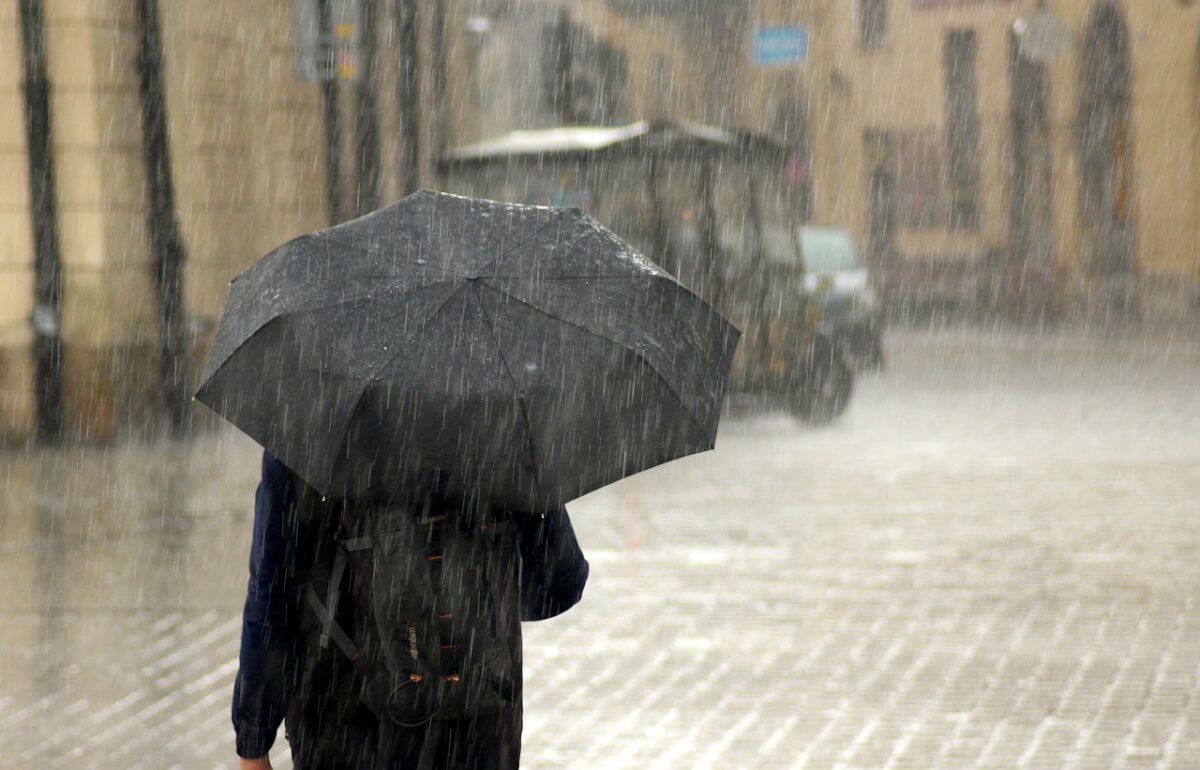
Photo by _Alicja_ from Pixabay
In A Nutshell
- More concentrated rainfall, meaning heavier downpours separated by longer dry spells, drains land water supplies even when total annual precipitation stays the same.
- Dartmouth researchers found the drying effect of bunched-up rainfall is nearly as powerful as the wetting effect of getting more rain overall.
- Computer models and satellite data both confirmed the pattern holds across major climate zones and most of the world’s largest river basins.
- At roughly 2°C of warming, changes in rainfall concentration alone could push about 27% of the global population into abnormally dry conditions.
A month’s worth of rain falls in a single weekend. Then nothing for weeks. The grass browns, the soil cracks, the reservoir drops, even though it technically rained “enough.” That scenario, once considered unusual, is becoming more common in some regions. And according to a new study published in the journal Nature, the shift in how rain falls, not just how much, could drain land water supplies in ways scientists have not fully accounted for.
Researchers found that when precipitation becomes more concentrated, meaning heavy downpours separated by long dry stretches rather than steady, spread-out rainfall, the land holds onto less water overall. The drying effect of this concentration is roughly as powerful as the wetting effect of simply getting more total rain. A region could see its annual rainfall hold steady or even increase and still end up drier than before, simply because of how that rain is distributed across the calendar.
For years, debates about future water supplies have focused almost entirely on whether a place will get more or less total precipitation as the planet warms. This research puts that framing under serious scrutiny.
How Scientists Measured Rainfall Patterns and Where the Water Goes
The research team, based primarily at Dartmouth College, used satellite data from the GRACE mission, a program that has tracked land water storage since 2002 by measuring tiny changes in Earth’s gravitational pull. It captures water held in soils, underground aquifers, vegetation, and surface water bodies, giving researchers a rare global view.
To measure how “bunched up” rainfall is in any given year, the team adapted the Gini coefficient, an economic tool used to measure income inequality, to daily rainfall data. A score close to zero means rain falls fairly evenly throughout the year; a score close to one means nearly all the year’s rain fell on just a handful of days. Researchers calculated this figure using three separate global rainfall datasets and compared year-to-year changes in rainfall concentration against changes in how much water the land was holding.
Results were consistent across all three datasets and across major climate zones, from deserts to rainforests, although a few river basins showed the opposite pattern. Among basins where the relationship was statistically clear, about 80% showed water losses when rainfall became more concentrated, including the Amazon, Nile, Mississippi, Ganges, and Yangtze. The effect was not explained by irrigation or groundwater pumping across the roughly 95% of land areas that are not heavily irrigated.

Why Concentrated Rain Drains the Land
When a massive amount of rain hits the ground all at once, soil can only absorb water so fast. Heavy bursts overwhelm the ground’s ability to soak it in, and excess water pools on the surface. That pooled water evaporates quickly, especially when followed by long dry stretches between storms, and those dry spells tend to be sunnier on average, which means more solar energy reaches the surface and speeds up evaporation further.
To test whether this explanation held up beyond the satellite data, researchers ran simulations using both a simplified computer model of land-surface processes and more complex climate models. Both reproduced the same drying pattern seen in real-world data. In the simplified model, evaporation from surface water rose by roughly 300 millimeters per year on average. Because evaporation from soil fell at the same time, the net increase in total evaporation was closer to 240 millimeters per year, still enough to explain the modeled drop in land water storage. The researchers also ran roughly 365,000 variations of the model with different settings, and the drying effect held up across all of them.
Warmer Temperatures Could Push More Concentrated Rainfall to Affect 1 in 4 People
As Earth continues to warm, basic atmospheric physics dictates that the heaviest rain events will intensify faster than average rainfall does. Using a model of how warming changes precipitation patterns, researchers estimated what a world roughly 2°C above pre-industrial temperatures would look like, a threshold used in the study to test how warming could reshape rainfall patterns. Their estimate: about 27% of the global population would be pushed into abnormally dry conditions based on water storage, driven entirely by changes in rainfall concentration, with no assumed change in total annual precipitation or irrigation.
Key regions facing heightened risk include the Amazon basin, where drying from concentrated rainfall could worsen already-documented water stress, and high-latitude zones like the boreal forests of Canada and Russia, where projected rainfall increases might be significantly offset by this concentration effect.
In heavily irrigated regions, including the North China Plain, the Gangetic Plain, and the Mississippi and Nile deltas, the physical drying may be compounded if farmers respond by pumping more groundwater, drawing down underground reserves on top of the climate-driven losses.
More Rain Doesn’t Always Mean More Water
As the authors write, “the utility of precipitation for land water availability depends as much on its high-frequency distribution as on its annual total.” More rain does not guarantee more water if that rain arrives in increasingly erratic bursts.
Dams, reservoirs, and irrigation systems were largely designed around historical rainfall patterns. If those patterns continue shifting toward fewer, more intense events, infrastructure and policy built on old assumptions may prove increasingly inadequate, even in places that do not appear to be getting drier on paper.
Disclaimer: This study is observational and model-based in nature. While researchers identified a consistent global relationship between concentrated rainfall and reduced land water storage, the future projections assume no change in total annual precipitation or irrigation practices and should not be interpreted as a direct forecast of drought conditions in any specific region.
Paper Notes
Limitations
The authors identify several important boundaries to their findings. The analysis works on a yearly time scale, which means it does not capture seasonal dynamics or the role of snowpack and ice, both of which can be significant in colder regions and may respond differently to warming-driven concentration. The study also cannot fully separate the roles of soil type, vegetation, and land-use change, though the statistical approach used does attempt to account for broader regional differences. While results point to increased evaporation as the driver of land drying, high-quality evaporation observations are not globally available, so some of that evidence relies on model-simulated data, which the authors treat cautiously. The study also cannot resolve whether concentrated rainfall might recharge groundwater more in specific locations, only that any such gains appear insufficient to offset the evaporative losses across most of the world. The authors also note they do not separate plant-based water release from direct surface evaporation, and that future work should examine how soil moisture memory and seasonal timing affect the response. The future projection assumes no change in total annual precipitation or irrigation practices, so it should be understood as an estimate of what concentration-driven changes alone could produce, not a full forecast of future drought risk.
Funding and Disclosures
Research funding came from the Fonds de recherche du Québec, Nature et technologies (award no. 31916, Lesk), the Dartmouth Neukom Institute for Computational Science (both authors), NOAA MAPP (NA20OAR4310425, Mankin), NSF CLD (2304953, Mankin), DOE (DESC0022302, Mankin), and The Rockefeller Center (Mankin). The funders had no role in study design, data collection and analysis, decision to publish, or preparation of the manuscript. The authors declare no competing interests.
Publication Details
Authors: Corey S. Lesk and Justin S. Mankin. Lesk is affiliated with the Department of Geography at Dartmouth College, the Neukom Institute for Computational Science at Dartmouth College, and the Department of Earth and Atmospheric Science at Université du Québec à Montréal. Mankin is affiliated with the Department of Geography at Dartmouth College, the Department of Earth & Planetary Sciences at Dartmouth College, and the Division of Ocean and Climate Physics at Lamont-Doherty Earth Observatory, Columbia University. | Journal: Nature, Vol. 653, published May 14, 2026, pages 425–431. | Paper Title: “More concentrated precipitation decreases terrestrial water storage” | DOI: https://doi.org/10.1038/s41586-026-10487-7 | Received: May 31, 2025 | Accepted: April 2, 2026 | Published online: May 13, 2026


