
Photo by Vitaly Gariev on Unsplash
In A Nutshell
- Children who believed their mothers disapproved of their best friends were more likely to see those friendships end within the following school year.
- Maternal disapproval didn’t just push the child away from the friend; it also made the friend feel less supported in the relationship, quietly eroding the bond from the outside.
- About a quarter of confirmed best friendships dissolved over the study period, and perceived maternal disapproval was a meaningful predictor of which ones fell apart.
- Researchers caution that ending a friendship through parental pressure may backfire: children who lose close friends don’t always replace them with better ones, and some may end up more vulnerable to negative peer influence as a result.
A new study finds that children who believe their mothers disapprove of their friends are more likely to see those friendships fall apart, but the costs of that outcome may outweigh the benefits.
Many mothers share a similar experience. At some point, their child comes home with a new best friend, but something just doesn’t feel right. Maybe the friend seems like a bad influence. So, the mother says something, a pointed comment here, a flat-out “no” there. According to new research, children who perceived their mothers as disapproving of their friends were more likely to see those friendships end. But researchers warn that the outcome may not be as good as it looks to all the moms out there nodding in agreement.
A study published in Child Development tracked nearly 400 students in Lithuania between the ages of 9 and 14 over two school years. Researchers wanted to answer a surprisingly understudied question: when a parent disapproves of a child’s friend and makes that known, does the friendship actually end? According to their findings, perceived disapproval does appear to raise the risk, and the way it unravels is more layered than a parent simply laying down the law.
How Maternal Disapproval Predicts Friendship Dissolution
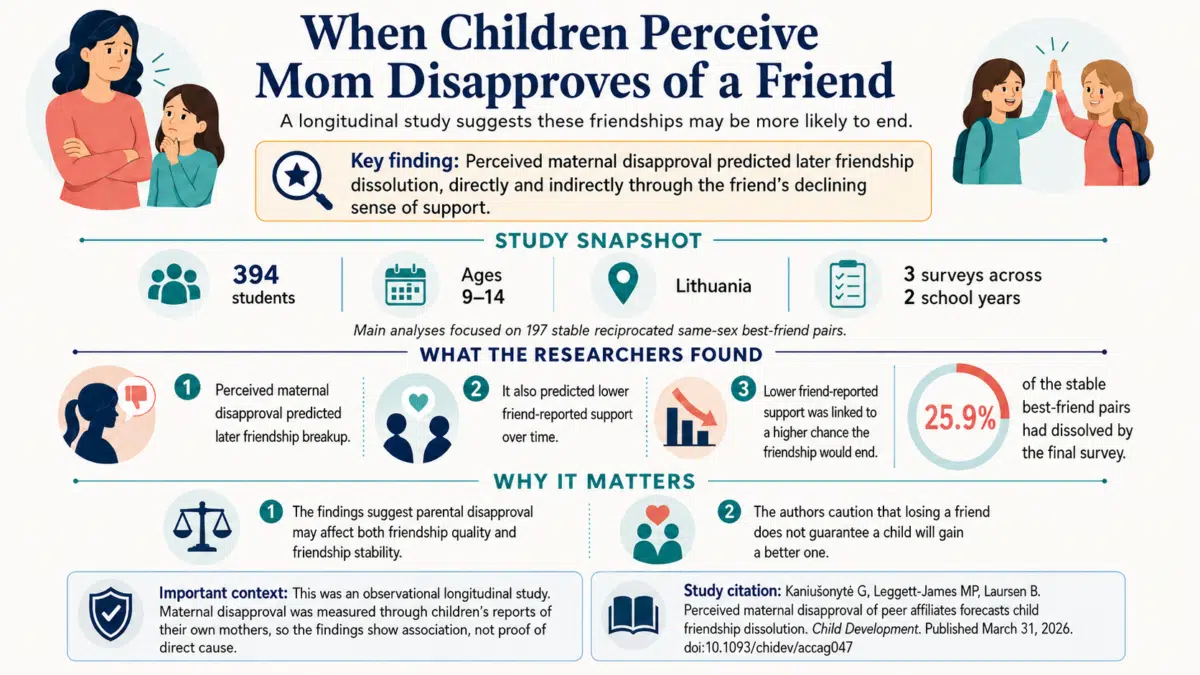
Researchers followed 394 students, 200 boys and 194 girls, attending public schools in a mid-sized community in Lithuania. Students were surveyed three times: once in the fall of 2021, once in the winter of 2022, and again in the fall of 2022. Each time, they answered questions about how much support they felt from their closest friends and how much they believed their mother disapproved of those friends.
To identify real, committed friendships rather than casual acquaintances, researchers looked for pairs of students who had each named the other as a top best friend at two consecutive time points. That narrowed the pool to 197 confirmed close-friend pairs, genuine best friendships with mutual investment from both sides.
By the third survey, about a quarter of those friendships had dissolved. Researchers then examined what predicted which friendships survived and which ones did not.
What the Research Found About Friendship Breakups
Perceived maternal disapproval at the start of the school year was a meaningful predictor of friendship breakups later on. Children who believed their mother disapproved of a specific friend were more likely to report that the friendship had ended by the following fall.
But there was more happening beneath the surface. Maternal disapproval appeared to operate not only by nudging the child to pull back, but also by eroding the friend’s experience of the relationship. When one child’s mother disapproved of the friendship, the other child, the friend, tended to report feeling less supported in the relationship over time. Friendships where that sense of support was declining were more likely to eventually fall apart.
One particularly notable finding: it was the friend’s perception of declining support that appeared to matter most, not the disapproved child’s own. Children did not necessarily report feeling less close to a friend their mother disliked, but the friend did. Researchers suggested that children may become withdrawn or emotionally distant in response to parental pressure without fully realizing it, and the friend may pick up on those subtle shifts. That is a plausible interpretation, though the study measured reported support levels rather than directly tracking what any individual sensed or felt.
A Win That May Not Be Worth It
Researchers were careful to note that while perceived maternal disapproval was associated with a higher likelihood of friendship dissolution, the strategy carries real risks. Prior research cited by the authors has linked some forms of parental interference in peer relationships with defiance, affiliation with more troubled peers, and behavior problems. A child who loses a close friend doesn’t automatically land somewhere better socially, and one left without strong friendships may be more susceptible to influence from whoever is willing to fill that gap.
As the study’s authors wrote: “The dissolution of a friendship can put a child in a precarious position; there is no guarantee that children who lose friends will gain new or better ones.”
Researchers suggest parents consider alternatives, particularly building the kind of warm, trusting relationship with their child that naturally acts as a buffer against negative peer influence, rather than issuing verdicts on specific friends. That kind of parental warmth and support, the authors note, may do more to protect a child from harmful peer dynamics than trying to end a specific friendship outright. For parents inclined to intervene, the study offers a useful pause: the short-term win of ending one friendship may quietly set off a chain of social consequences that are harder to see and even harder to undo.
Paper Notes
Limitations
Several limitations are worth noting. Participants could only nominate classmates as friends, meaning friendships that formed outside of school were not captured. This may have reduced the magnitude of the observed effects, since children considered problematic by parents may be more likely to socialize with disapproved peers in non-school settings. Disapproval was measured entirely through children’s self-reports rather than mothers’ own accounts, and those reports were not specific to individual friendships, meaning some mothers may have disapproved of only certain friends who may or may not have been included in the study. The sample was limited to children ages 9 to 14, and the authors suggest the effects of perceived maternal disapproval may be even stronger among older teenagers, who place greater importance on autonomy. Finally, the study acknowledged limited statistical power to detect small effects, meaning some real associations may have gone undetected.
Funding and Disclosures
Data collection was supported by the European Social Fund under a grant agreement with the Research Council of Lithuania. Manuscript preparation was funded by the State Budget as part of an initiative establishing Centers of Excellence at Mykolas Romeris University, implemented under the Ministry of Education, Science and Sports of the Republic of Lithuania. Authors declared no conflicts of interest. The study was not preregistered.
Publication Details
Paper title: Perceived maternal disapproval of peer affiliates forecasts child friendship dissolution | Authors: Goda Kaniušonytė (Mykolas Romeris University, Vilnius, Lithuania), Mary Page Leggett-James (Florida Atlantic University, Fort Lauderdale, FL), and Brett Laursen (Mykolas Romeris University and Florida Atlantic University) | Journal: Child Development | Published: March 31, 2026 | DOI: https://doi.org/10.1093/chidev/aacag047


