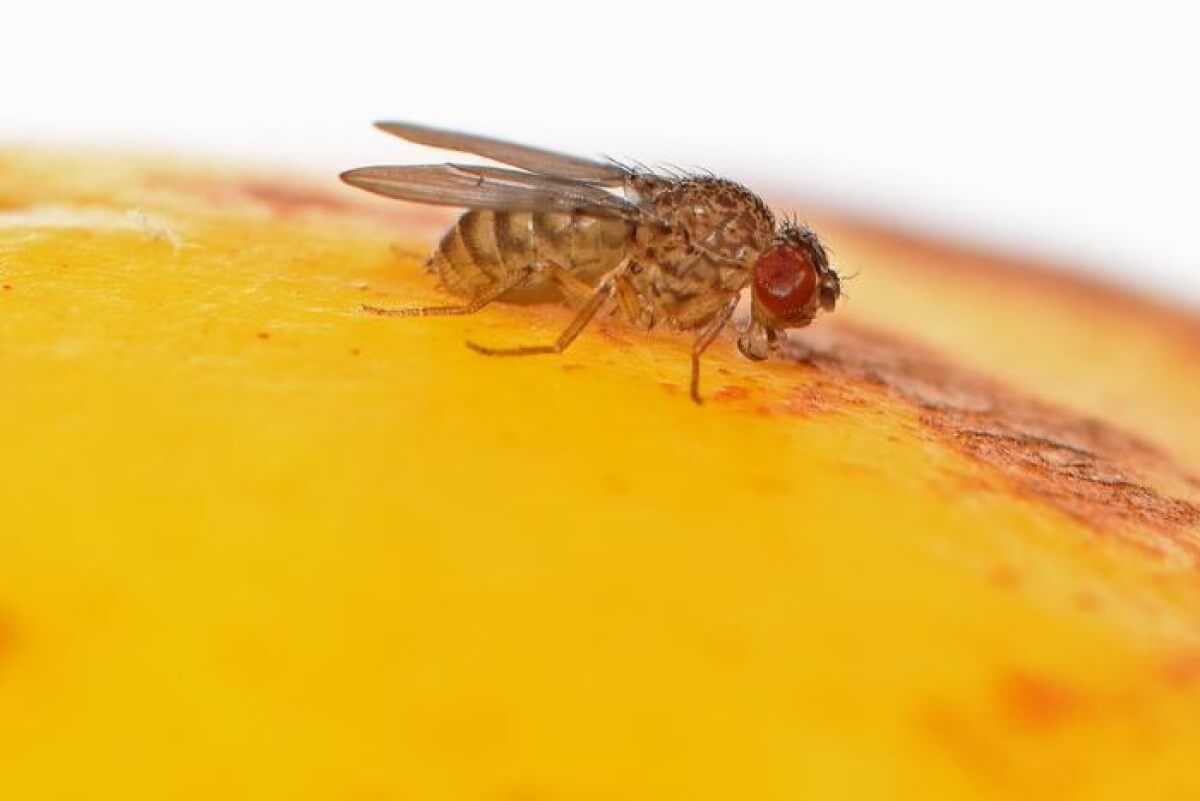
Researchers have identified the genes that are switched on, or switched off, when these flies reproduce without fathers. CREDIT: Jose Casal and Peter Lawrence
In a Nutshell
- A single clock gene in fruit flies can be spliced into a winter-specific version that keeps the insect in cold-season mode.
- Flies engineered to make only that winter version stayed locked in winter behavior even in warm, summer-like conditions.
- The winter version maintains low levels of a brain chemical called PDF, which shifts daily activity earlier and shuts down reproduction.
Every fall, something invisible flips inside animals across the planet. Bears bulk up for hibernation, birds set off on their long journeys south, and even tiny fruit flies shut down their reproductive systems and shift their daily routines to match the shortening days. Scientists have long suspected that the body’s internal 24-hour clock, the timekeeper that governs sleep, hunger, and hormone cycles, sits at the center of these seasonal changes. Exactly how that clock reads the calendar, though, has stayed one of biology’s most stubborn puzzles.
A new study points to a surprising answer. Researchers working with the common fruit fly, Drosophila melanogaster, found that a gene sitting at the core of the biological clock can build different versions of itself depending on the season. One of those winter-specific versions behaves like a lock, holding the fly in a cold-weather state. Flies engineered to make only that winter version stayed stuck in winter mode even after scientists moved them into warm, summer-like conditions.
Published in the journal Science Advances, the work moves seasonal biology away from the old picture of a simple on/off switch controlled by the weather. Part of the machinery, it turns out, may be built into the clock itself, a setup the authors think could show up in other species too.
How the Fruit Fly’s Biological Clock Reads the Seasons
Inside every animal’s biological clock sits a set of genes that switch each other on and off over a roughly 24-hour cycle. In fruit flies, one of the most important genes is called timeless. Researchers already knew that timeless can make different protein versions depending on temperature: a standard “long” version that dominates in warm weather, plus two alternate versions that appear in the cold.
This study adds something new. One of those cold-weather versions, called tim-sc, turns out to be more than a leftover of chilly temperatures. It actively tracks day length. As days shorten heading into winter, the timing of tim-sc‘s daily peak moves by as much as six hours, while the standard warm-weather version barely budges. Put simply, tim-sc reads the calendar in a way the standard version cannot.
To watch how each version behaved, the team raised fly populations under three setups: summer (long days, warm temperatures), equal days and nights, and winter (short days, cold temperatures). Across three separate rounds of the experiment, with roughly 100 fly heads sampled at each time point, the winter version showed a sharp shift in its daily rhythm as days got shorter. The standard version stayed put.

What the “Winter Lock” Does Inside the Body
To find out what tim-sc actually does, the researchers built two groups of flies: one that could make only the standard summer protein, and one that could make only the winter protein. They then tested both groups by running behavioral trials on batches of about 90 flies for a range of seasonal traits.
Flies stuck with the winter protein showed a cluster of cold-season changes. Their evening burst of activity moved about 2.5 hours earlier, matching the pattern flies use in winter to push activity toward the warmer middle of the day. Their reproductive systems shut down, and ovarian development stalls. Even under warm, long-day summer conditions, these flies could not restart reproduction.
At the center of all this is a brain chemical called pigment-dispersing factor, or PDF. When PDF levels fall, flies drift toward winter activity and reproductive shutdown. Flies that made only the winter protein kept PDF low, even in a fake summer. That stuck-low PDF helps pin several winter traits in place, though the authors are clear that these flies did not copy every feature of a real winter fly.
The winter protein also acts differently inside cells. Normally, the standard version spends much of its time in the fluid part of the cell before moving into the nucleus, the cell’s control center, later in the day. When the winter version takes over, the protein sits in the nucleus throughout the night instead.
That change in location ripples through the clock. A partner protein called PERIOD usually rides into the nucleus alongside timeless and puts a brake on another clock protein, keeping it from latching onto DNA. In the winter-only flies, PERIOD dropped and gathered less in the nucleus. With the brake weakened, the other clock protein gripped DNA more tightly, yet the genes it normally switches on did not crank out more product. The authors read this as a clock rebuilt into a different working mode, not one simply running fast or slow.
Why the Biological Clock Discovery Reaches Beyond Fruit Flies
The trick behind the winter lock, one gene spliced into several protein versions, is called alternative splicing, and it shows up in clocks across the living world, from plants to insects to mammals. Similar patterns already turn up in other cold-adapted flies and in plants. Whether the same setup runs in mammals is a question the authors leave for later work.
The paper also carefully touches on human health. Seasonal shifts in the body are well documented in many animals, and a glitch in this kind of seasonal gene switching could, in theory, contribute to conditions that track the seasons. The team makes no direct claim about human disease, and whether anything similar occurs in people remains unknown.
What the fly work does show is a clear demonstration: a single switch within the core clock, determined by which version of a gene the body uses, can be enough to keep an animal in a seasonal state. The biological clock, then, is more than a daily timer. It also holds a kind of seasonal memory, and in winter, a fly’s own genes appear to keep that memory locked in.
Paper Notes
Limitations
The authors flag several limits on their work. The engineered flies in the key experiments were locked into producing only one version of the TIMELESS protein at a time, which does not reflect the natural situation in which several versions are present at once. The flies that made only the winter version did not reproduce all aspects of winter biology observed in wild flies kept under real winter conditions, a sign that other molecular players are involved. Some of the daily rhythms observed in gene activity were very small, and the researchers caution that the meaning of these weak rhythms remains unclear. A few experiments sampled only two time points, which may not be enough to capture a full daily rhythm. The study also centers on the winter version, tim-sc, and does not fully separate the role of a second cold-induced version, tim-c, which is also present in winter and is recognized by the same antibody used in testing.
Funding and Disclosures
This work was supported by National Institutes of Health grants K99NS133470 and R00NS133470, both awarded to Sergio Hidalgo. Research in the laboratory of Joanna C. Chiu was supported by NIH grant R01 DK124068. Sergio Hidalgo is also a Latin American Fellow in the Biomedical Sciences supported by the Pew Charitable Trusts. Access to imaging equipment was provided through NIH grant GM122968. The authors declare no competing interests.
Publication Details
Authors: Sergio Hidalgo, Rodrigo Del Rio, Christine A. Tabuloc, Lorenzo A. Perez Hernandez, Audrey L. Berry, Yao D. Cai, Kyle M. Lewald, and Joanna C. Chiu
Affiliations: Department of Entomology and Nematology, College of Agriculture, University of California, Davis; Department of Integrative Physiology and Neuroscience, College of Veterinary Medicine, Washington State University; Center for Reproductive Biology, Washington State University
Journal: Science Advances
Paper Title: “Splicing of a core circadian clock gene regulates seasonal adaptations by a winter gating mechanism”
Volume/Issue: Vol. 12, Issue 29, eaed4249
Published: July 15, 2026


