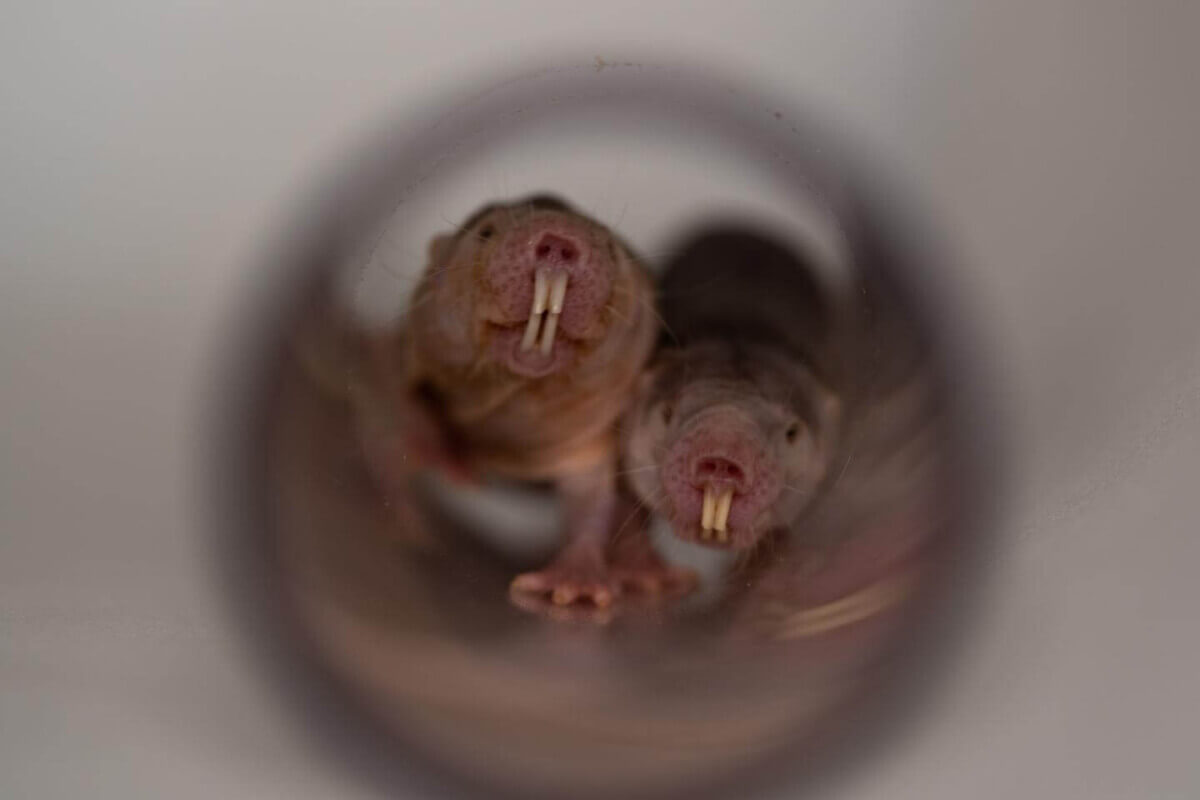
(Credit: Photo by Colin Lewin)
In a Nutshell
- Queen naked mole-rats carry high levels of one chemical, isopropyl myristate, that other females detect by smell.
- Exposure to it raises a hormone called prolactin in those females, which keeps them infertile.
- It appears to be a long-sought signal for how a single queen controls reproduction across an entire mammal colony, much as queen insects rule their hives and nests.
Naked mole-rats are one of nature’s strangest animals: hairless, wrinkled rodents that live like ants in underground tunnels, ruled by a single breeding queen. For decades, biologists were stumped by one question about them. How does that queen stop every other female in her colony from ever having babies? Researchers now have a strong lead, and much of it comes down to a single chemical her body makes.
A study published in the journal Nature points to a waxy, nearly odorless compound called isopropyl myristate, found at high levels in queen naked mole-rats and almost nowhere else in the colony. Picked up through the nose, it appears to flip a hormonal switch in other females that keeps them from reproducing. When the queen is around and the chemical is present, the colony stays calm and infertile. When it disappears, order breaks down fast.
Scientists have long known that queen bees, ants, and termites use chemical signals to keep their workers from breeding. Mammals were assumed to be too complicated for anything that direct. Finding the same basic trick in a rodent, on a completely separate branch of the animal family tree, came as a surprise. Adding to the oddity: isopropyl myristate is a common ingredient in lotions and cosmetics.
The Chemical Hidden in the Naked Mole-Rat Queen
Naked mole-rats live in underground tunnel networks in East Africa and have intrigued biologists since their unusual social setup was first described in 1981. Like a beehive, each colony revolves around one breeding female. She is normally the only one having pups, and every other female stays infertile as long as she is in charge. Remove her, and that infertility collapses almost overnight as high-ranking females start fighting to take the throne.
To figure out how the queen pulls this off, researchers gathered 771 odor samples from 351 individual naked mole-rats of different ranks, ages, and reproductive stages. Using lab equipment that separates and identifies the individual chemicals in a sample, they picked out 240 different compounds. One jumped out: isopropyl myristate, an oily substance formed when an acid and an alcohol react. It was plentiful in queens but nearly undetectable in non-breeding females and in males.
Levels of the compound rose and fell with the queen’s own fertility. They peaked during ovulation, when she was most fertile, and dropped during pregnancy and nursing. The chemical acted, in effect, as a running broadcast of exactly where she stood in her reproductive cycle.
How the Naked Mole-Rat Queen’s Signal Reaches the Nose
Was the colony actually smelling this compound? To check, researchers used a drug called methimazole to briefly knock out the smell-sensing cells in the animals’ noses. Animals that lost their sense of smell stopped chasing food odors and could no longer tell colony members from strangers. High-ranking animals, normally the quickest to pick fights, also stopped starting them once their sense of smell was gone, a sign that scent drives much of the colony’s aggression.
Brain scans backed this up. After 90 minutes of exposure to isopropyl myristate, the animals showed increased activity in smell-processing regions of the brain, whereas harmless control substances elicited no such response. Given a choice between bedding scented with the compound and plain bedding, high-ranking females, the ones with the most to gain if the queen vanished, actively steered clear of it. Lower-ranking animals showed no preference, and animals with their sense of smell disabled ignored it entirely. The animals most likely to challenge a queen turned out to be the most sensitive to her chemical.
One Smell That Shuts Down Reproduction
Fertility in female mammals is governed in part by prolactin, a hormone best known for triggering milk production and for its ability to switch off ovulation. Non-breeding naked mole-rats naturally run high on prolactin, which keeps them infertile. High-ranking females run a bit lower, leaving them closer to being able to breed.
Prolactin in non-breeding females rose and fell in step with the queen’s cycle, climbing exactly when her isopropyl myristate levels were highest. When females were pulled out of their colonies and cut off from her scent, their prolactin dropped and their own levels of the compound climbed. Knocking out their sense of smell also lowered prolactin. Researchers describe a chain of events in which the queen produces the chemical, the colony smells it, prolactin rises, and reproduction shuts down, while cautioning that they cannot rule out a role for other cues, such as sound or touch.
To see whether the chemical alone could block breeding, researchers moved non-breeding males and females out of their colonies and paired them off under three setups. One group got no colony scents. A second got bedding carrying the queen’s natural mix of odors. A third got isopropyl myristate added to their bedding every day. After 18 weeks, the result was clear-cut. In the scent-free group, five of six females got pregnant. In both the colony-bedding group and the isopropyl myristate group, none of the thirteen females did. Males in the scent-free group showed physical signs of gearing up to breed that were absent in the other two groups.

What Happens to a Colony Without Its Queen
Researchers saved the boldest test for last. They removed the queen from an intact colony of 19 animals, then added isopropyl myristate to the bedding daily for 12 weeks. Losing a queen normally sets off hormonal upheaval, vicious fighting, and a scramble to replace her.
None of that happened. For all 12 weeks, the colony stayed peaceful. Prolactin in the non-breeding females held high, right where it sits when a queen is present, and there were no signs of ovaries switching on or any dominance battles.
Then researchers stopped adding the compound. Within a month, prolactin fell and progesterone, a hormone that climbs as breeding gears up, shot upward. About a week after the chemical was withdrawn, high-ranking females began fighting, and one female was killed in an attack. By week 19, a dominant female had put on the body weight that signals a rising queen, had begun mating, and became pregnant. She later gave birth as the colony’s new queen.
This test used a single colony, and the authors caution that they do not yet know whether the same thing would hold in wild colonies. Isopropyl myristate also showed up in the breeding females of several related mole-rat species that live in groups led by a single female, though at lower levels, and was absent in mole-rat species that live alone. Naked mole-rats, which have the strictest breeding hierarchy of any known mammal, carried the most, hinting that a queen makes more of it the tighter her grip needs to be. The compound has turned up in human breath and in breast secretions of nursing mothers, but when the team tested 766 human odor receptors, they found only weak, inconsistent responses, suggesting people likely cannot smell it, or can barely do so.
So a rigid social order in one of the animal kingdom’s oddest species rests on something almost comically simple. A single chemical, carried on the air and read through the nose, appears to hold an entire colony’s biology in place. The queen may not have to enforce her rule directly. As long as she is present, her chemistry appears to do much of the work for her.
Paper Notes
Study Limitations
The researchers acknowledge several boundaries to their findings. The colony-stability experiment involved a single colony, and the authors note it remains unclear whether the effects of isopropyl myristate would generalize to natural wild conditions or to the rare cases in which a colony has more than one breeding female. The study also cannot fully exclude contributions from other sensory or behavioral signals, such as sound or touch, in maintaining reproductive suppression alongside the chemical signal. In addition, while the compound activates smell-processing circuits, the specific smell receptor in naked mole-rats that detects it was not identified. Because queens and breeding males are continuously exposed to isopropyl myristate yet remain reproductively active, determining why breeders are not self-suppressed will require further research into the brain and hormonal changes associated with queen status. Finally, the fecal hormone analyses in the opposite-sex pair experiments were conducted only on a subset of pairs from a single location.
Funding and Disclosures
This work was supported by the Helmholtz Association and the European Research Council (grants 789128 and 101142488 to Gary R. Lewin, and grant 101040759 to Alison J. Barker). Additional support came from the Max Planck Society, the Berlin Institute of Health, Charité–Universitätsmedizin Berlin, and the Department of Science and Technology, South African Research Chair of Mammalian Behavioural Ecology and Physiology (GUN 64756, to Nigel C. Bennett). Individual researchers were supported by von Humboldt fellowships and an MD scholarship. Open-access funding was provided by the Max Delbrück Center. The authors declare no competing interests.
Publication Details
Paper Title: “A queen odour mediates reproductive suppression in a eusocial mammal”
Authors: Mohammed A. Khallaf, Daniel W. Hart, Wenhan Luo, Firdevs Murad, Felipe Cybis Pereira, Daniel Mendez-Aranda, Nicole Hagenah, Alice Rossi, Valérie Bégay, Jan Okrouhlík, Dietmar Krautwurst, Mungo Kisinza Ngalameno, Andre Ganswindt, Alison J. Barker, Radim Šumbera, Markus Knaden, Sophie Pezet, Andrew Woehler, Bill S. Hansson, Nigel C. Bennett, and Gary R. Lewin
Journal: Nature
DOI: 10.1038/s41586-026-10772-5
Received: September 17, 2025 | Accepted: June 5, 2026


