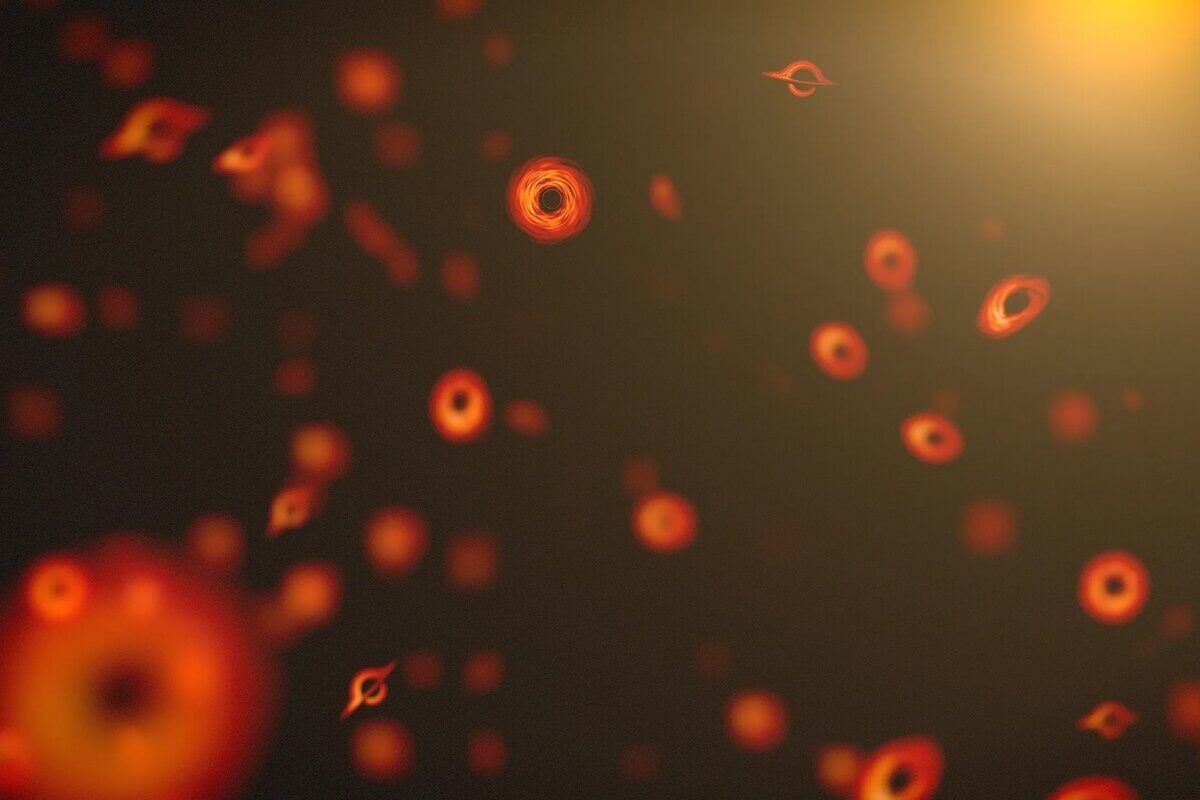
An illustration of small primordial black holes. In reality, such tiny black holes would have a difficult time forming the accretion disks that make them visible here. (Credit: NASA)
BUFFALO, N.Y. — Could tiny primordial black holes, formed in the earliest moments of our universe, be lurking inside asteroids or even beneath our feet? A provocative new study suggests an innovative way to search for these elusive cosmic objects – and the evidence of their existence might be as close as the rocks in ancient buildings or the asteroids floating through our solar system.
When most people think about black holes, they imagine massive dying stars collapsing in on themselves. However, in the chaotic conditions of the early universe, something else may have happened. As space rapidly expanded after the Big Bang, some areas became significantly denser than their surroundings, potentially collapsing into what scientists call primordial black holes (PBHs). These cosmic objects could even be the solution to one of physics’ greatest mysteries – dark matter, the invisible substance that makes up 85% of the universe’s total mass.
“We have to think outside of the box because what has been done to find primordial black holes previously hasn’t worked,” says study co-author Dejan Stojkovic, a professor of physics at the University at Buffalo, in a media release.
Stojkovic’s research, along with colleague De-Chang Dai, suggests we might need to look both at the cosmic scale and right here on Earth to find evidence of these elusive objects.
These aren’t the massive black holes that lurk at the centers of galaxies. The researchers are focusing on much smaller specimens, weighing between 1,017 and 1,024 grams – imagine the mass of a mountain compressed into something the size of an atom. While that might still sound enormous, in the realm of black holes, these would be considered tiny.
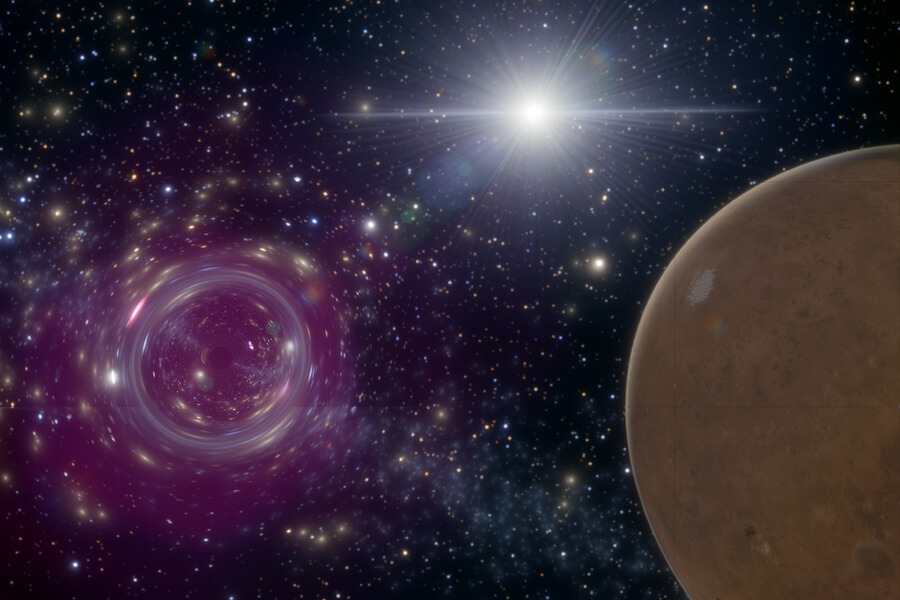
Credit: Image by Benjamin Lehmann, using SpaceEngine @ Cosmographic Software LLC.
The mechanism is surprisingly straightforward: If one of these miniature black holes gets captured by a planet or asteroid that has a liquid core surrounded by a solid outer layer (similar to Earth’s structure), the black hole would gradually consume the denser liquid core. If the outer solid layer is strong enough, it wouldn’t collapse, leaving behind a hollow shell – essentially creating a natural cosmic cathedral.
“If the object has a liquid central core, then a captured PBH can absorb the liquid core, whose density is higher than the density of the outer solid layer,” Stojkovic explains.
The black hole might later escape if the object is struck by another asteroid, leaving behind nothing but an empty shell. The researchers calculated the precise conditions needed for such structures to remain stable. Using known materials like granite and iron, they determined that hollow structures up to about one-tenth the size of Earth could theoretically exist.
Intriguingly, several known asteroids fall within this size range, including Lutetia (about 62 miles in diameter) and Vesta (about 326 miles across). Such hollow objects could potentially be detected using telescopes, as their unusually low density would be revealed by studying their orbits. In fact, some asteroids like Bennu and Ryugu are already known to have surprisingly low density, though this is likely due to their rubble-pile structure rather than black holes.
The study also suggests another, perhaps more accessible way to search for these cosmic visitors. A fast-moving primordial black hole passing through solid matter would leave behind a distinctive calling card: a remarkably straight, extremely narrow tunnel. How narrow? A black hole weighing around 1,022 grams would create a tunnel about 0.1 microns in radius – small enough to be invisible to the naked eye but large enough to spot with an optical microscope.
And if you’re worried about a primordial black hole passing through you – don’t be. Unlike solid materials like rock, human tissue has very little tension, so a PBH wouldn’t tear it apart.
“If a projectile is moving through a medium faster than the speed of sound, the medium’s molecular structure doesn’t have time to respond. Throw a rock through a window, it’s likely going to shatter. Shoot a window with a gun, it’s likely to just leave a hole,” Stojkovic colorfully explains.
The researchers also explored a more futuristic application of their calculations. Future civilizations might want to build structures around black holes to harvest their energy. Using the strongest material currently known – multiwall carbon nanotubes – they calculated that such a structure would need to be built at least 10,000 solar radii away from a solar-mass black hole to remain stable. That’s quite a construction project for our descendants to contemplate.
The field of physics is currently facing serious challenges, with dark matter being one of the most significant.
“The smartest people on the planet have been working on these problems for 80 years and have not solved them yet. We don’t need a straightforward extension of the existing models. We probably need a completely new framework altogether,” Stojkovic concludes.
And who knows? Perhaps the next time you walk past an ancient stone building, you’ll be walking past silent evidence of one of the universe’s most exotic objects – a cosmic visitor that left its mark millions of years ago, waiting to be discovered under a microscope. While the odds might be small – about one in a million for a billion-year-old boulder – the potential payoff of finding the first evidence of a primordial black hole would be immense.
The paper will be published in the December issue of Physics of the Dark Universe.
Paper Summary
Methodology
The researchers used Einstein’s general relativity to perform their calculations, specifically focusing on how space-time bends around a black hole with a massive shell surrounding it. They started with what’s called a “spherically symmetric spacetime metric” – imagine this as a mathematical map showing how space and time curve around a perfectly round object. Using this framework, they calculated two critical values: the surface density (how much mass is packed into the shell’s surface) and surface tension (the forces trying to pull the shell apart).
These calculations revealed a crucial ratio between tension and density that determines whether a hollow structure can survive. Think of it like a soap bubble – there’s a balance between the surface tension holding the bubble together and the pressure trying to break it. For their cosmic structures, this ratio needed to be compared with the strength of real materials.
To make these comparisons practical, they examined common materials found in asteroids and planets. For example, granite can withstand pressures up to about 0.0965 gigapascals, while iron can handle up to 1 gigapascal. They also looked at more exotic materials like multiwall carbon nanotubes, which can withstand up to 60 gigapascals, making them the strongest known material for this purpose.
Key Results
The calculations yielded several specific findings. For natural materials like granite or iron, a hollow structure could be stable up to 0.1 Earth radii (about 637 kilometers or 395 miles). This size range is particularly interesting because we know of several asteroids within it. For instance, the asteroid Lutetia, with a diameter of about 100 kilometers and density of 3.4 g/cm³, falls within this range. Similarly, Vesta, measuring 525.4 kilometers across with a density of 3.456 g/cm³, could theoretically support a hollow structure.
Intriguingly, some asteroids we’ve already discovered show unexpectedly low densities. Bennu and Ryugu, for example, have densities of only about 1.2 g/cm³. While these low densities are currently attributed to their rubble-pile structure (essentially loose collections of rocks held together by gravity), their discovery proves we already have the technology to detect unusually low-density objects in space.
For the microscopic tunnels, the researchers calculated that a black hole of 1,022 grams would leave a tunnel 0.1 microns in radius – about the size of a large virus. While the probability of finding such a tunnel is very small (0.000001 for a billion-year-old rock with a 10-square-meter cross-section), the ability to detect such features with standard optical microscopes makes the search feasible.
Study Limitations
The probability of finding evidence of black hole passages through Earth materials is extremely small – about 0.000001 for a billion-year-old boulder. The calculations assume perfect conditions and symmetrical structures, which might not reflect real-world scenarios. The study also relies on our current understanding of material properties under extreme conditions, which might be incomplete.
Discussion & Takeaways
The research opens up new possibilities for detecting primordial black holes using existing technology and materials. It suggests that we might find evidence of these cosmic objects in unexpected places, from ancient buildings to asteroids. While the chances of finding these signatures are small, the search wouldn’t require expensive equipment or elaborate preparation. The study also provides valuable insights for future space engineering projects involving black holes.
Funding & Disclosures
Stojkovic’s work was supported by the National Science Foundation, while Dai’s work was funded by the National Science and Technology Council (Taiwan). The authors reported no conflicts of interest.


