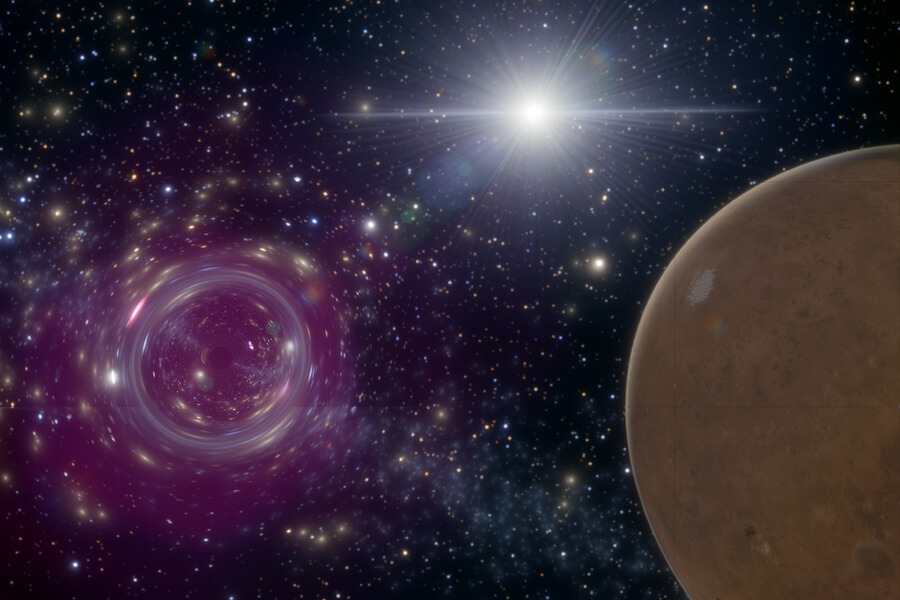
An artist’s illustration depicts a primordial black hole (at left) flying past, and briefly “wobbling” the orbit of Mars (at right), with the sun in the background. MIT scientists say such a wobble could be detectable by today’s instruments. Credits:Credit: Image by Benjamin Lehmann, using SpaceEngine @ Cosmographic Software LLC.
CAMBRIDGE, Mass. — Have you ever wondered what’s really out there in the vast expanse of space? Well, scientists at MIT have a mind-bending theory that might just change how we look at the night sky. They’re suggesting that microscopic black holes could be whizzing through our solar system right under our noses!
At the heart of this theory is dark matter. It’s one of the biggest puzzles in modern physics. Despite scientists believing that it makes up a whopping 80% of all matter in the universe, we can’t see it, touch it, or detect it with our current technology. It’s like trying to catch a ghost – we know it’s there because we can see its effects on the things around it, but we can’t quite grab hold of it.
For years, scientists have been scratching their heads, trying to figure out what dark matter is made of. The most popular theory has been that it’s some kind of exotic particle we haven’t discovered yet, but what if it’s something else entirely?
This is where MIT’s new study published in the journal Physical Review D comes in. They’re revisiting an old idea from the 1970s that suggests dark matter could be made up of tiny black holes that formed just moments after the Big Bang. These aren’t your run-of-the-mill black holes that form when massive stars collapse. We’re talking about primordial black holes – cosmic relics from the very dawn of the universe.
“If we see it, that would count as a real reason to keep pursuing this delightful idea that all of dark matter consists of black holes that were spawned in less than a second after the Big Bang and have been streaming around the universe for 14 billion years,” says study author David Kaiser, a professor of physics at MIT, in a media release.
Now, here’s where things get really interesting. The MIT team thinks these miniature black holes might be zipping through our solar system more often than we realize – possibly once every decade! So, how could we possibly detect something so small and fast-moving?
The answer, they suggest, lies in the orbit of Mars. These tiny black holes, despite their size, pack a serious gravitational punch. If one were to pass close enough to Mars, it could cause a tiny “wobble” in the planet’s orbit.
“Given decades of precision telemetry, scientists know the distance between Earth and Mars to an accuracy of about 10 centimeters,” Kaiser explains. “We’re taking advantage of this highly instrumented region of space to try and look for a small effect.”
The Martian Wobble
So, just how big of a wobble are we talking about? According to the study, if a primordial black hole passed within a few hundred million miles of Mars, it could shift the planet’s orbit by about a meter. Now, that might not sound like much, especially when you consider that Mars is more than 140 million miles away from Earth. However, with today’s super-precise instruments, we just might be able to spot it.
The team used computer simulations to model how these black holes might interact with our solar system. They found that the effects on Earth and the Moon were too uncertain to pin down, but Mars offered a clearer picture.
Of course, even if we do detect a wobble in Mars’ orbit, there’s still work to be done to prove it was caused by a primordial black hole and not just a run-of-the-mill asteroid. The researchers are already thinking ahead of time about this challenge.
“We need as much clarity as we can of the expected backgrounds, such as the typical speeds and distributions of boring space rocks, versus these primordial black holes,” Kaiser notes. “Luckily for us, astronomers have been tracking ordinary space rocks for decades as they have flown through our solar system, so we could calculate typical properties of their trajectories and begin to compare them with the very different types of paths and speeds that primordial black holes should follow.”
The MIT team is now working on even more detailed simulations to help distinguish between the effects of ordinary space rocks and these hypothetical primordial black holes. They’re teaming up with experts who can simulate many more objects in the solar system to get a more precise picture of what to look for.
While this research is still in its early stages, the implications are huge. If we can confirm that primordial black holes are indeed zooming through our solar system, it could revolutionize our understanding of dark matter and the early universe.
So, the next time you look up at the night sky, remember – there might be more out there than meets the eye. Tiny black holes could be silently streaking past, carrying with them the secrets of the universe’s birth.
Paper Summary
Methodology
The researchers conducted simulations to examine the influence of asteroid-mass primordial black holes (PBHs) as they travel through our Solar System. The central hypothesis was that these PBHs could be responsible for detectable perturbations in the orbits of planets and other objects, allowing scientists to indirectly measure their presence.
Using current high-precision astronomical data, including observations from lunar laser ranging and Mars orbiters, they modeled how PBHs could interact with Solar System bodies. The team used numerical models to predict the rate of PBH encounters based on their expected mass range and velocity. These models allowed them to estimate how a flyby from a PBH could alter planetary orbits in a way that could be measured by existing technologies.
Key Results
The study found that if PBHs make up dark matter, at least one of these objects could pass through the inner Solar System every 10 years. When a PBH comes close to a planet or the Moon, it would cause tiny changes in their orbits. These changes are so small that they are only noticeable with extremely precise measurements.
However, the study shows that with current technology, especially data from tracking the Moon and Mars, we could detect these flybys. If enough data is gathered, it might be possible to identify PBHs as a part of dark matter.
Study Limitations
One limitation of this study is the reliance on models and simulations. While the predictions made are based on our current understanding of astronomy and physics, there are always uncertainties in models. For example, the exact distribution of PBHs in space and their behavior as they pass through the Solar System is not entirely known.
Additionally, the study assumes that the observational data are accurate enough to detect these small changes, but unforeseen factors could affect the precision of the measurements. Finally, the analysis did not include some secondary physical effects, such as more complex gravitational interactions or relativistic effects, which may influence the results.
Discussion & Takeaways
This research highlights a novel approach to investigating the mysterious dark matter that makes up a significant portion of the universe. Instead of looking for dark matter directly, the study suggests that we can observe its effects on nearby planets and other celestial bodies.
By closely watching the movements of planets and objects in the Solar System, scientists could detect changes caused by PBHs passing through. If these predictions hold true, it could open up a new way of confirming or ruling out the existence of PBHs as a form of dark matter. The study’s findings point to exciting future research possibilities in both astronomy and particle physics.
Funding & Disclosures
This research was carried out by a team of physicists from the Massachusetts Institute of Technology and the University of California, Santa Cruz. It was funded by the U.S. Department of Energy and supported by the MIT Undergraduate Research Opportunities Program (UROP), along with additional contributions from the National Science Foundation (NSF). No conflicts of interest or other disclosures were reported by the authors.


