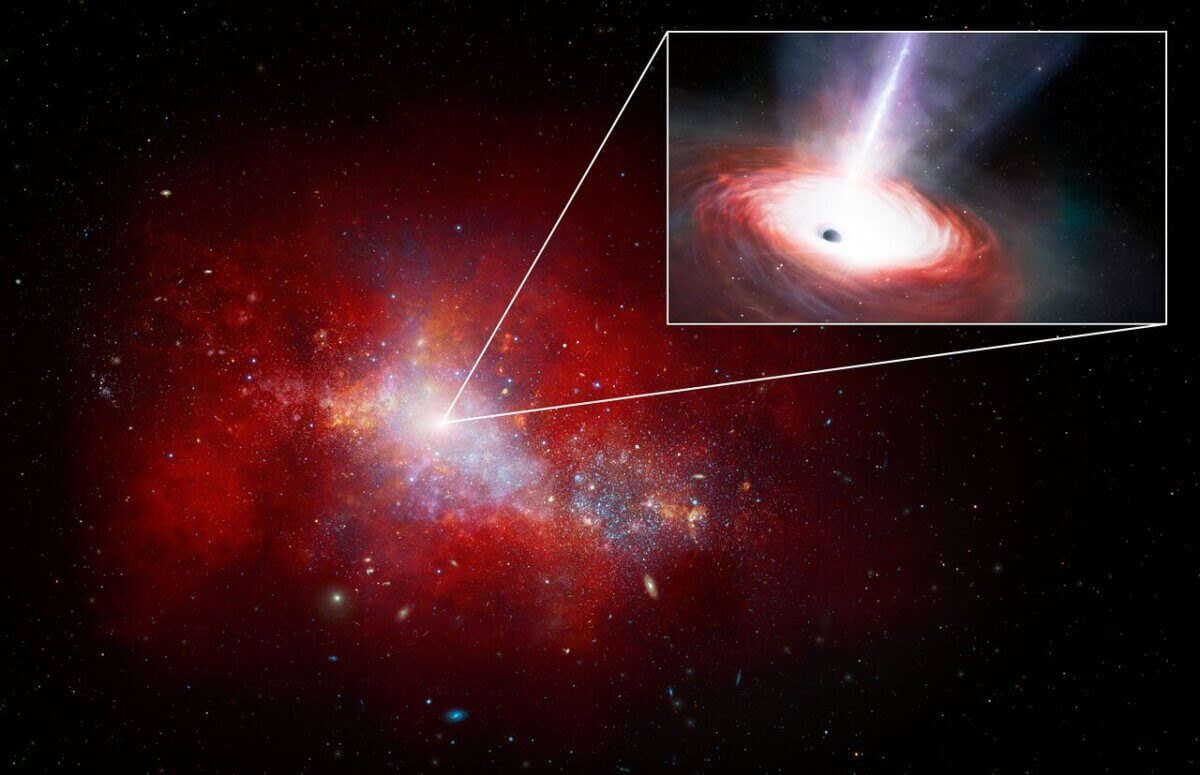
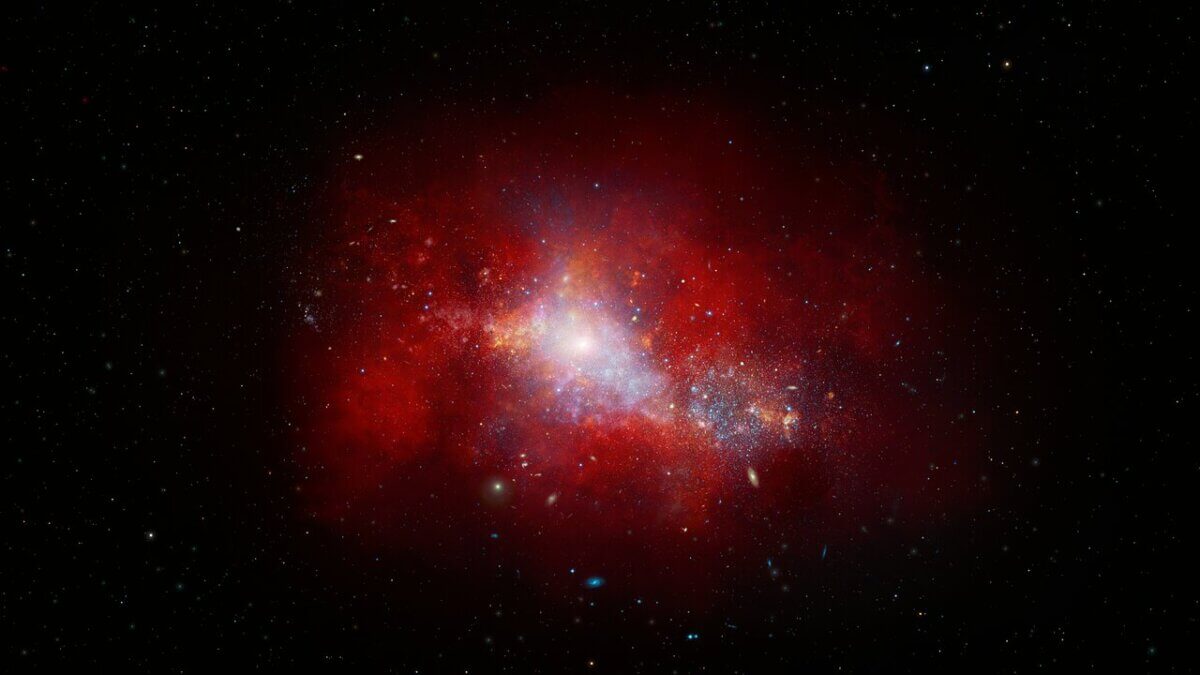
This artist’s illustration shows a red, early-Universe dwarf galaxy that hosts a rapidly feeding black hole at its center. Using data from NASA's JWST and Chandra X-ray Observatory, a team of U.S. National Science Foundation NOIRLab astronomers have discovered this low-mass supermassive black hole at the center of a galaxy just 1.5 billion years after the Big Bang. It is accreting matter at a phenomenal rate — over 40 times the theoretical limit. While short lived, this black hole’s ‘feast’ could help astronomers explain how supermassive black holes grew so quickly in the early Universe.
HILO, Hawaii — In a discovery that challenges our understanding of the cosmos, astronomers have found what could be described as the universe’s hungriest black hole – one that’s breaking fundamental physics by consuming matter at an astonishing rate, over 40 times what scientists thought possible.
Using NASA’s advanced James Webb Space Telescope (JWST) and Chandra X-ray Observatory, researchers have spotted this cosmic glutton, known as LID-568, in action when the universe was just 1.5 billion years-old – practically its infancy, considering the universe is now about 13.8 billion years-old.
“This black hole is having a feast,” says Julia Scharwächter, an astronomer at the NSF’s NOIRLab who co-authored the study published in Nature Astronomy.
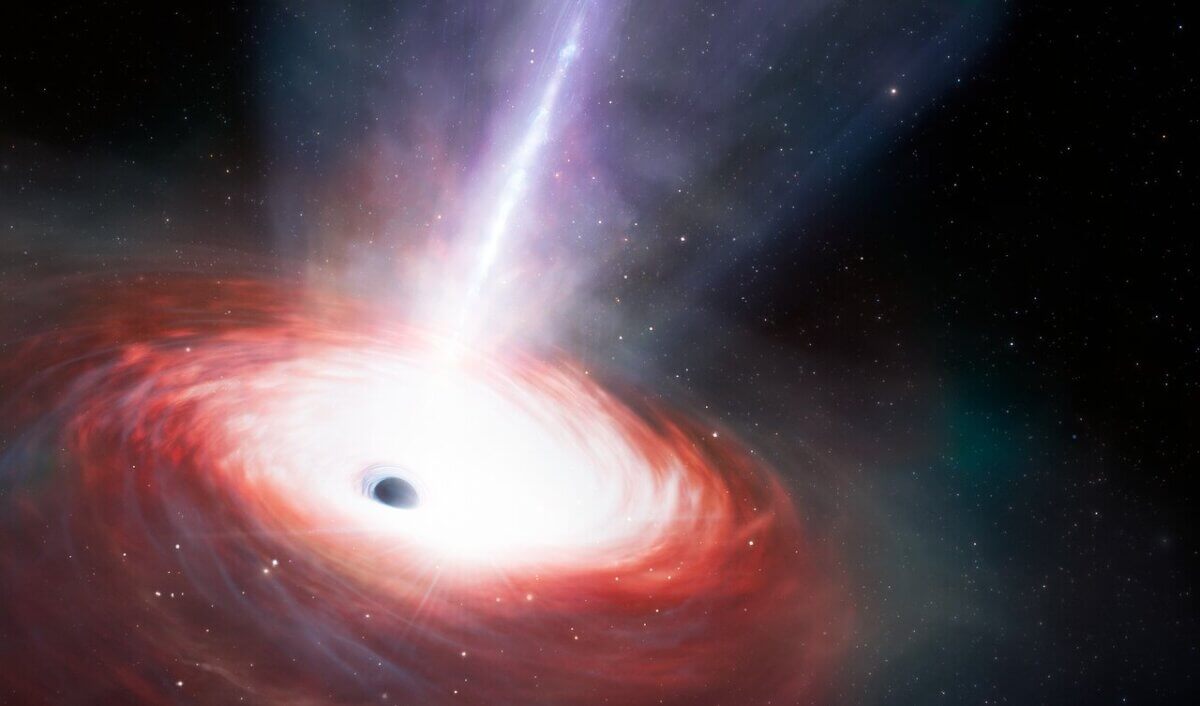
To understand just how extraordinary this discovery is, imagine a buffet with a strict limit on how much food you can pile on your plate based on your size. In the cosmic realm, black holes have a similar limit – called the Eddington limit – which determines how fast they can consume matter before the forces involved become unstable. This newly discovered black hole isn’t just exceeding its limit; it’s demolishing it by consuming matter at 40 times the expected rate.
The research team, led by astronomer Hyewon Suh, made this discovery through a clever use of technology. They first identified LID-568 through X-ray observations, which showed it was unusually bright. However, the black hole was completely invisible in regular light, making it challenging to study. This is where JWST’s superior infrared vision came into play, allowing astronomers to peer through the cosmic dust and observe the black hole’s feeding frenzy in unprecedented detail.
What makes this discovery particularly significant is that it might help solve a long-standing cosmic mystery: how did supermassive black holes manage to grow so enormous so quickly in the early universe?
“Owing to its faint nature, the detection of LID-568 would be impossible without JWST. Using the integral field spectrograph was innovative and necessary for getting our observation,” co-author Emanuele Farina explains in a media release.
The observations revealed powerful outflows of gas surrounding the black hole, suggesting that a significant portion of its growth may have occurred during a single episode of rapid feeding. Think of it like a cosmic growth spurt, where instead of growing steadily over time, the black hole gained much of its mass in one extended binge.
The team plans to conduct follow-up observations using JWST to better understand how this black hole manages to maintain such an extreme feeding rate without becoming unstable. Their findings could revolutionize our understanding of how the universe’s largest black holes came to be, suggesting that these cosmic titans might have grown through periods of extreme consumption rather than steady, measured growth.
This research marks another breakthrough in our understanding of the early universe, demonstrating that even fundamental physics can sometimes be bent in ways we never expected. It seems that when it comes to cosmic appetites, some black holes don’t just break the rules – they devour them.
Paper Summary
Methodology
The researchers observed a low-mass black hole (LID-568) from approximately 1.5 billion years after the Big Bang using the James Webb Space Telescope (JWST). By analyzing spectral data from the Near-Infrared Spectrograph and Mid-Infrared Instrument on JWST, they identified signs of rapid growth, or “super-Eddington accretion,” where the black hole pulls in material at a rate far exceeding standard limits. This accretion phase was marked by high-velocity outflows, evidenced by specific spectral lines in the data that indicate material moving away from the black hole at significant speeds.
Key Results
The study found that LID-568 has a mass of around 7.2 million solar masses and is accreting at over 4,000% of the Eddington limit. The high-energy emissions and dusty appearance suggest that it is in a rare and intense growth phase. Compared to other active galactic nuclei (AGN) discovered by JWST, LID-568 emits stronger X-ray signals, implying that it is more active and possibly obscured by dust. The extended Hα emission showed that material was being expelled from the black hole’s center at velocities of about 500-600 kilometers per second, suggesting powerful outflows likely due to the black hole’s rapid intake of material.
Study Limitations
The study faced challenges in interpreting the origin of outflows. The researchers could not rule out that some observed emissions could stem from a merger event rather than purely from the black hole’s activity. Additionally, they used single-epoch measurements to estimate the black hole’s mass, which may introduce slight uncertainties. The extreme accretion rate observed is also based on specific models that assume continuous super-Eddington activity, which may not apply universally across similar black holes.
Discussion & Takeaways
LID-568 represents a missing piece in understanding how early black holes could have grown so rapidly. This discovery supports theories suggesting that black holes could undergo phases of super-Eddington accretion, enabling faster growth. The study’s findings highlight the potential role of black holes in influencing their surroundings through intense energy release, possibly even affecting star formation in their host galaxies by expelling or heating nearby gas.
Funding & Disclosures
The research was supported by multiple institutions, including the Gemini Observatory, National Science Foundation, INAF, and the Spanish Ministry of Science and Innovation. The study utilized data from NASA’s JWST and ALMA observatories, and no competing interests were declared by the authors.


