
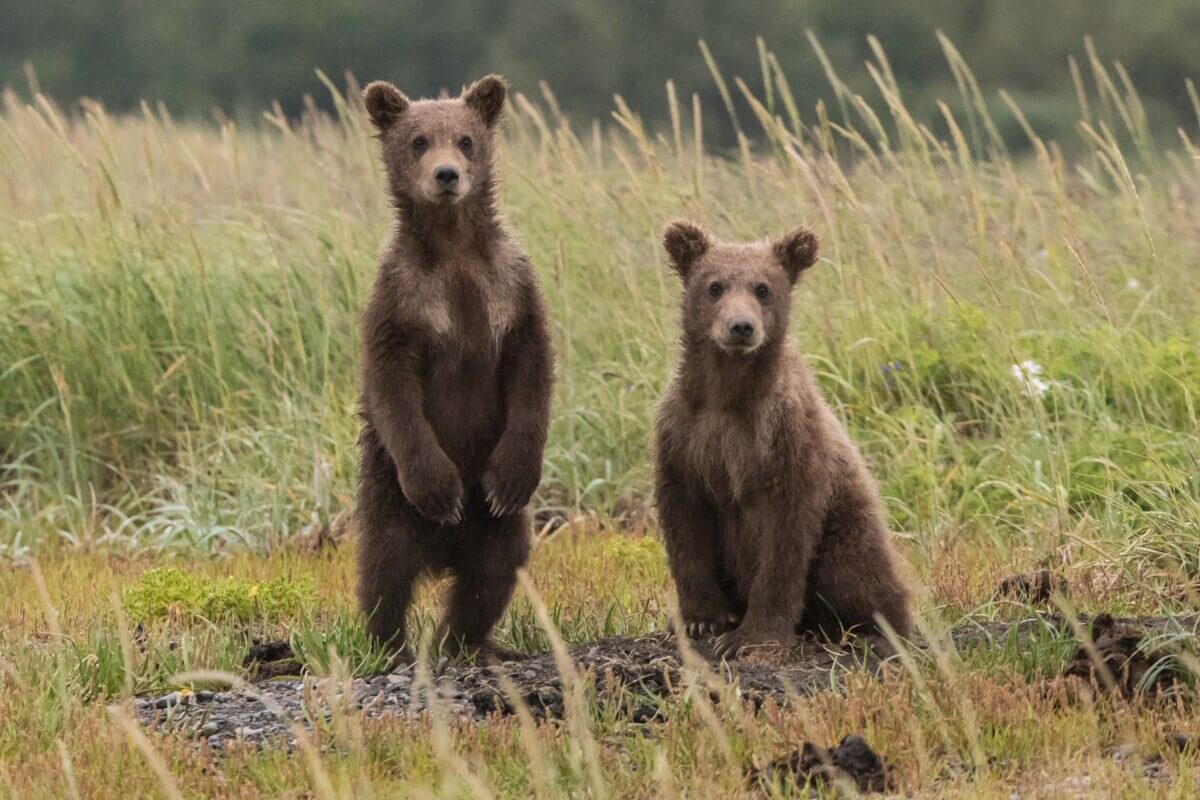
He won't bite...seriously (Credit: Massimiliano Paolino on Shutterstock)
An apparent case of accidental domestication, these bears developed calmer temperaments over millennia.
In A Nutshell
- Italy’s 50 remaining Apennine brown bears carry genetic signatures at 17 genes linked to brain development and behavior, similar to patterns seen in domesticated animals like dogs and foxes
- Centuries of humans killing aggressive bears may have accidentally selected for calmer temperaments, with genetic evidence suggesting this behavioral shift has a hereditary component rather than being purely learned
- The bears now suffer extreme inbreeding (66% of their genome is identical DNA) and carry a heavy burden of harmful mutations, but their reduced aggression toward humans may be the very trait that allowed their survival
- The findings raise difficult conservation questions: should managers preserve these genetically unique but compromised bears, or introduce bolder individuals that might disperse better but cause more human-wildlife conflicts?
What happens when humans kill off the boldest, most aggressive members of a wild animal population for thousands of years? According to research on Italian brown bears, you may get something that resembles the early stages of domestication at the genetic level, without any deliberate breeding.
Scientists have discovered that a small population of brown bears living in Central Italy’s mountains carry genetic signatures similar to those found in domesticated animals like dogs and foxes. The twist? Nobody deliberately bred these bears for tameness. Instead, generations of humans hunting and killing aggressive bears appear to have accidentally selected for docility, potentially altering the population’s genetic makeup in ways that could influence behavior.
The Apennine brown bear exists nowhere else on Earth. Just 50 individuals remain in the mountains of Central Italy, where they’ve coexisted with dense human populations for millennia. Unlike brown bears in North America or other parts of Europe, these animals rarely show aggression toward people, even during frequent encounters, compared with other brown bear populations.
Researchers from the University of Ferrara assembled the first complete genome for an Apennine brown bear and compared genetic data from 22 European bears with published genomes from North American populations. Their analysis revealed that Apennine bears possess distinctive genetic variants at 17 genes associated with brain development and behavior, many of which fall within biological pathways also implicated in domestication studies of other species.
Because the population is small and isolated, genetic drift cannot be ruled out as a contributing factor. However, the researchers concluded that human populations likely exerted an unintentional pressure on the Apennine brown bear that resulted in an evolutionary adaptive change, according to their study published in Molecular Biology and Evolution. Multiple independent analyses point toward selection rather than random genetic drift.
The comparison to domestication isn’t just superficial. Russian scientists famously bred silver foxes for tameness starting in the 1950s, selecting only the calmest individuals to reproduce over several decades. Those experiments produced foxes with floppy ears, changed coat colors, and docile temperaments. The genetic changes underlying that behavioral transformation involved many of the same biological pathways now identified in the Apennine bears.
The difference? The fox experiment happened intentionally under controlled conditions over a few decades. The Apennine bears may have undergone a similar process through natural selection imposed by human persecution spanning millennia.
Genetic Analysis Reveals Brain Development Changes
The research team examined over 12 million genetic variants across 35 brown bears from different populations. Using three independent statistical methods, they identified regions of the genome showing signs of recent positive selection specifically in the Apennine population.
Several genes stood out. DCC helps guide nerve cell development during brain formation and has been linked to tameness in domesticated animals. SLC13A5 plays a role in brain function and metabolism. NUMB directs cell differentiation during nervous system development. All three showed notable genetic differences between Apennine bears and other brown bear populations.
Six other genes cluster in a chromosomal region that, when deleted in humans, causes Williams-Beuren syndrome, a condition characterized by intellectual disability and an unusually friendly, trusting personality. The Apennine bears don’t have deletions in these genes, but they do carry variants that appear to alter how these genes function.
Notably, the genetic changes weren’t in the genes themselves but in surrounding regulatory regions. Think of it like adjusting a dimmer switch rather than replacing the lightbulb. The researchers found variants predicted to alter splicing factor binding sites, which change how genetic instructions get processed into functional proteins. These molecular switches appear to have fine-tuned brain development in ways that could favor calmer behavior.

Bruno D’Amicis/ Molecular Biology and Evolution)
Ancient Roman Hunting Likely Accelerated Bear Evolution
The process likely accelerated during Rome’s expansion across Italy more than 2,000 years ago. Historical records document Romans capturing bears for arena spectacles and systematically hunting them to clear land for agriculture.
Demographic analysis revealed that the Apennine bear population crashed during this period and has remained completely isolated for at least 1,500 years. Forest clearance and land conversion fragmented habitat, trapping the bears in increasingly small pockets of wilderness surrounded by growing human settlements.
When aggressive bears encountered people in this shrinking habitat, those bears were more likely to be killed. Meanwhile, shyer individuals that avoided humans had better survival rates. Over countless generations, this relentless pressure would have removed aggressive temperaments from the breeding population while allowing calmer bears to reproduce.
The researchers calculated that many of the harmful mutations present in today’s Apennine bears originated before the population became isolated, meaning they were once part of a larger, connected European bear population. But the variants associated with reduced aggressiveness show patterns consistent with recent selective sweeps, situations where advantageous mutations spread rapidly through a population.
High Inbreeding Levels Threaten Bear Population
This evolutionary adaptation came with serious consequences. The Apennine bears now show extreme levels of inbreeding, with more than 66% of their genome consisting of long stretches of identical DNA. By comparison, bears from Slovakia showed only 7% to 26% of their genome in these regions.
The population also carries a heavy burden of harmful mutations. While they have fewer total mutations than bears from larger populations, a much higher proportion exist in duplicate copies. This means the negative effects aren’t masked by normal gene versions, potentially impacting survival and reproduction.
Despite this genetic erosion, the bears persist. Their reduced aggression may be the very trait that allowed their survival. Studies show that local attitudes toward bears in the Apennine region are more positive than in areas where bears recently recolonized, possibly because residents have adapted to living with these calmer animals.
Wildlife Management Faces Difficult Conservation Choices
The findings raise challenging questions for wildlife managers. Should they prioritize preserving the Apennine bears’ unique genetic makeup, even though it includes many harmful mutations? If genetic rescue becomes necessary, should managers introduce bold bears that might disperse more effectively, or shy bears that cause fewer conflicts?
The research shows that even populations with severe genetic problems can harbor important adaptations. The Apennine bears’ tolerance of humans, encoded in their DNA, represents a rare example of how wildlife may evolve to coexist with people. As habitat fragmentation forces more animals into contact with humans worldwide, understanding these evolutionary dynamics becomes increasingly important.
From domesticated dogs to farm-raised salmon, humans have intentionally shaped the genetics of numerous species. The Apennine brown bears remind us that we’ve also been unintentionally shaping wild populations for thousands of years, creating evolutionary pressures that alter species in ways we’re only beginning to understand.
Paper Notes
Limitations
The study acknowledges several limitations. The small sample size of Apennine bears (11 individuals analyzed) reflects the entire remaining population but limits statistical power. The demographic reconstructions using PSMC may be affected by changes in migration rates or cryptic population structure rather than purely reflecting population size changes. The structural variant analysis could be affected by technical factors, as identifying hemizygous deletions is more difficult than homozygous deletions. While the study identifies genes under selection and their predicted effects on splicing, the actual functional consequences of these variants were not experimentally validated. The authors note they cannot definitively determine whether genetic drift or selective hunting drove the observed genetic patterns, though the evidence strongly suggests selection.
Funding and Disclosures
This work was supported by the University of Ferrara (Italy) and funded by the MIUR PRIN 2017 grant 201794ZXTL to Giorgio Bertorelle. Sibelle Torres Vilaça was supported by a Young Researchers (Marie Skłodowska-Curie winners) grant awarded by the Italian Ministry for Universities and Research. Paolo Ciucci was supported by the European Union—NextGenerationEU National Biodiversity Future Center. The authors declared no conflicts of interest.
Publication Details
Fabbri, G., Biello, R., Gabrielli, M., Torres Vilaça, S., Sammarco, B., Fuselli, S., Santos, P., Ancona, L., Peretto, L., Padovani, G., Sollitto, M., Iannucci, A., Paule, L., Balestra, D., Gerdol, M., Ciofi, C., Ciucci, P., Mahan, C.G., Trucchi, E., Benazzo, A., & Bertorelle, G. (2025). Coexisting With Humans: Genomic and Behavioral Consequences in a Small and Isolated Bear Population. Molecular Biology and Evolution, 42(12), msaf292. DOI: 10.1093/molbev/msaf292. Published December 15, 2025.


