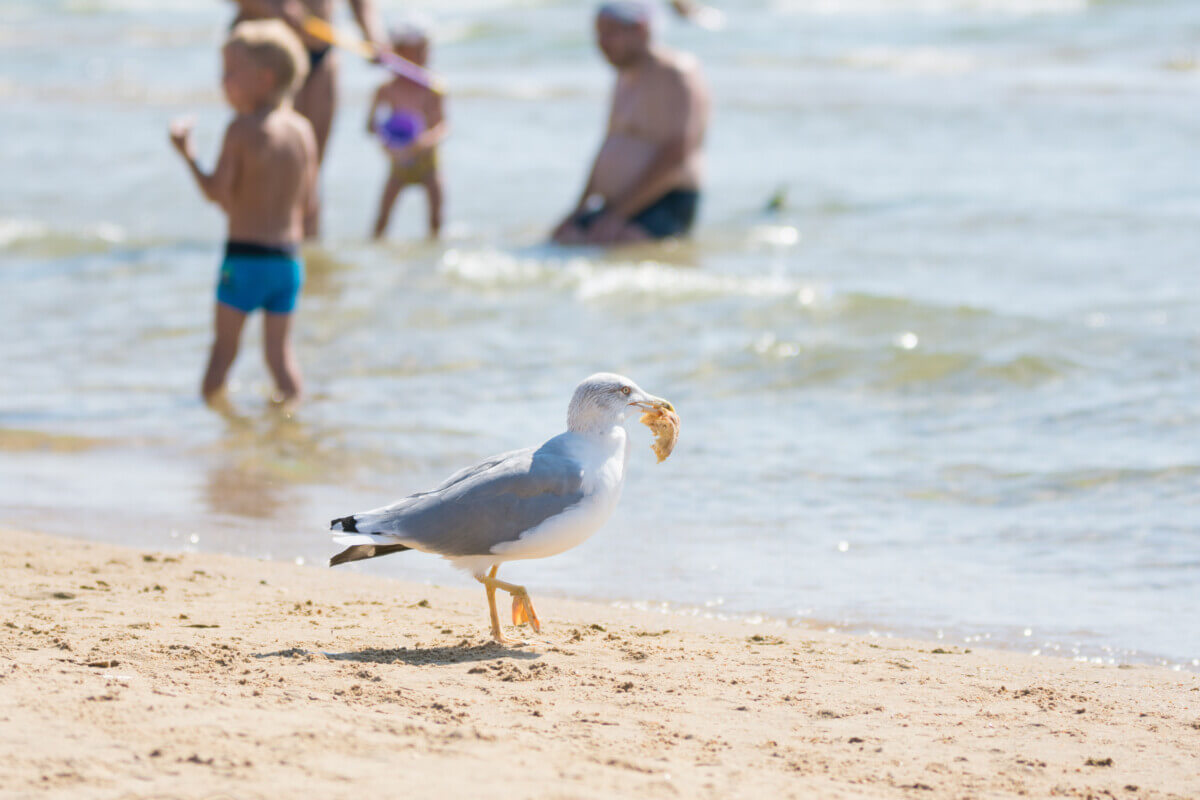
Seagulls are notorious lunch thieves. Research finds shouting is the best way to clear them out quickly. (© madhourse - stock.adobe.com)
In A Nutshell
- Volume isn’t everything: Seagulls can tell the difference between shouting and speaking even when both are played at exactly the same loudness, showing they respond to acoustic properties beyond just decibels.
- Different exits, different threats: When researchers tested 61 wild gulls in Cornwall, birds flew away from shouting but walked away from speaking—flying signals they view shouting as a more serious danger.
- Both work to stop stealing: Whether someone talks or shouts, gulls stopped foraging and left sooner than when they heard harmless robin song, so either vocalization protects beachside lunches.
- Shouting clears them out faster: For people dealing with persistent gulls near food, shouting proved five times more effective at making birds fly away completely compared to the neutral baseline.
Anyone who has eaten near the beach has probably had a seagull swoop in to claim their lunch at some point. Now, scientists at the University of Exeter have figured out exactly how to keep those feathered bandits at bay, and the answer might surprise people who thought volume was the only thing that mattered.
Researchers tested 61 wild herring gulls across nine coastal towns in Cornwall, England, playing recordings of men shouting, men speaking, and a robin’s song at the exact same volume. The gulls treated both shouting and speaking as threats compared to the harmless robin chirps. There was, however, a twist. When gulls decided to leave, they flew away from shouting but merely walked away from speaking.
How Scientists Tested Seagull Responses to Human Voices
Setting up the experiment required some creativity. Scientists placed a speaker inside a plastic shopping bag to avoid spooking the birds, then set out a clear plastic box filled with chips 150 centimeters away. Once a gull approached, researchers started one of three randomly selected 30-second audio tracks while filming the bird’s reaction from eight meters away.
The vocal recordings came from five British men who recorded themselves saying the same phrase twice: once shouting and once speaking normally. “No! Stay away! That’s my food, that’s my pasty!” Each recording was edited to reach 60 decibels peak amplitude at 150 centimeters, a level chosen to reflect what gulls would experience under natural conditions. This ensured that differences in the gulls’ responses reflected the acoustic properties of the voices rather than loudness alone. Five different robin songs served as the control, representing a familiar and non-threatening sound.

The Surprising Difference Between Flying and Walking Away
When the audio started playing, gulls exposed to human voices flinched at the sudden sound, spent longer scanning their surroundings for danger, pecked at the food or speaker fewer times, and left the area much sooner than those listening to robin song.
But the real difference appeared in how the gulls chose to exit. When researchers analyzed the 47 gulls that left before the one-minute trial ended, a clear pattern emerged: gulls that heard shouting were five times more likely to fly away compared to those that heard robin song, while gulls that heard speaking were seven times more likely to walk away compared to the robin baseline.
Flying away from danger represents a more urgent escape response than walking. Birds typically reserve flight for serious threats, as flying requires more energy and leaves them vulnerable while airborne. The fact that gulls flew from shouting but walked from speaking suggests they perceived shouting as a more immediate danger, even though both sounds came through the speaker at identical volumes.
Why Urban Seagulls Are Getting Bolder
European herring gulls have rapidly colonized British urban areas over the past century. Today, most of the UK’s herring gull population nests in towns and cities rather than coastal cliffs, creating friction between humans and birds. Complaints about noise, mess, and aggressive food-seeking behavior have become common in seaside communities.
Previous research has shown that urban gulls can read human behavioral cues, like where someone is looking, and use that information to decide when to steal food. They’re less likely to approach food when a person maintains eye contact with them. Published in Biology Letters, the findings add another layer to this. Speaking at a normal volume appears sufficient to interrupt a bird’s meal, but shouting proves more effective at making the gull leave entirely.
The research team conducted all trials during late February and early March 2025, outside the breeding season. They tested birds across 52 different locations, carefully tracking previously tested gulls to avoid counting the same bird twice.
Seagulls Just Make You Want To Shout
Shouting and speaking differ in acoustic features beyond volume. In this study, the three playback types also differed in fundamental frequency, even when normalized to the same decibel level. These differences remain detectable to animals with acute hearing.
Birds possess sophisticated auditory systems that can detect subtle variations in sound. Many bird species use vocal cues to assess threats and distinguish between predators and non-predators. That urban gulls have learned to interpret human vocal properties makes sense given their increasing reliance on human food sources and frequent interactions with people.
Interestingly, St. Ives and Hayle, two towns with higher tourism levels, yielded more successful trials than larger towns like Penzance and St. Austell. The researchers suspect that tourist-heavy areas provide more foraging opportunities from street vendors and outdoor dining, potentially making gulls in those locations bolder and more willing to approach human food.
For anyone trying to protect their beachside lunch, the research offers a simple takeaway. Either talking or shouting at a pesky gull will make it less likely to continue foraging, but shouting is more effective at making the bird leave entirely.
Paper Summary
Methodology
Scientists tested 61 wild European herring gulls across nine coastal towns in Cornwall, England, between late February and early March 2025. Researchers set up a speaker concealed in a shopping bag and placed a clear plastic box containing chips 150 centimeters away. When a gull approached, they played one of three 30-second recordings: a man shouting, a man speaking, or robin song. All recordings were edited to 60 dB peak amplitude (dB A weighting; 20 μPA reference value), chosen to reflect what gulls would experience under natural conditions and to allow comparison with previous research. Five different recordings of each type were used, with five British male volunteers recording the phrase “No! Stay away! That’s my food, that’s my pasty!” in both shouting and speaking voices. Researchers filmed the gulls from eight meters away and recorded behaviors including flinching, vigilance, pecking, time spent near the apparatus, and how the gull left. Trials were conducted in 52 different locations at least 50 meters apart to minimize the chance of testing the same bird twice.
Results
Gulls responded similarly to men shouting and speaking in several ways: none flinched at robin song, but many flinched at human voices. Birds exposed to human vocalizations showed longer vigilance periods, pecked less frequently, and left the experimental area sooner than those hearing robin song. However, gulls differentiated between shouting and speaking when choosing how to leave. Of the 47 gulls that departed before the trial ended, those hearing shouting were five times more likely to fly away (odds ratio = 5.154) compared to those exposed to robin song, while those hearing speaking were seven times more likely to walk away (odds ratio = 6.964) compared to those exposed to robin song. Both human vocalizations deterred foraging behavior equally, but shouting triggered a more urgent flight response. Whether a gull was alone or in a group did not affect its response.
Limitations
The study tested gulls during the non-breeding season, so responses during breeding season when birds are more territorial might differ. The research focused on gulls bold enough to approach the experimental setup, which may not represent the behavior of more cautious individuals. All recordings used male voices, so whether gulls respond differently to female voices remains unknown. Sample sizes for some specific comparisons were relatively small, and the study couldn’t definitively determine which specific acoustic properties (pitch, intonation, rhythm) drove the gulls’ ability to discriminate between shouting and speaking.
Funding and Disclosures
Céline Rémy was funded by Université Paris-Saclay through the Bourse de stage à l’international IDEX and by AgroParisTech through the Bourse de mobilité internationale. Neeltje Janna Boogert and Laura Ann Kelley are funded by Royal Society Dorothy Hodgkin Research Fellowships. The authors declared no competing interests.
Publication Details
Rémy, C.M.I., Zikos, C., Kelley, L.A., and Boogert, N.J. “Herring gulls respond to the acoustic properties of men’s voices,” was published November 12, 2025 in Biology Letters, 21, 20250394. DOI:10.1098/rsbl.2025.0394


