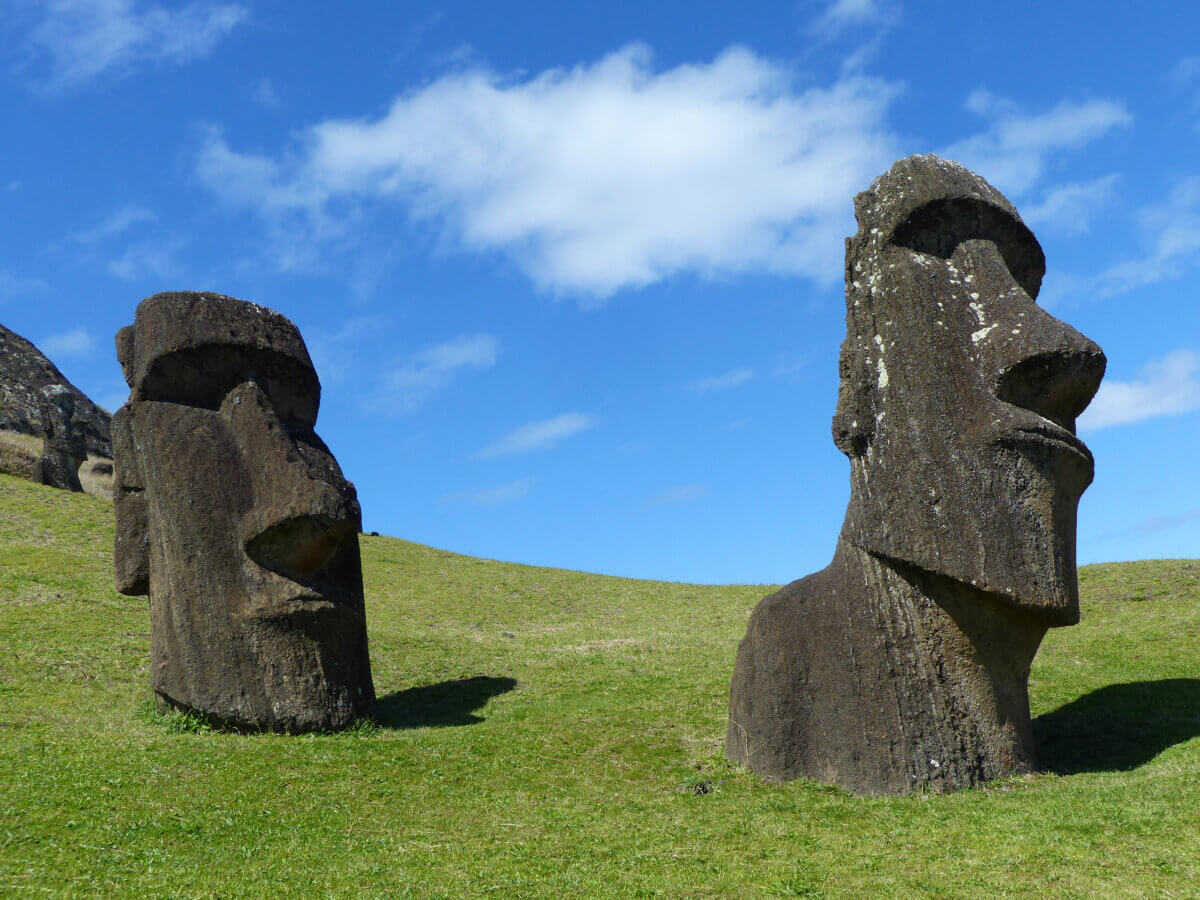
Moai statues under a blue sky at Rano Raraku on Easter Island. (Photo by Aeonian Photography on Shutterstock)
In A Nutshell
- Researchers used 11,686 drone photos to create the first complete 3D map of Easter Island’s main statue quarry, revealing 30 separate workshop areas where small family groups carved moai independently
- Each clan-sized team of 15-25 people had their own workspace and used different carving techniques, yet somehow all produced statues with the same distinctive style
- The evidence shows no central authority controlled production—multiple groups worked simultaneously without a boss coordinating efforts, challenging assumptions that massive monuments require kings or centralized governments
- Small teams could handle the entire process: experiments show 15-50 people could “walk” even the largest statues across the island, and just 15 could place the massive stone “hats” on top
Easter Island’s famous stone heads have puzzled researchers for decades, but not for the reasons most people think. The real mystery wasn’t how ancient Polynesians carved and moved these massive sculptures across a remote Pacific island. Instead, scientists have long pondered how a society with no clear island-wide government managed to produce more than 1,000 giant statues.
Now, research using drone technology and 3D modeling has answered that question by mapping the primary quarry where these statues, called moai, were carved. Multiple small groups, likely family clans of around 15 to 25 people each, worked simultaneously in separate areas of the quarry without any boss coordinating their efforts. Each group had its own workspace, used different carving techniques, and operated independently while somehow maintaining a shared artistic vision.
The study, published in PLOS ONE, upends assumptions about what it takes to build monuments. Researchers had long debated whether Easter Island, known locally as Rapa Nui, was ruled by a centralized authority that controlled statue production. After all, coordinating the creation of over 1,000 multi-ton sculptures sounds like it would require serious organizational muscle.
The evidence points to something more interesting: a decentralized network of semi-autonomous communities that competed while cooperating, maintained distinct identities while sharing cultural practices, and built monuments without building a bureaucracy.

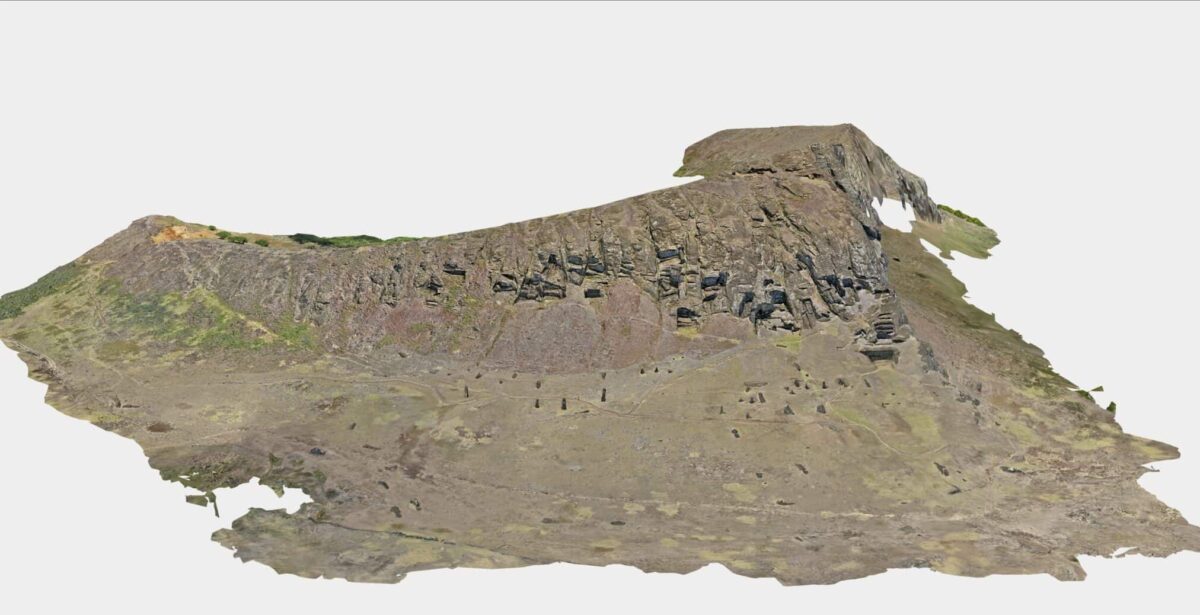
areas. (Credit: ArcGIS)
11,000 Drone Photos Reveal Hidden Patterns
Researchers from Binghamton University and the University of Arizona spent months flying drones over Rano Raraku, the volcanic crater that served as Easter Island’s primary statue factory. They captured 11,686 photographs and used software to stitch them into the first comprehensive 3D model of the quarry.
The level of detail was extraordinary. The model captured individual chisel marks, unfinished statues still attached to bedrock, and even the exact angles at which carvers approached the volcanic rock. This allowed researchers to see patterns that traditional ground surveys had missed.
The analysis revealed 426 moai in various stages of completion, 341 trenches cut to outline blocks for carving, and 133 empty spaces where statues had been successfully removed. More crucially, it showed 30 distinct workshop areas distributed across the crater, each separated by unworked bedrock or natural boundaries.
Each workshop contained the full toolkit of production features: trenches, partially carved statues, and the voids left by completed figures. This redundancy is telling. If production had been centrally organized, researchers would expect to see specialized areas, some for roughing out shapes and others for detailed work. Instead, each zone functioned as a complete, self-contained operation.

Competing Clans Used Different Carving Methods
The carvers didn’t even use standardized techniques. Researchers identified at least three distinct approaches to quarrying. The most common method, found in 143 cases, involved carving facial details first before outlining the head and body. In 120 instances, workers cut complete outlines of rectangular blocks before adding any decorative details. Five statues were carved sideways into near-vertical cliff faces, a completely different approach dictated by local geology.
The variation shows that different groups adapted to their specific locations in the quarry rather than following instructions from a central authority. Yet despite these technical differences, the statues themselves remained remarkably uniform in style. All featured the characteristic elongated heads, pronounced brows, and straight backs that define Rapa Nui’s aesthetic.
This combination of technical diversity and stylistic consistency points to information sharing between independent groups. Families or clans apparently communicated about artistic standards while maintaining autonomy over production methods.
The physical constraints of the workshops also reveal the scale of operations. Each workspace could accommodate perhaps four to six active carvers at a time, with another 10 to 20 people supporting them by making tools, preparing ropes, or providing food. These are kin-group numbers, not the massive labor forces that centralized projects would require.
Previous experiments have shown that teams of 15 to 50 people could “walk” even the largest moai across the island using ropes and coordinated rocking motions. Placing the cylindrical red stone “hats” atop finished statues required only about 15 people. The entire production chain, from quarrying to transport to final installation, operated at a scale consistent with extended family groups rather than island-wide mobilization.
How Competition Fueled Easter Island’s Monument Building
This decentralized pattern matches other recent findings about Easter Island’s social organization. Analysis of settlement patterns shows spatially discrete communities with their own ceremonial platforms and redundant architectural features. Studies of obsidian tools reveal highly localized material culture with limited sharing between communities. Road systems radiating from the quarry follow separate paths rather than forming an integrated network.
Historical accounts from the island’s first European visitors consistently described a society organized into competing mata, or clans, each with its own territory and chiefs. These clans maintained distinct identities and sometimes fought, but they also shared a common culture and language. The quarry evidence now extends this pattern to the island’s most labor-intensive and symbolically important activity.
Competition between clans could be fierce. While the spiritual and cultural significance of moai remained central, competition over status and resources likely fed into the statue building as groups sought to demonstrate their clan’s prestige through larger and more numerous monuments.
The research team notes that this decentralized system may have offered advantages beyond simply getting statues carved. Shared control over the quarry may have helped prevent any one group from monopolizing this resource or overusing the volcanic stone. Allowing multiple groups to develop their own techniques enabled flexible responses to geological challenges.
The finding has broader reach for understanding how societies build monumental architecture. The assumption that pyramids, cathedrals, or giant statues require kings, pharaohs, or centralized states turns out to be just that: an assumption. Rapa Nui demonstrates that communities can coordinate complex projects through horizontal social networks rather than vertical chains of command.
The study also provides a baseline for heritage management. The comprehensive 3D model documents the quarry’s current condition in unprecedented detail, creating a reference point for monitoring erosion, climate impacts, and tourism effects on this UNESCO World Heritage site. The publicly accessible model enables future researchers to test new hypotheses without conducting their own field surveys.
Easter Island’s statues have long symbolized both human ambition and environmental limits. The new findings add another layer. Monumentality doesn’t require monarchy, coordination can emerge from cooperation rather than coercion, and some of history’s most impressive achievements may have been bottom-up efforts rather than top-down projects.
Paper Notes
Study Limitations
Based on the methods described in the paper, some natural limits of this work include the following: The research focused on spatial analysis and production features visible in the 3D model. While this approach revealed organizational patterns, it cannot determine the precise chronology of different workshop areas or establish absolute dates for when specific groups worked in the quarry. The study also could not directly observe tool marks or micro-features that would require hands-on examination of individual statues. The analysis relied on features visible on the surface and could not account for potentially important subsurface archaeological deposits. The interpretation of workshop boundaries as clan territories, while consistent with ethnographic evidence, remains a hypothesis. Future research directions like DNA analysis of skeletal remains or geochemical sourcing of tools from different workshop areas could help test these interpretations.
Funding and Disclosures
The research was funded by National Science Foundation grant number 2218602. The study was conducted at the request of and authorized by the Rapa Nui Comunidad Indígena Ma’u Henua. The authors declare no competing financial interests. All necessary permits were obtained for the research, which complied with relevant regulations. ESRI Customer Support provided technical assistance with the 3D modeling software.
Publication Details
The study, “Megalithic statue (moai) production on Rapa Nui (Easter Island, Chile),” was authored by Carl Philipp Lipo (Department of Anthropology, Binghamton University), Terry L. Hunt (School of Anthropology, University of Arizona), Gina Pakarati (Hanga Roa, Rapa Nui, Chile), Thomas Pingel (Department of Geography, Binghamton University), Noah Simmons, Kevin Heard, Laryssa Shipley, Caroline Keller, and Colin Omilanowski. The paper was published in PLOS ONE on November 26, 2025. The digital object identifier (DOI) is 10.1371/journal.pone.0336251. The research was peer-reviewed, with reviewer comments and author responses published alongside the article following PLOS ONE’s open peer review policy. All feature data and the 3D model are publicly available on Zenodo at https://doi.org/10.5281/zenodo.17095895, and an interactive version of the model is available at https://arcg.is/qu59O1.


