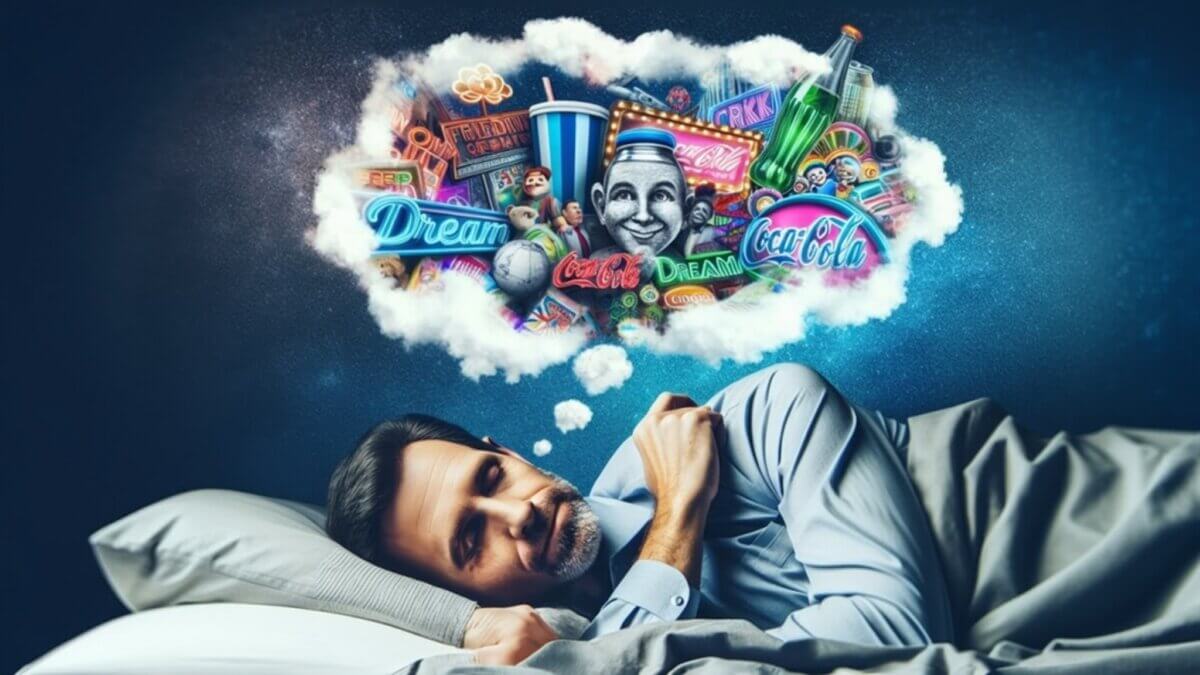
Dreaming of ads

(Image by Shutterstock AI Generator)

Shocking new survey reveals 54% of young Americans report ads infiltrating their dreams

LONDON — Remember when sleep offered an escape from endless advertising? That era may be ending. While U.S. citizens already face up to 4,000 advertisements daily in their waking hours, research suggests that even our dreams are no longer safe from commercial messaging. A new study reveals that 54% of young Americans report experiencing dreams influenced by ads—and some companies might be doing it intentionally.

The findings come at a critical time, as the American Marketing Association previously reported that 77% of companies surveyed in 2021 expressed intentions to experiment with “dream ads” by this year. What was once considered science fiction may now be becoming reality, with major implications for consumer protection and marketing ethics.

According to The Media Image’s newly released consumer survey focusing on Gen Z and Millennials, 54% of Americans aged 18-35 report having experienced dreams that appeared to be influenced by advertisements or contained ad-like content. Even more striking, 61% of respondents report having such dreams within the past year, with 38% experiencing them regularly—ranging from daily occurrences to monthly episodes.

Conducted by Survey Monkey on behalf of The Media Image between January 2nd and 3rd, 2025, the research included a representative sample of 1,101 American respondents aged 18-35. While the sample skewed slightly female (62%), the findings are considered reflective of broader perspectives within this age group.

Boy holding a teddy bear in a dream
The fun of having wildly imaginative dreams may become corroded by dream-based maketing, a new survey suggests. (© Sergey Nivens – stock.adobe.com)

The data shows a striking pattern: 22% of respondents experience ad-like content in their dreams between once a week to daily, while another 17% report such occurrences between once a month to every couple of months.

The phenomenon isn’t merely passive. The survey reveals that these dream-based advertisements may be influencing consumer behavior in tangible ways. While two-thirds of consumers (66%) report resistance to making purchases based on their dreams, the other third admit that their dreams have encouraged them to buy products or services over the past year—a conversion rate that rivals or exceeds many traditional advertising campaigns.

The presence of major brands in dreams appears to be particularly prevalent, with 48% of young Americans reporting encounters with well-known companies such as Coca-Cola, Apple, or McDonald’s during their sleep. Harvard experts suggest this may be due to memory “reactivation” during sleep, where frequent exposure to brands in daily life increases their likelihood of appearing in dreams.

Perhaps most troubling is the apparent willingness of many consumers to accept this new frontier of advertising. The survey found that 41% of respondents would be open to seeing ads in their dreams if it meant receiving discounts on products or services. This raises serious ethical questions about the commercialization of human consciousness and the potential exploitation of vulnerable mental states for marketing purposes.

Woman screaming from bad dream or nightmare
Seeing and hearing annoying ad jingles in our heads could be a nightmare for many. (© Prostock-studio – stock.adobe.com)

Despite these concerns, there appears to be limited interest in protecting dreams from commercial influence. Over two-thirds of respondents (68%) indicated they would not be willing to pay to keep their dreams ad-free, even if such technology existed. However, a significant minority (32%) expressed interest in a hypothetical “dream-ad blocker,” suggesting growing awareness and concern about this issue among some consumers.

The research comes in the wake of dream researchers issuing an open letter warning the public about corporate attempts to infiltrate dreams with advertisements, sparked by Coors Light’s experimental campaign that achieved notable success. This confluence of corporate interest and technological capability raises serious questions about the future of personal privacy and mental autonomy.

The potential manipulation of dreams for advertising purposes raises serious concerns about psychological well-being and the need for protective regulations. As companies explore ways to influence our subconscious minds, the lack of existing safeguards becomes increasingly problematic.

Man sleeping happily
Nearly a third of respondents would consider paying for an ad blocker that kept their dreams marketer-free. (Photo by Unsplash+ In collaboration with Sir Manuel)

These results emerge against a backdrop of increasing advertising saturation in daily life. Current estimates suggest that U.S. citizens are exposed to up to 4,000 advertisements daily, making sleep one of the last remaining refuges from commercial messaging. The potential erosion of this final sanctuary raises important questions about consumer rights and mental well-being in an increasingly commercialized world.

The research presents a clear warning: without immediate attention to the ethical and regulatory challenges of dream-based advertising, we risk losing the last advertisement-free space in modern life. As companies develop new technologies to influence our dreams, the choice between consumer protection and commercial interests becomes increasingly pressing.

Methodology

The research was conducted through a comprehensive survey commissioned by The Media Image, a specialist digital marketing agency, and carried out by Survey Monkey. The study took place between January 2nd and 3rd, 2025, gathering responses from 1,101 American participants aged 18-35. This age range was specifically chosen to focus on Gen Z and Millennials, demographics that represent core target audiences for many brands and marketers. While the survey sample had a higher representation of female respondents (62%), the findings are considered representative of broader perspectives within the 18-35 age group. All statistical percentages were rounded to the nearest whole number for clarity of reporting.

About StudyFinds Analysis

Called "brilliant," "fantastic," and "spot on" by scientists and researchers, our acclaimed StudyFinds Analysis articles are created using an exclusive AI-based model with complete human oversight by the StudyFinds Editorial Team. For these articles, we use an unparalleled LLM process across multiple systems to analyze entire journal papers, extract data, and create accurate, accessible content. Our writing and editing team proofreads and polishes each and every article before publishing. With recent studies showing that artificial intelligence can interpret scientific research as well as (or even better) than field experts and specialists, StudyFinds was among the earliest to adopt and test this technology before approving its widespread use on our site. We stand by our practice and continuously update our processes to ensure the very highest level of accuracy. Read our AI Policy (link below) for more information.

Our Editorial Process

StudyFinds publishes digestible, agenda-free, transparent research summaries that are intended to inform the reader as well as stir civil, educated debate. We do not agree nor disagree with any of the studies we post, rather, we encourage our readers to debate the veracity of the findings themselves. All articles published on StudyFinds are vetted by our editors prior to publication and include links back to the source or corresponding journal article, if possible.

Our Editorial Team

Steve Fink

Editor-in-Chief

John Anderer

Associate Editor

Leave a Reply

8 Comments

  1. K. Taylor says:

    I am a victim too. I have been suffering from this since late 2021. I thought I was going crazy until now. These people have wrecked my physical and mental health, my life is in shambles because of all the mental health issues this has caused!

    I never asked nor agreed to this. This needs to END NOW. As others have said, this is an invasion of our private lives and minds. We should not have to pay for this to stop, the people who want to receive this are the ones who should pay for it (or get paid, whatever).

    In Canada, this is against the CanSpam act, therefore, these people ARE CRIMINALS. I would like to see a class action lawsuit and all the people responsible for this “brain hijacking” to rot in jail for a very long time. If there is any lawyer reading this, I think there is an opportunity here for you.

    Their pathetic excuse that we are seeing what we’ve been exposed to during the day doesn’t fly with me because I don’t use social media, don’t watch TV, etc. I have had my brain hijacked many times without any connection whatsoever to what I have done during the day. Now I know that my brain wasn’t making stuff up.

    In fact, before 2021, it was very easy for me to interpret my dreams, have lucid dreaming, control my subconscious, etc. Since then, they’ve slowly encroached and managed to find ways to control my mental state (how awake I am) and to use my brain for whatever they want (remote viewing, computer processing, deciphering languages, trying to gage my reaction to some political issue which I had no clue because I don’t follow the news, and many, many other things). I consider this as RAPE and I can’t wait to see these people arrested. Even if they are not arrested, I know they will burn in hell forever.

    Even if they came clean and apologized and made amends ($ compensation for physical and psychological damages) this would never bring back the years of lost sleep, trauma, mental health damage, etc. This is real. They are destroying people’s lives.

    I’ve tried to boycott all the companies involved as much as possible (most of them I had already quit buying their products decades ago anyway), but now I will make an even more conscious effort of boycotting/speaking against. For reference, here are some of them that I remember, so that anyone reading this can also boycott them: Home Depot, Bell, L’Occitane, Ontario government custom license plate (yes, these jerks have tried to sell even this nonsense in our dreams), Big Pharma, cigarettes, cigars, Coca-Cola, Pepsi, McDonald’s, Pizza Hut, Tim Hortons. These are the ones I can think off the top of my head.

  2. Chad smith says:

    Beleave me, I’m a victim of remote neural monitoring and these criminal police pigs can already manipulate your dreams in any way they want , who is in them , where your at, what your doing, good dreams, nightmares with feeling and fear included, ECT, this is real and this is our future, no way to prepare, no way to stop it, buckle up

  3. ROBERTO says:

    Where do I sign up? And why has this pay-to-sleep not been offered to the homeless? More info please.

  4. RJC says:

    We should not have to pay for dream ad blocking to protect our consciousness from advertisers, law enforcement or the government or anyone. We have a right to our consciousness. Any infiltration of this kind should be assault and illegal.

  5. Zazu says:

    I have a simple approach to invasive advertising. If you use invasive advertising, i.e. force me to watch an ad that I can’t skip in a video or streaming event, OR call/text me uninvited trying to sale me a product or service, then I will actively boycott that product or service. Also for uninvited calls or texts, expect an extremely rude response.

  6. Daniel Peterson says:

    Looks like a hoax article.

    1. Ddd says:

      Or yet another way for people to ignore accountability for their own decisions.

    2. Alfred E. Neuman says:

      Yup. Kinda leaps over a few Nobels that would have been awarded by now.