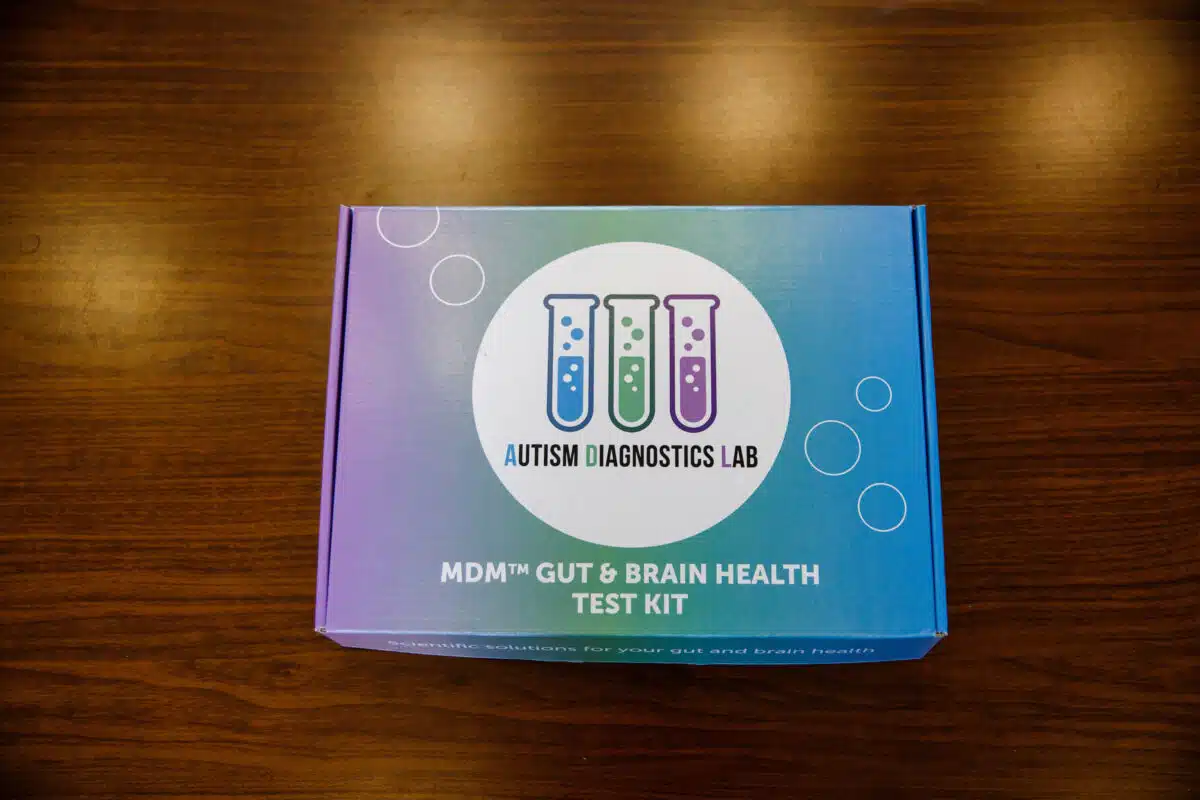
New urine test provides a simple way to screen for autism in children. (ASU Knowledge Enterprise/Andy DeLisle)
In A Nutshell
- A new pilot study found that a urine test correctly identified 90% of children with autism by detecting abnormally high levels of gut-produced chemicals not found in healthy children.
- Researchers hypothesize these chemicals, produced by bacteria and yeast in the gut, may disrupt brain development by interfering with key neurotransmitters like serotonin and dopamine.
- Current autism assessments don’t typically begin until nearly age four; a urine-based screen could potentially flag children as young as two, during a more critical window for early intervention.
- The findings are promising but come from a small pilot cohort, and several authors have financial ties to the testing lab, making independent replication essential before the test can be widely used.
For parents worried about their child’s development, the wait for an autism diagnosis can feel endless. In the United States, the average age when a child first gets assessed is nearly four years old, but research shows the earlier treatment begins, the better the outcomes. Now, a new multi-site study suggests a simple urine test may screen for autism in children as young as two, by detecting chemical byproducts from bacteria and microbes in the gut.
Published in Molecular Psychiatry, the study found that roughly 8 to 9 out of 10 children with autism in this pilot cohort had unusually high levels of at least one of these gut-produced chemicals. The same chemicals were largely absent among all of the healthy children tested. Researchers hypothesize these chemicals may affect brain development by traveling through what scientists call the gut-brain axis, the connection between the digestive system and the brain. The study does not prove these chemicals cause autism.
Still, the findings raise the possibility that most children with autism in this cohort share a distinct biological fingerprint detectable in a urine sample, one that could help identify children needing evaluation long before a formal behavioral diagnosis is made.
Gut Chemicals and Autism: What the Research Found
Every person carries trillions of bacteria, fungi, and other microbes in their gut. Under healthy conditions, these microbes help with digestion and support the immune system. But when the balance goes wrong, harmful chemical byproducts can build up.
Prior research flagged several of these byproducts as appearing at higher levels in children with autism. One, called p-cresol sulfate, showed up elevated in 17 out of 17 separate studies across six countries. Another, indoxyl sulfate, has been found elevated in 6 out of 6 studies. Animal research has shown that administering p-cresol directly causes autism-like symptoms, and that restoring a healthy gut microbiome reverses those symptoms.
Rather than examining just one or two chemicals in isolation, the research team developed a scoring system that evaluates dozens together, producing a single score indicating whether a child’s levels fall outside the normal range for healthy children.

How the Urine Autism Screening Test Was Built and Tested
Researchers recruited 52 children with autism and 47 healthy, typically developing children between ages 2 and 11 from four U.S. sites: Arizona, Texas, Tennessee, and Massachusetts. All children with autism had a confirmed clinical diagnosis, verified using established autism rating tools. Healthy children were screened for autism signs.
Urine samples, mostly collected first thing in the morning, were stored frozen and shipped to laboratories. A broad initial scan identified more than 600 compounds that differed between the two groups. A more targeted phase then confirmed specific chemicals and measured their exact concentrations, verified by an independent laboratory.
Urine Test Correctly Flagged 90% of Children with Autism in Pilot Study
Chemicals detected fell into three main categories: those tied to protein breakdown, those connected to a building block of protein called tryptophan, and those produced by yeast. Tryptophan-related chemicals are thought to interfere with serotonin and melatonin, brain chemicals involved in mood, sleep, and social behavior. Protein-breakdown chemicals may disrupt dopamine, tied to motivation and reward. Yeast-related chemicals point to fungal overgrowth in the gut.
In the initial broad scan of 50 children with autism and 47 healthy children, 45 of the 50 with autism, or 90%, had at least one gut-produced chemical at a level higher than any of the healthy children, sometimes 100 to 1,000 times higher. All 47 healthy children had zero chemicals above that threshold.
A targeted confirmation phase found 78% accuracy, a somewhat lower rate the authors attribute partly to unavailable reference standards for some chemicals. No false positives appeared among healthy children under either approach.
Five children with autism showed no elevated chemical levels. Closer examination revealed four appeared to have separate underlying metabolic conditions, rare inherited disorders affecting protein processing, that may have contributed to their autism symptoms through a different pathway.
Based on their findings, researchers propose a new autism subtype defined not by behavior alone but by measurable biological markers in urine. They suggest this subtype may account for roughly 90% of children with autism, though that figure comes from this single pilot cohort and requires confirmation in larger, independent studies.
It’s worth noting that several authors hold patents related to ASD diagnosis and co-own Analutos, the laboratory that performed the targeted measurements and also provided funding. A replication study is underway, and that outside validation will matter.
On the treatment side, the gut connection opens an intriguing door. Microbiota Transfer Therapy, a procedure that restores a healthier microbial community in the gut, was found in prior research to substantially reduce p-cresol sulfate levels while also improving autism-related symptoms. Researchers point to this as a direction worth pursuing, though gut treatments are not established autism therapies and families should not try microbiome interventions without medical guidance.
A urine-based screening tool that could flag children as young as two would be a significant development. This study is a promising first step, but independent replication will be what turns that promise into something families and pediatricians can actually use.
Disclaimer: This article is based on a single pilot study and is intended for informational purposes only. The urine screening test described has not been independently replicated or approved as a clinical diagnostic tool. Parents concerned about their child’s development should consult a qualified healthcare professional.
Paper Notes
Limitations
The authors are transparent about several important limitations. The study excluded children with known single-gene disorders such as Fragile X syndrome, so it is unclear how common elevated metabolite levels are in those populations. The sample, 52 children with autism and 47 healthy children, is described by the authors as a pilot study appropriate for proof-of-concept purposes, and a larger independent replication cohort is needed before the findings can be generalized more broadly. Data on diet, medication use, and body mass index were not collected. Not all commercially available reference standards existed for every chemical the team wanted to measure precisely, which reduced the sensitivity of the targeted confirmation phase. The authors also note that the microbiome changes substantially in very young children transitioning from breast milk or formula to solid foods, which may limit how early the test could be reliably used, and that new reference ranges may be needed for children under age two. For some of the metabolites detected, whether or not they contribute to autism symptoms at high concentrations remains unknown.
Funding and Disclosures
Funding was provided by the Catalyst program at Arizona State University, the Zoowalk for Autism Research, Analutos, a private donor, James Adams, a Fulton Fellowship from Arizona State University, the Integrated Mass Spectrometry Shared Resource supported by the National Cancer Institute of the NIH under grant number P30CA033572, the Robert Luft Foundation, and the Biodesign Center for Health Through Microbiomes. Several authors report significant competing interests: James B. Adams, Christina K. Flynn, Rosa Krajmalnik-Brown, Juergen Hahn, Paul Whiteley, and Kevin Carr have patents or pending patents related to ASD diagnosis. Adams and Krajmalnik-Brown are co-founders of both Autism Diagnostics LLC and Gut-Brain-Axis Therapeutics Inc. Adams is also founder of Autism Diagnostics Lab Inc. Whiteley and Carr are co-owners of Analutos, the laboratory that performed the targeted quantitative measurements and also provided funding for the study.
Publication Details
Paper Title: Elevated microbially-derived metabolites in autism: a possible diagnostic screening test for a distinct ASD phenotype | Authors: Christina K. Flynn, Kevin Carr, Paul Whiteley, Khemlal Nirmalkar, Andrew Bellinghiere, Juergen Hahn, Hongbin Liu, Halil Arici, Laura Hewitson, Morgan Devlin, Elena L. Pollard, Khyatiben V. Pathak, Krystine Garcia Mansfield, Anakaren Rosales Torres, Patrick Pirrotte, Daniel B. Kalb, Rebekah Keen, Victoria Kenyon, Alessio Fasano, Rosa Krajmalnik-Brown, James B. Adams, and Sarah Kadzielski | Journal: Molecular Psychiatry | DOI: https://doi.org/10.1038/s41380-026-03620-5 | Received: September 17, 2025 | Revised: March 26, 2026 | Accepted: April 9, 2026


