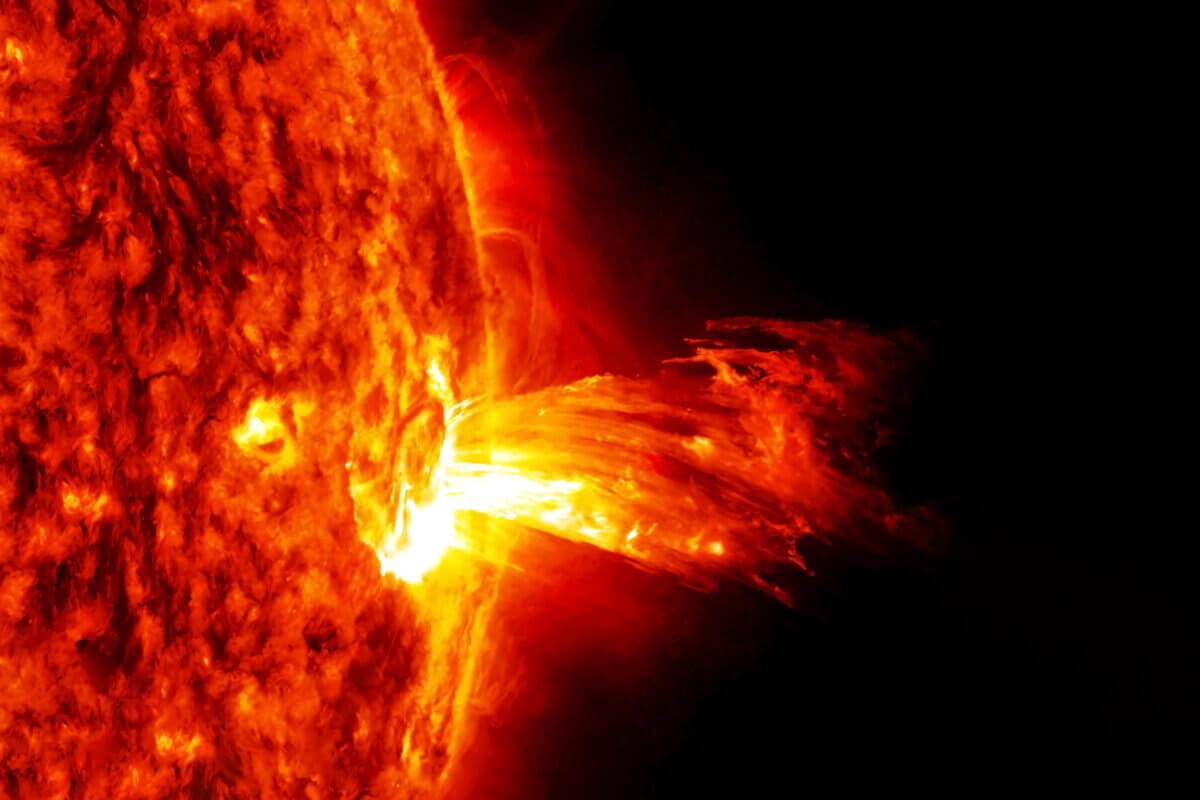
Depiction of a solar storm erupting from Sun's surface. Elements of this image furnished by NASA.(Image by Artsiom P on Shutterstock)
67 Years of Data Suggest Solar Storms Play Key Role in Earth’s Weather
In a Nutshell
- Strong geomagnetic storms appear to suppress rain and snow across wide regions of North America, especially during winter.
- Storm-linked weather swings ran as much as 100 times larger than the sun’s long-term effect on global average temperature, though the two are different measures and not directly comparable.
- Results argue against a popular theory that cosmic rays seed clouds and drive climate, pointing instead toward a mechanism in the upper atmosphere.
Sunlight and warmth are not the only things the sun sends toward Earth. It also hurls massive bursts of energy into space, and those bursts can rattle the planet’s magnetic field. According to a study, that disturbance appears to affect weather on the ground far more than scientists had expected.
Joachim Raeder, professor emeritus of physics at the University of New Hampshire, analyzed 67 years of atmospheric and solar storm data. He found that geomagnetic storms, the disturbances in Earth’s magnetic field set off by solar activity, appear to be linked to measurable changes in temperature, air pressure, wind speed, precipitation, and the amount of sunlight reaching the ground across North America. Those changes turned out to be large. Storm-related weather effects ran up to 100 times bigger than what scientists had previously attributed to the sun’s influence on global average surface temperature over a full 11-year solar cycle, though that comparison is meant only to illustrate scale: the two reflect different kinds of solar influence and are not measures of the same thing.
The study, published in Geophysical Review Letters, shows that effects also shift with the season and the region. What a geomagnetic storm does to winter weather over the western United States can look nothing like what it does over the central part of the continent in summer. That patchwork of regional and seasonal variation may be exactly why the sun’s influence on weather has been so hard to pin down, and so easy to miss.
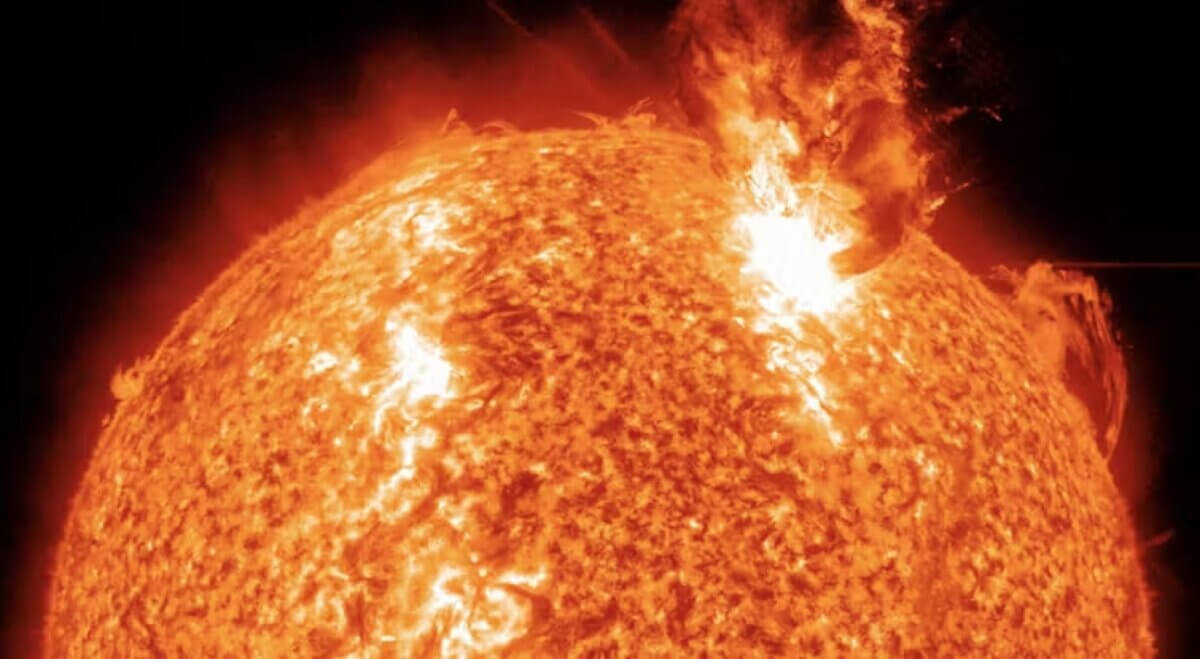
Six Decades of Geomagnetic Storm Data, Mapped
To carry out the work, Raeder paired a well-established index that tracks geomagnetic storm intensity with ERA5, a high-quality dataset that reconstructs past weather across the globe. His analysis covered North America, reaching from the tropics to the high Arctic and from the Atlantic coast deep into the Pacific.
Storms were sorted by strength, from mild disturbances up to the most intense events. For each category, Raeder mapped how five weather measures — temperature, air pressure, wind speed, precipitation, and surface sunlight — strayed from normal conditions, broken down by season.
Results came back consistent and organized. Even during moderately strong storms, departures from normal reached or exceeded 50% of the typical range for those measurements. Those patterns were not random noise scattered across the map. They formed large-scale, organized shifts that lined up with geographic features such as Hudson Bay and the mountain ranges of the western United States.
As storm intensity climbed, so did the size of the disruptions. During the strongest storms, winter temperature swings reached roughly 20 degrees Celsius, and the affected areas grew much wider. To test whether these patterns might be statistical accidents, Raeder ran the same analysis on randomly chosen hours when no storms were happening. That test produced essentially no comparable signal, which strengthens the case that the storm-linked patterns are unlikely to be a statistical artifact.
Geomagnetic Storms and a Surprising Drop in Rainfall
One of the most consistent findings involved precipitation, and its direction runs against what many people would guess. Rather than storms bringing more rain or snow, the data pointed the other way. During the strongest geomagnetic storms in winter, precipitation fell across much of the North American study area, though the size of the drop varied by region and season. A similar decline showed up in summer, though it was weaker.
That result runs against one of the longest-standing theories about how the sun might shape weather. According to that idea, energetic particles streaming in from deep space help seed cloud formation, so when solar activity rises, it blocks those particles, thins the clouds, and shifts precipitation patterns. If the theory held, stronger solar storms would be expected to let more sunlight reach the surface. That is not what the data showed.
Raeder’s analysis concluded that the results argue strongly against this hypothesis. Precipitation dropped even during smaller storms that would not produce the particle changes the theory requires. Patterns of surface sunlight also failed to match what a cloud-based mechanism would predict.

Tracing the Weather Effects to the Upper Atmosphere
If cosmic rays seeding clouds are not the cause, then what is? Raeder’s analysis points toward a top-down process, one in which solar storm energy first disturbs the upper atmosphere and those changes then ripple downward into the lower atmosphere where daily weather forms, though the study notes that the specific physical pathways have not yet been fully confirmed.
Two pathways look most plausible. One runs through the ionosphere, the electrically charged layer of the upper atmosphere that geomagnetic storms are known to disturb directly. Another runs through the polar vortex, the large rotating mass of cold air high above the poles that strongly shapes winter weather across the Northern Hemisphere. Disruptions to the polar vortex, the study argues, could carry a solar storm’s energy downward into the part of the atmosphere where daily life happens.
Seasonal timing in the data backs this up. Storm effects were strongest in Northern Hemisphere winter, exactly when the polar vortex is most active. In summer they largely faded, and the storm signals in the data weakened along with them.
Results also point to a possible gap in current weather and climate models. As the study suggests, these effects may not yet be fully captured in the models scientists use to simulate atmospheric conditions. Getting that right could matter not just for day-to-day forecasting, but for more accurately accounting for natural influences on climate over longer stretches of time.
For more than a century, the sun’s 11-year activity cycle has been loosely tied to shifts in temperature and rainfall around the world, yet scientists have struggled to explain how such a small change in solar output could meaningfully move Earth’s weather. Raeder’s work raises a different possibility: that the answer may not lie in that slow cycle at all, but in the short, sharp jolts of individual geomagnetic storms, which appear to hit harder and faster than earlier solar-weather research had recognized.
Paper Notes
Limitations
The study is restricted to North America because of computational constraints, and the author acknowledges that the atmospheric reanalysis data used is best validated over continental land areas. The storm index used, known as the Dst index, has documented limitations as a measure of geomagnetic storm intensity. While the statistical analysis included a null hypothesis test that showed no false signal from randomly selected time periods, the study cannot yet fully confirm or rule out the specific physical mechanisms connecting solar storms to the observed weather changes. The author also notes that the relationship between solar flares and geomagnetic storms is not always straightforward, which complicates efforts to separate their individual contributions. Further work, including extending the analysis globally and examining individual major storm events and time-delay effects, is identified as a priority.
Funding and Disclosures
The paper’s acknowledgments thank Dr. Patrick Zippenfenig for help accessing atmospheric data and Dr. Janet Green for discussions that helped clarify the role of the Russell-McPherron effect. The author declares no conflicts of interest relevant to the study. No external funding sources are listed in the paper.
Publication Details
Author: Joachim Raeder, Department of Physics and Astronomy & Space Science Center, University of New Hampshire, Durham, NH, USA Title: “Regional and Seasonal Effects of Geomagnetic Storms on Terrestrial Weather” Journal: Geophysical Research Letters, Vol. 53 (2026), article e2025GL121097 DOI: 10.1029/2025GL121097


