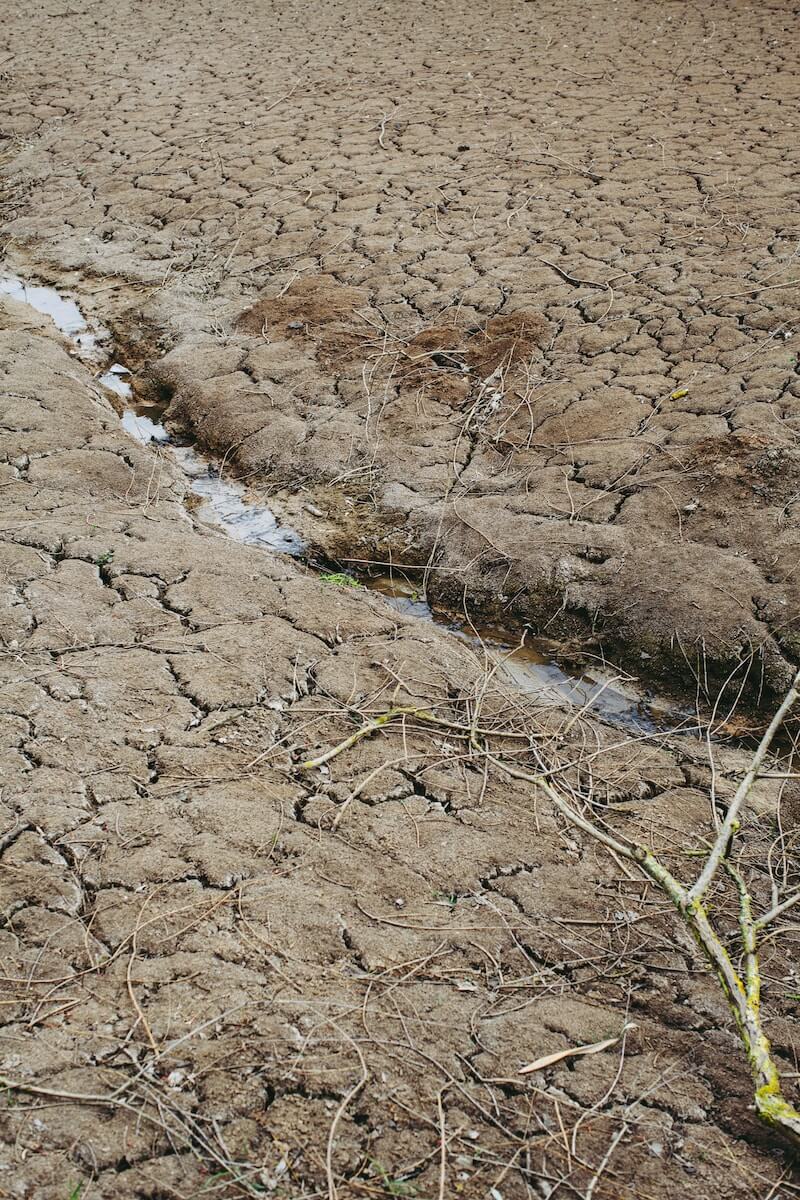
(Credit: Photo by Markus Spiske from Unsplash)
In a Nutshell
- Before Polynesian peoples expanded eastward, the western islands they were leaving behind experienced some of the worst droughts in these mud records over the past 1,500 years.
- Eastern Pacific islands where settlers landed appear to have turned wetter around the time of arrival, which may have helped early communities take hold.
- Computer models, which the authors describe as “simplified constructs of complex systems,” suggest that as island populations grew, prolonged droughts could have increasingly pushed people to leave.
For thousands of years, people settled the western Pacific on islands like Samoa and Tonga, then stopped short of the open ocean to the east. Sometime around 900 to 1250 CE, that hesitation ended. Within a few centuries, Polynesian peoples had spread across an enormous stretch of the Pacific, reaching Hawaii, New Zealand, and Easter Island. A new study argues that one reason may have been surprisingly basic: the islands they were leaving behind were running dry.
Researchers who examined ancient climate records locked in lake and swamp mud across the tropical South Pacific found that a shift in rainfall came just before and during the period when Polynesian peoples moved rapidly east. Islands people were leaving behind were getting drier, sharply so in some cases, while islands to the east seem to have turned wetter around the time settlers arrived. The team calls the timing a strong and consistent pattern, while cautioning that overlapping dates alone cannot prove one thing caused the other.
Published in the Journal of Pacific Archaeology, the study pulls together rainfall records from several island sites, along with computer models of island life, and weighs them against the best available dates for when humans first reached eastern Pacific islands. A picture emerges of populations nudged eastward by a mix of forces, with a changing climate among the largest.
How Scientists Read a Thousand Years of Pacific Rainfall
To reconstruct the climate of a thousand years ago, the research team pulled cylinders of ancient mud from the bottoms of lakes and swamps across the Pacific islands. These sediments work like a slow-motion recorder, trapping chemical clues from rainfall, plants, and runoff year after year as they pile up. By reading the chemistry of each layer, scientists can estimate how wet or dry things were at different points in time.
Two chemical clues did most of the work. One comes from the waxy coating on plant leaves, which takes in hydrogen from rainwater in a way that reflects how much rain fell. The other comes from tiny algae in lakes, which record a similar signal from the surrounding water. Together, they let the team track rainfall for roughly 2,000 years.
To account for natural uncertainty in both the chemistry and the dating, researchers ran thousands of computer simulations, each nudging the inputs within known margins of error. The result is not a single line on a graph but a range of probabilities, a more honest read of what the evidence actually shows.

A Pacific-Wide Dry Spell Before the Polynesian Migration
What the mud revealed across sites spanning the South Pacific was a broad dry stretch centered roughly between 800 and 1050 CE. That window lines up closely with the earliest confirmed dates of human arrival on eastern Pacific islands. Drawing on 64 carefully vetted archaeological samples, the study puts the median date of that first settlement wave at about 1074 CE.
In the islands to the southwest, including sites tied to Samoa, Vanuatu, and Uvea, the drought ran deep. Rainfall drops during this stretch were the largest seen in those site records over roughly the past 1,500 years, larger than anything the natural wet-and-dry climate cycles, such as El Niño, would normally produce.
Just as telling were the sudden swings the researchers call “shocks,” rapid flips from wet to dry. These were not slow, grinding droughts but abrupt lurches in rainfall that would have hit communities relying on steady water and crops like taro. The largest of these swings landed around 900 CE, right before the main move east began.
Records from the eastern islands, in the Cook Islands, Society Islands, and Marquesas, tell a different story. Those areas appear to have turned wetter on average around the time people arrived, with fewer sharp swings. According to the authors, the wetter eastern climate could have helped small founding groups establish themselves on new islands.
Too Many People, Too Little Rain
Climate data alone cannot explain why people did what they did, and the researchers do not claim it does. But pairing the rainfall records with computer models of how populations cope with food and water stress made the link look stronger.
One model, built around a type of island common in the Cook Islands, examined what happens to a growing community when drought strikes. Populations above roughly 100 people per square kilometer were far more vulnerable to severe or prolonged dry spells. Below that level, communities could usually adapt by storing food, adjusting how they farmed, or leaning more on fishing. Above it, options ran out fast. Several islands, according to the study’s population figures, may have been near or above those levels.
Oral tradition fits the same pattern. One account from Atiu, one of the Cook Islands, describes the first people to arrive as having been driven from their homeland by a “scarcity of land,” a detail that, while not scientific proof, aligns with the broader story told by the climate data.

What Pushed the Polynesian Migration East
Blaming drought by itself is something the study avoids. Instead, it casts drought as one pressure among several, working alongside growing populations, better canoes, and prior knowledge of islands farther out, all of which made migration a reasonable if risky bet. Researchers frame it as a “push” from worsening conditions at home paired with a “pull” toward wetter eastern islands that offered a better shot at survival for new arrivals.
Researchers are open about the limits of tying climate to human choices across such wide gaps of time and distance. Better records, sharper population estimates, and closer work between climate scientists, archaeologists, and Pacific Island communities, they argue, are the next step.
Still, the science lines up with something Pacific communities have carried in memory for generations. The voyagers who pointed their canoes east into open water were likely driven by several forces at once, and, this study argues, among them was a homeland that could no longer feed the people living on it.
Paper Notes
Limitations
Several limits are worth keeping in mind. Sediment records used to reconstruct past rainfall are relatively low in resolution, so the team cannot pinpoint climate changes at the level of single years or even decades. Dating of both the climate records and the archaeological evidence carries built-in uncertainty, which the researchers addressed through statistical modeling but could not remove entirely. Global climate models have known trouble simulating rainfall in the South Pacific specifically, a weakness the authors note affects earlier work in this area. The population models used to simulate drought responses are, in the authors’ own words, “simplified constructs of complex systems.” The study also centers on the traditional migration route from Samoa and Tonga, and it acknowledges that other origin routes, including from Micronesia, are supported by some genetic and linguistic evidence but could not be fully weighed here because comparable climate records from those areas are missing. As the authors stress, matching dates does not establish cause, and they call for more detailed, island-by-island studies to test the ideas raised.
Funding and Disclosures
Funding came from a UKRI grant (NE/W005565/1) awarded to two of the authors. Fieldwork was supported by National Geographic Expedition awards (NGS-58688R-19 and NGS94645R-21). Additional funding for work at one field site came through a NERC Urgent grant (NE/N006674/1). One author was supported by a Royal Society Dorothy Hodgkin Fellowship. The authors declare no conflicts of interest. The study did not use primary data from Indigenous contexts.
Publication Details
Authors: David Sear, Mark Peaple, Pete Langdon, Daniel Skinner, Manoj Joshi, Adrian Matthews, Charlotte Hipkiss, Tim Osborn, Gordon Inglis, and Justin Sheffield, representing institutions including the University of Southampton, University of East Anglia, University of Bristol, and the British Geological Survey.
Journal: Journal of Pacific Archaeology, 2026, Volume 16, Issue 2, Article 5, pages 1–31.
Paper Title: “How did a changing climate in the tropical South Pacific contribute to the eastward migration and settlement of Polynesia?”
Submitted: December 20, 2025 | Accepted: March 27, 2026 |
First published online: May 6, 2026


