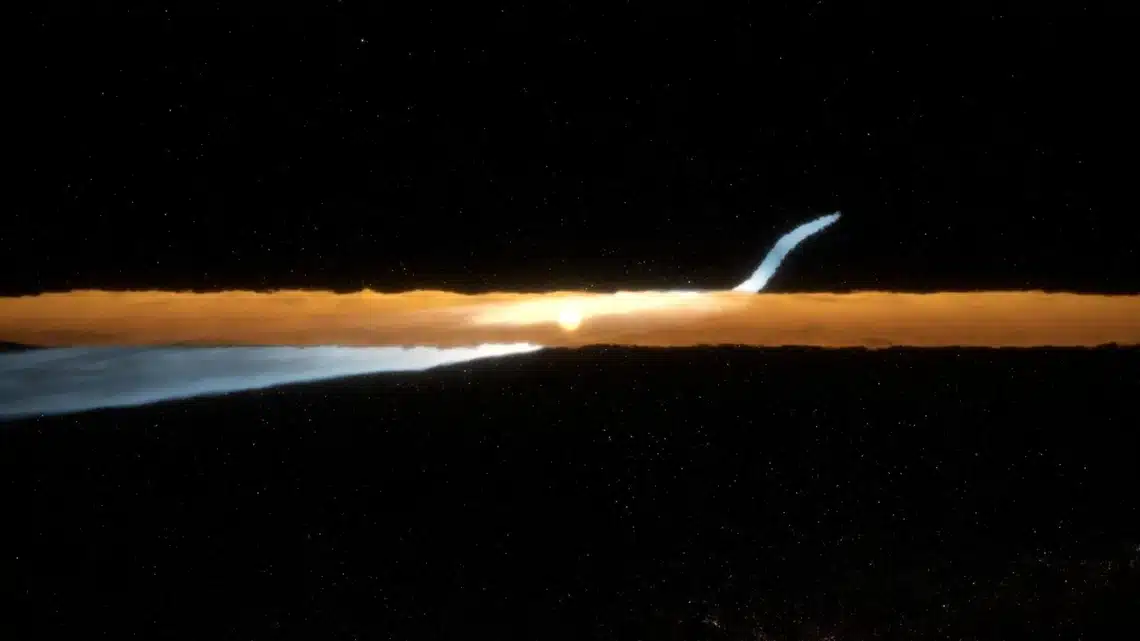
In this artist's illustration of the Beta Pictoris debris disk – seen edge-on as it appears from Earth – the swirling gas and dust are depicted in orange. A secondary disk, discovered previously, appears as a whitish feature below the plane of the main disk. On the right, the "Cat's Tail" feature is visible, reaching far into space. (Credit: NASA, ESA, CSA, STScI, Ralf Crawford (STScI) via news.arizona.edu)
In a Nutshell
- Hubble confirmed a faint, glowing tail of dust around the star β Pictoris that the James Webb Space Telescope first spotted, proving it’s a real structure and not an imaging artifact.
- Dust in the tail is made almost entirely of a dark, tar-like carbon material rather than rocky minerals, a sign it came from deep inside large icy bodies that broke apart.
- Based on how much of that material exists, each colliding object likely weighed at least as much as the dwarf planets Charon or Makemake in the outer solar system.
Hubble Space Telescope images have confirmed that a strange, smoky streak of debris near the young star β Pictoris, first spotted by the James Webb Space Telescope, is real and not an imaging fluke. The wreckage, astronomers say, likely came from two icy worlds roughly the size of dwarf planets like Charon or Makemake that smashed into each other sometime in the last 100 to 200 years, a blink of an eye by cosmic standards.
β Pictoris, located about 65 light-years from Earth, has fascinated astronomers for decades. The young star, only about 18.5 million years old, is surrounded by a huge disk of dust and rock left over from planet formation, along with three confirmed giant planets. In 2024, a team using Webb’s camera spotted an odd, curving structure poking out from that disk and nicknamed it the “Cat’s Tail,” proposing it formed when two large, planet-building chunks of ice and rock collided and threw off a cloud of debris still drifting through the system today.
A new study led by researchers at the University of Arizona and published in The Astrophysical Journal Letters set out to find that same tail using a different kind of light entirely. Instead of looking for heat, as Webb had, this team searched for faint sunlight bouncing off the dust itself, a much harder signal to catch. By combining six separate rounds of Hubble observations collected between 2012 and 2025, they not only found the tail glowing in visible light but used that glow to figure out what the colliding objects were likely made of, and roughly how big they must have been.
How Hubble Tracked Down the Dwarf Planet Collision’s Tail
Spotting faint dust next to a bright star is a bit like trying to see a wisp of smoke next to a spotlight. β Pictoris is several hundred times brighter than the disk surrounding it, so astronomers use a tiny mask inside the telescope to block the star’s glare and let the much dimmer material around it show through.
Those six visits spanned 14 years, including brand-new data collected in 2024 and 2025, and added up to roughly three hours of total exposure time. That long stretch of data let them trace the disk out to a distance about 500 times farther than Earth is from the Sun, the farthest that instrument had ever detected it. Across much of the middle of the disk, the signal was strong and clean.
Buried inside that enormous, smooth halo of dust, the team found a faint extension reaching out in exactly the spot where Webb had spotted the Cat’s Tail. The signal was weak, so weak that the researchers had to digitally cancel out the symmetric, mirror-image parts of the disk to expose the subtle feature hiding underneath. What was left lined up closely with the shape Webb had already mapped in infrared light, though the Hubble version seemed to cut off sooner, likely because the very tip of the tail is simply too faint to see in reflected starlight even though it still glows with heat.
Testing the Faint Signal Against the Noise
To make sure the faint tail wasn’t just a processing error, the team removed one round of observations at a time and checked whether the feature still showed up in what remained. It did every time, which gave them confidence the signal was a real structure in space and not a quirk tied to one observing session.
They also compared how bright the tail looked to Hubble against how bright it looked to Webb. Hubble picked up visible light reflecting off the dust grains, while Webb measured heat radiating from those same grains. By testing how different kinds of dust would scatter light versus give off heat, the researchers worked backward from that brightness comparison to figure out what the grains are made of and how they’re put together.

What the Debris Reveals About the Dwarf Planet Collision
Running thousands of computer models, the team found the dust grains in the tail are overwhelmingly made of a dark, tar-like carbon material, the same kind of compound found on the reddish surfaces of distant icy worlds like Pluto. Their best estimates put that material at 85 to 99 percent of the grains, with only a small sliver made of rocky minerals. The grains also appear to be fluffy and loosely packed rather than dense and solid.
That composition matters because of where the debris came from. Carbon-rich material like this tends to sit deep inside the cores of large bodies rather than floating loosely through space, so finding so much of it in one place points to a tail formed from genuinely large objects being torn apart, not just leftover dust drifting around.
Using estimates of how much of that material would be needed to produce the tail they observed, and comparing that to what’s known about comets and dwarf planets closer to home, the researchers calculated that each of the two suspected colliding bodies would have weighed at least as much as Charon, Pluto’s largest moon, or Makemake, one of the dwarf planets orbiting beyond Neptune. Given how dense icy bodies like these tend to be, that points to objects with radii of roughly 600 to 800 kilometers, genuine worlds by planetary standards, not pebbles or boulders.
A Lopsided Halo and a False Alarm
Beyond the tail itself, the observations turned up something else: the huge outer halo of dust around β Pictoris isn’t symmetric. One side bulges out more than the other, and the whole structure appears subtly warped, curving one way above the star’s midplane and the opposite way below it. Researchers compared this lopsided shape to computer models of how a tilted planet’s gravity can slowly reshape a disk over time, and found the pattern roughly matches what those models predict, hinting that one of β Pictoris’s known planets may be sculpting the dust from a distance.
Deep imaging also revealed a single point of light far out in the disk, nicknamed S1. For a moment, it raised the possibility of an undiscovered object lurking in the outer disk. But by tracking how its position shifted over roughly two years, the team concluded S1 is likely an unrelated background object with no connection to β Pictoris. Separately, the researchers flagged a very weak, uncertain signal below the disk that might be a faint echo of a different structure Webb had spotted earlier, though they say it could just as easily be a glitch in the imaging, and follow-up observations will be needed to settle the question.
What began as an odd infrared smudge in Webb’s images now has a second, independent confirmation in visible light, along with a rough profile of the worlds that most likely made it. Two bodies the size of Charon or Makemake appear to have slammed together within the last couple of centuries, and their shattered, carbon-rich remains are still drifting outward in a streak so faint that today’s best telescopes can barely register it. β Pictoris has spent decades as one of astronomy’s clearest windows into how planetary systems take shape, and the Cat’s Tail shows that the building and breaking are still going on, millions of years after the star first lit up.
Paper Notes
Limitations
Hubble’s scattered-light detection of the Cat’s Tail was faint, with a signal-to-noise ratio of only about 5 to 10, and became indistinguishable from background noise beyond a certain distance from the star, meaning the full extent of the tail could not be traced with Hubble the way it was with Webb. The researchers also note that the apparent low-signal detection of a possible secondary disk structure could not be confirmed and might instead be an imaging artifact, requiring deeper future observations to resolve. Additionally, the mass estimate for the colliding bodies assumes a constant density across all debris fragment sizes, which the authors say is unlikely given that the dust grains appear highly porous; they describe their mass estimate as a lower limit rather than a precise figure. The authors also note that fully explaining the warped, asymmetric halo will require dedicated follow-up modeling that accounts for the full planetary system and the effects of radiation pressure, which was beyond the scope of this study.
Funding and Disclosures
This work was supported by grants HST-GO-16174, HST-GO-17456, and HST-GO-17741 obtained at the Space Telescope Science Institute, which operates under NASA contract NAS 5-26555, and by National Aeronautics and Space Administration agreement No. 80NSSC21K0593 for the program “Alien Earths.” One author, A. A. Sefilian, is supported by the Heising-Simons Foundation through a 51 Pegasi b Fellowship. The authors also acknowledge information exchange through NASA’s Nexus for Exoplanet System Science research coordination network.
Publication Details
Paper Title: “Deep HST/STIS Coronagraphic Imaging of the β Pictoris Debris Disk: On the Scattered Light Component of the Cat’s Tail”
Authors: Arin M. Avsar, Kevin Wagner, Dániel Apai, Isabel Rebollido, Antranik A. Sefilian, Marshall D. Perrin, Christopher C. Stark, Gabriel Weible, and András Gáspár.
Journal: The Astrophysical Journal Letters, Volume 1010, L10, on October 10, 2026.
DOI: 10.3847/2041-8213/aeac4a
The underlying Hubble Space Telescope data are available through the Mikulski Archive for Space Telescopes via doi:10.17909/hr6e-dv84.


