
This image was taken by NASA's New Horizons spacecraft on Jan. 1, 2019 during a flyby of Kuiper Belt object 2014 MU69, informally known as Ultima Thule. It is the clearest view yet of this remarkable, ancient object in the far reaches of the solar system – and the first small "KBO" ever explored by a spacecraft. (Credit: NASA)
In A Nutshell
- Arrokoth, a snowman-shaped object billions of miles from Earth, is one of the oldest and least-disturbed relics of the early solar system
- Scientists have long debated whether its two lobes formed separately and merged later, or came together almost immediately during the collapse of a spinning pebble cloud
- New computer simulations show that the direct collapse scenario can produce contact binaries like Arrokoth, with the two lobes meeting at gentle speeds comparable to a slow walk or a sprint
- Because Arrokoth sits in a quiet, undisturbed region of space, its shape and chemistry may preserve a direct snapshot of planet formation more than 4 billion years ago
For years, a snowman-shaped rock drifting billions of miles from Earth has stumped scientists. Its name is Arrokoth, and its peculiar double-lump form sparked a long-running argument: how does something like that even happen in space? A study published in Monthly Notices of the Royal Astronomical Society adds weight to one long-debated theory, tracing Arrokoth’s origin back more than 4 billion years to one of the most ancient processes in solar system history.
Arrokoth belongs to a class of objects called “contact binaries,” celestial bodies made of two distinct lobes fused into one. NASA’s New Horizons spacecraft flew past it in 2019, returning images that revealed its unusual double-lump shape in remarkable detail. Earlier analyses of that mission data found that both lobes share nearly identical surface chemistry, similar amounts of frozen volatile compounds (ices that evaporate easily when exposed to heat), and roughly the same crater age. The two halves appear to have had nearly identical histories, suggesting they formed at the same time, in the same place, under the same quiet conditions.
That quietness sits at the heart of the debate. One camp of scientists argued Arrokoth’s two lobes first formed as separate objects orbiting each other, then slowly spiraled together over millions of years due to gravitational nudges from giant planets or gas drag from the early solar system. Another camp believed both lobes came together far more directly, created nearly simultaneously when a spinning cloud of tiny pebbles collapsed under its own gravity. A team of researchers from Michigan State University and the Planetary Science Institute set out to settle the question through computer simulation, and their results add meaningful support to the direct collapse theory.
How Scientists Re-Created Arrokoth’s Birth in a Computer
To test whether contact binaries like Arrokoth could form through direct gravitational collapse, the researchers ran 54 computer simulations using a modeling tool called a soft-sphere discrete element method, or SSDEM. Rather than treating particles as objects that instantly merge upon collision, this method allows simulated particles to rest on each other’s surfaces, creating realistic clumps the way sand grains or pebbles would in real life. Each simulation modeled a collapsing cloud of 100,000 particles, each with a radius of about 2 kilometers, with the total mass equivalent to that of a roughly 100-kilometer-sized planetesimal, representing the kind of pebble cloud scientists believe populated the outer solar system during planet formation.
As these clouds collapsed under gravity, their rotation rates sped up, much like a spinning figure skater pulling in their arms. Because rapid rotation can prevent a collapsing cloud from settling into a single compact object, it instead broke into multiple pieces. Most of the time, the simulations produced separated bodies or wide binary systems. In roughly 3 percent of cases, something more interesting happened.
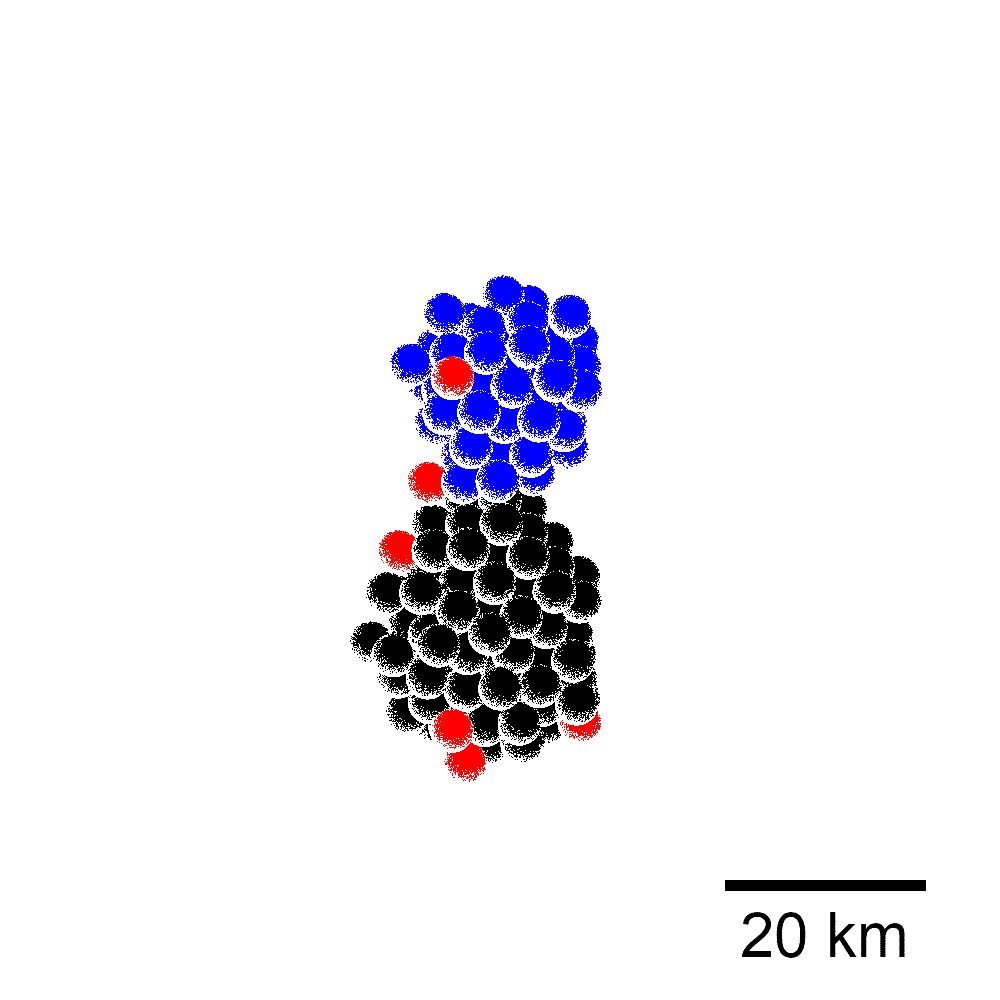
The Surprisingly Gentle Collisions That Built Arrokoth
Out of 834 total planetesimals produced across all 54 simulations, 29 formed as contact binaries. Each started as two separate objects, gravitationally bound and slowly orbiting one another. Over time, interactions with other passing planetesimals bled away the orbital energy holding them apart, causing the pair to spiral closer until they finally made contact.
Those collisions were extraordinarily gentle. All but one of the 29 simulated contact binaries came together at speeds between 0.4 and 5.8 meters per second, roughly the range from a slow walk to a hard sprint. That range lines up closely with estimates from prior geophysical analyses of what Arrokoth’s own two lobes could have withstood without sustaining the kind of surface damage visible in New Horizons imagery. The shapes of the simulated objects matched as well, producing the same kind of elongated, two-lobed profile seen not just in Arrokoth but in contact binary objects scattered throughout the solar system, from asteroids to comets.
Simulated spin rates generally fell between 2.1 and 3.0 revolutions per day, somewhat faster than Arrokoth’s current pace of about 1.51 revolutions per day. The authors suggest that low-energy impacts from smaller Kuiper Belt objects over billions of years may have gradually slowed Arrokoth to its present rate.
What Arrokoth’s Origin Reveals About the Early Solar System
Arrokoth sits in what scientists call the cold classical Kuiper Belt, a region so far from the sun and so distant from the giant planets that it has experienced relatively little gravitational disruption since the solar system formed. If its two lobes came together gently from the same source material, then Arrokoth’s chemistry and surface features preserve a direct record of conditions in the outer solar system more than 4 billion years ago.
“Contact binaries can form directly from the gravitational collapse of pebble clouds,” the authors concluded. The simulations also found that some contact binaries formed with orbiting satellites, creating small multi-body systems that resemble other known objects beyond Neptune.
Not every contact binary necessarily formed the same way. Objects found closer to the sun, among asteroids and comets, likely came together through collisions, spin-induced breakups, or other secondary processes. Arrokoth sits in a region quiet enough to preserve whatever formation process originally produced it, which is precisely what makes the question matter.
Objects in the cold classical Kuiper Belt are among the most pristine remnants of the material that built the planets. Every detail of Arrokoth’s shape, spin, and surface chemistry is a data point from an era when planets were still assembling. Two pebble clumps, born together, drifted gently into each other and stuck, and in doing so, preserved one of the clearest windows scientists have into how planets first began to assemble.
Paper Notes
Study Limitations
These simulations used 100,000 superparticles, each approximately 2 kilometers in radius, as stand-ins for what would realistically be approximately one septillion millimeter-sized pebbles in an actual collapsing pebble cloud. This resolution gap means the simulations cannot reproduce the fine-scale surface features seen on Arrokoth. Only contact binaries containing at least 45 particles could be reliably identified, limiting detection of very small objects. All simulated clouds started with a single uniform particle size, whereas real pebble clouds likely contained a range of sizes. Higher-resolution simulations using a mix of particle sizes could produce contact binaries with more varied shapes and more realistic surface detail. The mismatch between Arrokoth’s current spin rate and those of the simulated objects likely reflects billions of years of collisional history that the simulations do not directly model.
Funding and Disclosures
Funding was provided by the National Science Foundation (NSF, award number AST-2406891), the NASA Michigan Space Grant Consortium Graduate Fellowship (award number 80NSSC20M0124), and the Extreme Science and Engineering Discovery Environment (XSEDE), supported by NSF awards ACI-1053575 and ACI-1548562. Computational resources were also provided by the Institute for Cyber-Enabled Research at Michigan State University. No conflicts of interest were disclosed.
Publication Details
Authors: Jackson T. Barnes (Michigan State University), Stephen R. Schwartz (Planetary Science Institute; Universidad de Alicante, Spain), and Seth A. Jacobson (Michigan State University). | Journal: Monthly Notices of the Royal Astronomical Society (MNRAS), Volume 546, Pages 1–7, 2026. | Title: “Direct contact binary planetesimal formation from gravitational collapse” | DOI: https://doi.org/10.1093/mnras/stag002 | Published as Open Access under the Creative Commons Attribution License (CC BY 4.0).


