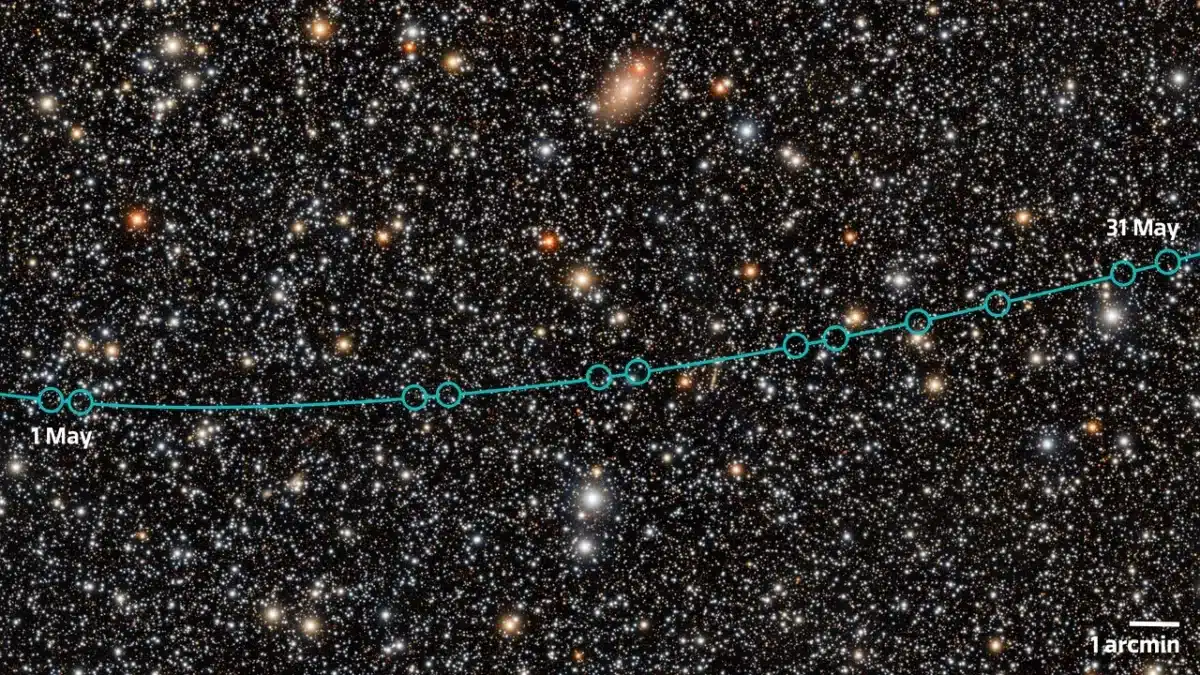
This image shows a portion of the orbital pathway of newly discovered dwarf planet candidate 2026 ED138 (ED138), as observed by NSF–DOE Vera C. Rubin Observatory. This image is a composite of multiple images captured by Rubin between 1 and 31 May 2026 at intervals indicated by the teal circles. ED138 is visible at the center of each circle. (Credit: NSF–DOE Vera C. Rubin Observatory/NOIRLab/SLAC/AURA Image Processing: M. Jurić (UW), D. de Martin & M. Zamani (NSF NOIRLab))
In a Nutshell
- Rubin Observatory has identified its first dwarf planet candidate, 2026 ED138, a trans-Neptunian object currently about 46 astronomical units from the Sun, beyond Pluto’s average distance of 40 au.
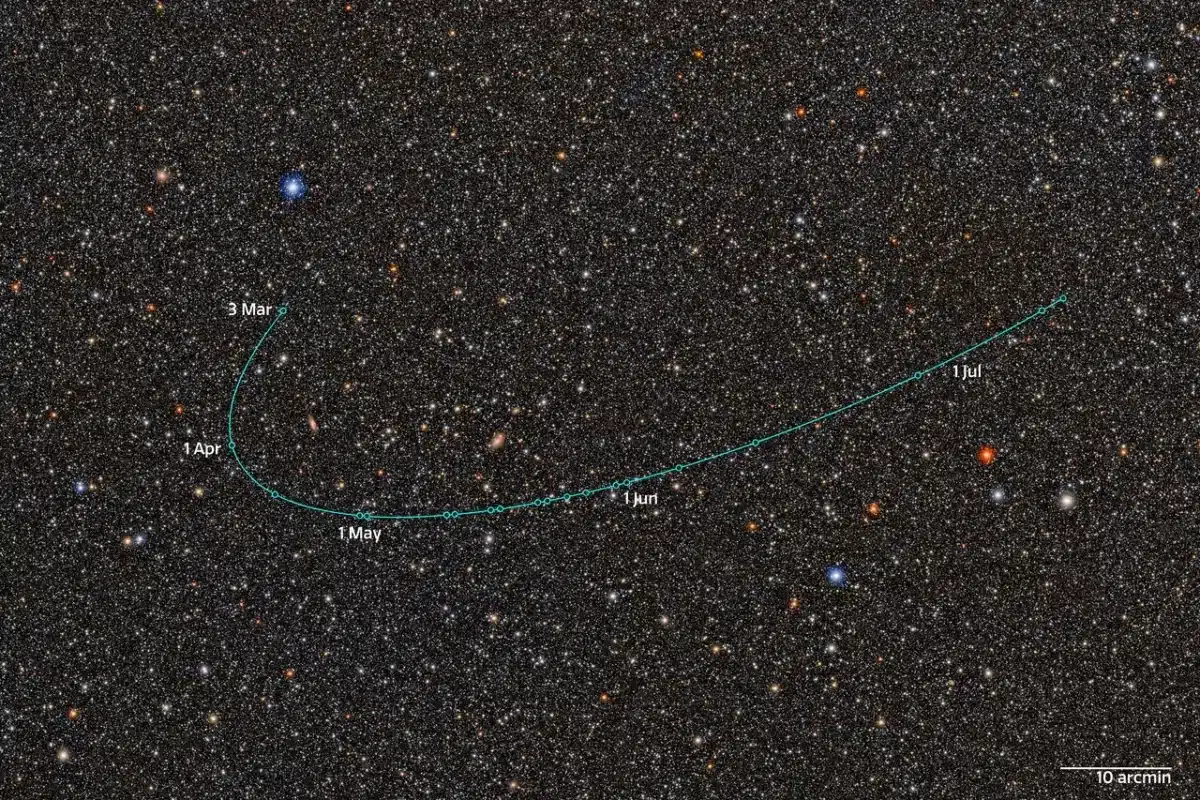
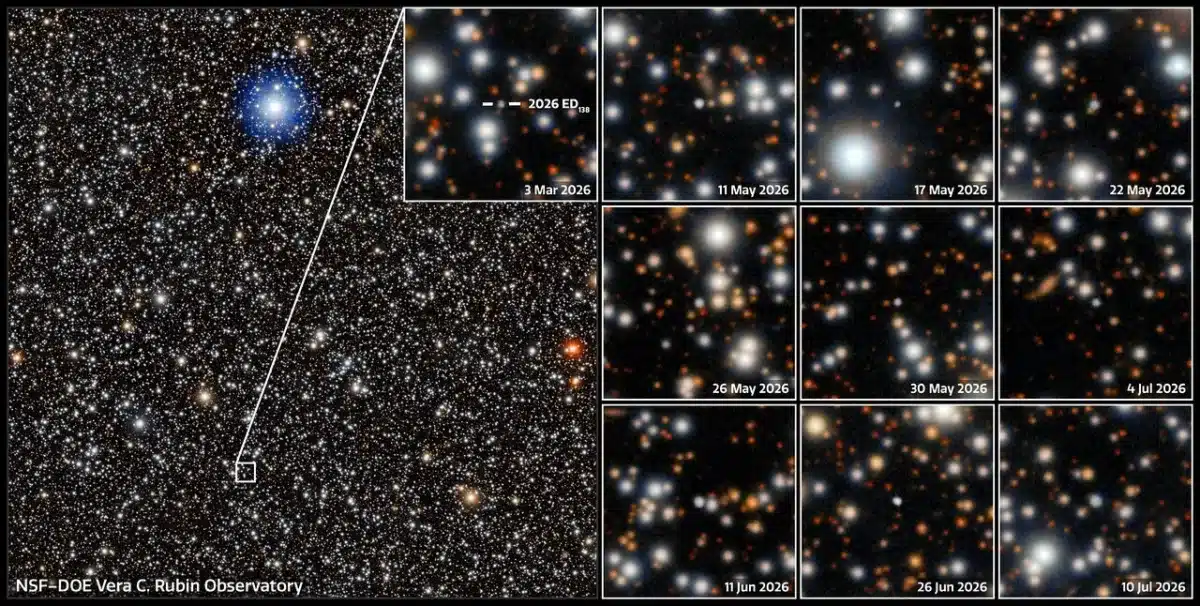
- Rubin’s Simonyi Survey Telescope observed ED138 30 times on 20 nights between March 4 and July 11, 2026, and archival Dark Energy Camera images extend the record back to 2016.
- Based on its distance, brightness, and estimated reflectivity, the team puts its size at 600 to 1,500 kilometers (about 370 to 930 miles), large enough that an icy body is expected to be round.
- ED138 is not yet a confirmed dwarf planet: infrared observations are needed to narrow its size and confirm its nature.
For about a decade, a distant world possibly hundreds of miles across has been showing up in telescope images of the outer solar system without anyone noticing it.
Now a new observatory in Chile has picked it out of the crowd. NSF–DOE Vera C. Rubin Observatory has found its first dwarf planet candidate, an object designated 2026 ED138 that currently lies beyond the orbit of Pluto. Early estimates suggest it may rank among the largest dwarf planet candidates ever discovered past Neptune.
If follow-up observations confirm it, ED138 would join a very short list. Only five objects carry official dwarf planet status from the International Astronomical Union: Pluto, Ceres, Eris, Haumea, and Makemake. Word of the discovery came from the IAU’s Minor Planet Center on October 27.
Finding a Dwarf Planet Candidate in Billions of Detections
Matthew Holman, a senior astrophysicist at the Center for Astrophysics | Harvard & Smithsonian (CfA), made the find on the evening of October 13. He was running Rubin data collected earlier in 2026 through a search program he built with CfA colleague Kevin Napier. Their code combs through billions of detections of moving objects and compares them to work out which specks of light belong to the same body.
One result stood out right away. Its brightness and distance pointed to something unusually large.
“My first reaction was one of excited disbelief,” Holman says in a statement. “Objects like this are very rare, so I immediately started checking whether I or the code had done something wrong.”
To rule out a mistake, Mario Jurić, Rubin’s Solar System lead scientist at the University of Washington, searched Rubin’s catalogs and images and turned up 20 more observations dating back to March 4, 2026. In all, Rubin’s Simonyi Survey Telescope caught ED138 30 times across 20 nights between March 4 and July 11. Archival images from the Dark Energy Camera in Chile, found through the Asteroid Institute’s ADAM Precovery service, stretched the record back to 2016, letting the team trace more than 10 years of ED138’s orbit.
A Tilted Orbit Beyond Pluto
ED138 currently sits about 46 astronomical units from the Sun. One astronomical unit equals the average distance between Earth and the Sun (roughly 93 million miles), which puts ED138 about 4.3 billion miles away. Pluto, by comparison, orbits at an average distance of 40 astronomical units. That placement makes ED138 a trans-Neptunian object, or TNO, the term for anything orbiting the Sun farther out than Neptune.
Its orbit also stands out for its angle. ED138’s path is tilted almost 25 degrees from the plane of the solar system, which classifies it as a hot-classical TNO. That steep tilt hints that Neptune’s gravity knocked it off the path it first followed.
Sizing Up Rubin’s Dwarf Planet Candidate
Plenty of objects orbit past Neptune, but only some qualify as dwarf planet candidates. To count as a dwarf planet, an object must be massive enough that its own gravity has squeezed it into a ball.
Using ED138’s distance, brightness, and estimated surface reflectivity (a property astronomers call albedo), the team estimates it measures between 600 and 1,500 kilometers across, or roughly 370 to 930 miles. An icy body of that size should be round. Because the reflectivity figure is an estimate rather than a measurement, the size range is wide, and infrared observations will be needed to pin down ED138’s size and confirm whether it truly is a dwarf planet.
Lost in a Crowded Patch of Sky
ED138’s location helps explain how something this big went unnoticed. It sits in a part of the sky near the Milky Way’s plane, where millions of stars crowd the view. Researchers say that dense background likely kept other telescopes from singling it out.
Rubin keeps returning to the whole Southern Hemisphere sky on a steady schedule, and its software checks enormous numbers of light sources to pick out the few that move like small solar system bodies.
“Rubin is giving us an unprecedented capacity to explore the sky through a combination of speed, depth, and precision,” says Jurić.
ED138 joins a fast-growing pile of Rubin discoveries. In April, before the Legacy Survey of Space and Time formally began in June 2026, the Rubin Solar System team submitted observations of more than 11,000 new asteroids to the Minor Planet Center, roughly 380 of them new TNOs.
“Rubin will image the whole southern sky again and again for ten years, so any others hiding in the places earlier surveys skipped are now within reach,” says Holman.
For now, ED138 remains a candidate whose final verdict depends on infrared follow-up. But with nearly a decade of sky-scanning still ahead, the solar system’s short list of dwarf planets may not stay short for long.
Research Notes
Discovery Method
Matthew Holman (Center for Astrophysics | Harvard & Smithsonian) found 2026 ED138 on October 13, 2026, by running Rubin data collected earlier in 2026 through a search code he developed with CfA colleague Kevin Napier. The code compares billions of detections of moving objects to identify those that belong to the same object. Mario Jurić (University of Washington, Rubin Solar System Lead Scientist) then searched Rubin’s catalogs and images and found 20 additional observations dating to March 4, 2026. Rubin’s Simonyi Survey Telescope observed ED138 30 times on 20 nights between March 4 and July 11, 2026, during the run-up to the Legacy Survey of Space and Time (LSST), which began in June 2026. Archival images from the Dark Energy Camera (DECam) on the NSF Victor M. Blanco 4-meter Telescope at Cerro Tololo Inter-American Observatory, located through the Asteroid Institute’s ADAM Precovery service, extend the observational record back to 2016, covering more than 10 years of the object’s orbit.
Key Measurements
ED138 is currently about 46 au from the Sun (Pluto’s average distance is 40 au), making it a trans-Neptunian object. Its orbit is tilted almost 25 degrees from the plane of the Solar System, classifying it as a hot-classical TNO and suggesting past gravitational interactions with Neptune. Size is estimated at 600 to 1,500 km from distance, brightness, and estimated albedo. Mile conversions in the article (about 370 to 930 miles; about 4.3 billion miles for 46 au using 1 au ≈ 93 million miles) are Study Finds calculations, not figures from the release.
Announcement Details
The discovery was announced October 27, 2026, by the IAU Minor Planet Center in a Minor Planet Electronic Circular (linked below) and presented by Jurić and Holman at a press conference during the 58th Annual Division for Planetary Sciences meeting in Spokane, Washington. Rubin Observatory is jointly funded by the U.S. National Science Foundation and the U.S. Department of Energy’s Office of Science and operated by NSF NOIRLab and SLAC National Accelerator Laboratory. Source: “NSF–DOE Vera C. Rubin Observatory Reveals Its First Dwarf Planet Candidate in Our Solar System,” Rubin Observatory, October 27, 2026.


