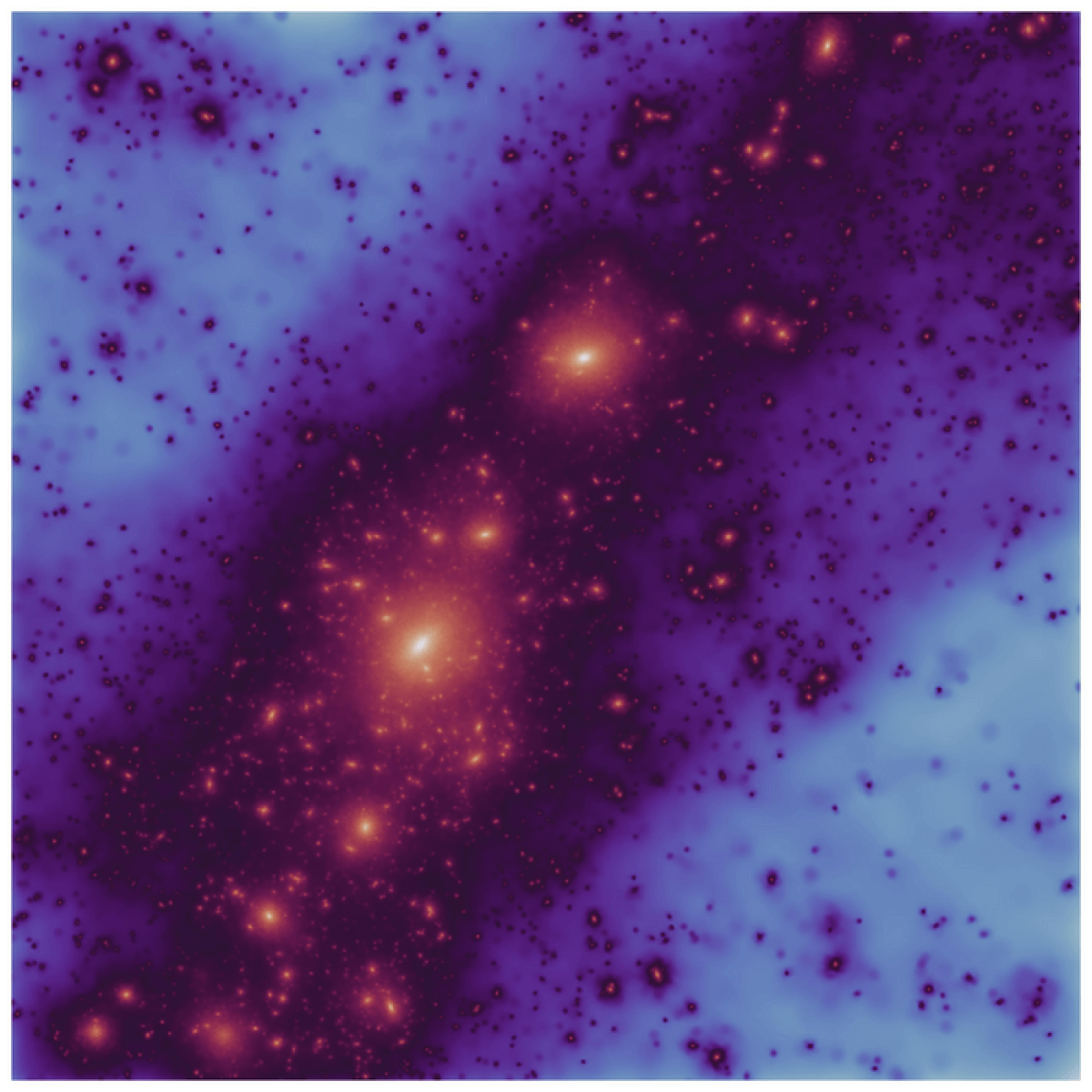
One of the new high-resolution simulations of the dark matter enveloping the Milky Way and its neighbor, the Andromeda galaxy. (CREDIT: Till Sawala/Sibelius collaboration)
SYDNEY — A cosmic conspiracy of sorts has been debunked. For years, astronomers believed that galaxies followed a secret formula when it comes to balancing their visible and invisible matter. However, a new study suggests this galactic guidebook might not exist at all.
The study, published in the Monthly Notices of the Royal Astronomical Society, uses cutting-edge observational techniques to peer into the hearts of distant galaxies, revealing a surprising diversity in their internal mass structures. This finding contradicts the idea of a “bulge-halo conspiracy,” a concept that has puzzled astronomers for decades.
At the core of this cosmic mystery is the relationship between a galaxy’s visible matter – its stars and gas – and its invisible dark matter halo. Previous observations have suggested that these two components work in tandem to create a remarkably consistent total mass distribution across different galaxies, regardless of their individual characteristics.
“This homogeneity suggested that dark matter and stars must somehow compensate for each other in order to produce such regular mass structures,” says Dr. Caro Derkenne, the first author of the paper and an ASTRO 3D researcher from Macquarie University, in a statement.
To investigate this phenomenon, the research team, led by C. Derkenne, utilized data from the MAGPI (Middle Ages Galaxy Properties with Integral field spectroscopy) Survey. This ambitious project employs the MUSE instrument on the Very Large Telescope in Chile to study galaxies when the universe was roughly half its current age – a period often referred to as the universe’s “middle ages.”
The team examined 22 massive galaxies, each weighing between 2.5 billion and 40 billion times the mass of our Sun. Using a sophisticated modeling technique called Schwarzschild orbit-based modeling, they reconstructed the three-dimensional structure and orbital motions of stars within these galaxies.
“In the past, people built simple models that had too many simplifications and assumptions,” says Derkenne. “Galaxies are complicated, and we have to model them with freedom or we’re going to measure the wrong things. Our models ran on the OzStar supercomputer at Swinburne University, using the equivalent of about 8,000 hours of desktop computing time.”
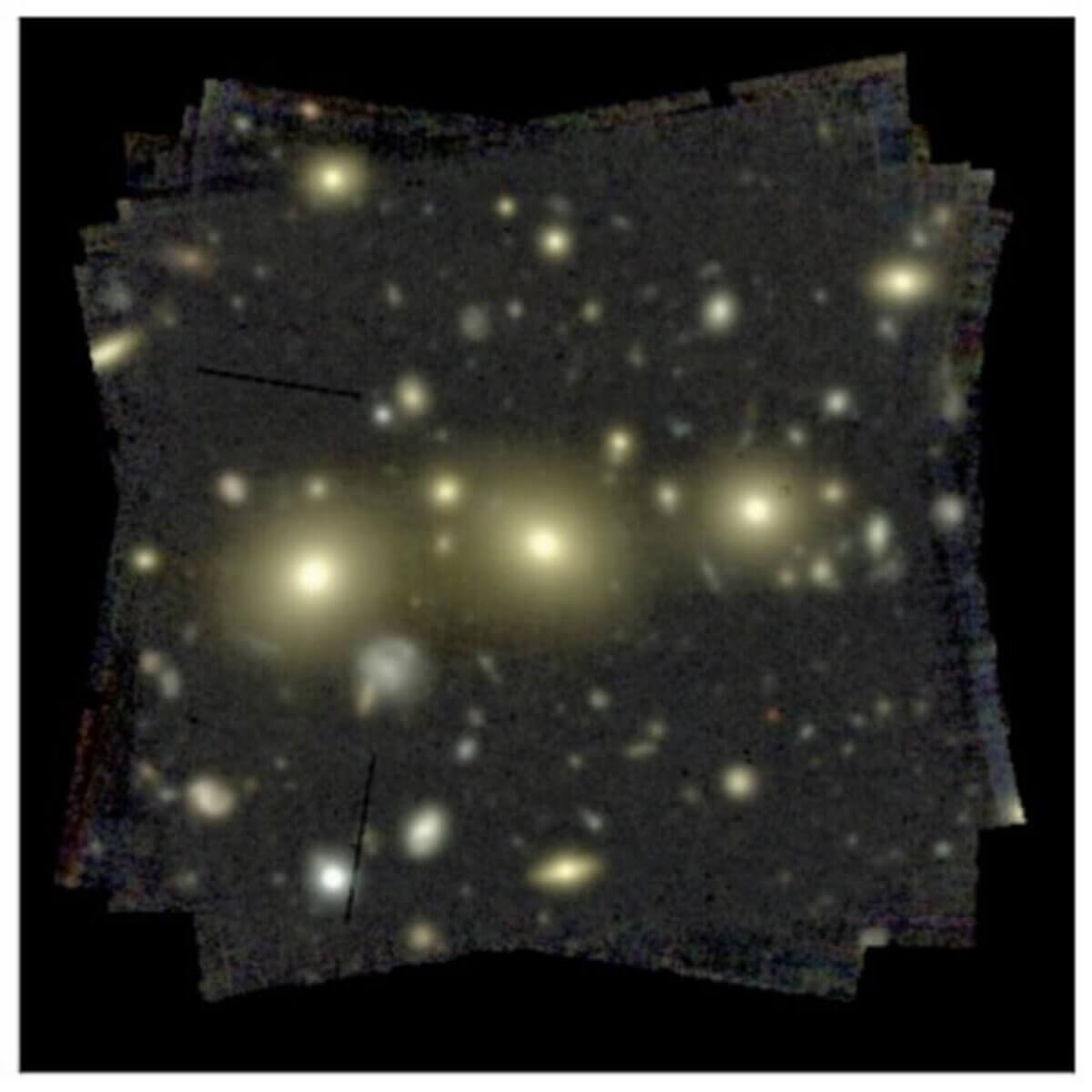
What they found was surprising. Instead of a uniform pattern across galaxies, the researchers discovered a wide range of mass distributions. Some galaxies had steep density profiles, with their mass concentrated heavily towards their centers, while others showed a more gradual distribution of mass from their cores to their outer regions.
This diversity challenges the idea of a cosmic conspiracy. If such a conspiracy existed, we would expect to see similar mass distributions across different galaxies. Instead, the study reveals that the interplay between visible and dark matter in galaxies is far more complex and varied than previously thought.
Perhaps most intriguingly, the research found no significant correlation between the distribution of visible matter and the amount of dark matter in a galaxy’s central regions. This lack of correlation suggests that the visible and dark components of galaxies do not “conspire” to create a uniform structure but rather coexist in a more random, possibly chaotic manner.
Understanding how galaxies form and evolve is crucial to our comprehension of the universe’s large-scale structure and the role of dark matter in cosmic evolution. This new perspective challenges existing models of galaxy formation and may require astronomers to rethink some fundamental assumptions about how the universe works.
Moreover, the research highlights the power of modern observational techniques in unveiling the hidden structures of the cosmos. By studying galaxies billions of light-years away, astronomers can peer back in time, observing these cosmic structures as they existed when the universe was much younger. This time-traveling capability provides crucial insights into the evolutionary processes that have shaped the galaxies we see today.
“Astronomy sets you up really well to understand big data,” adds Derkenne. “The real world is messy, and we don’t always have all the data. No one is there to tell you the answers or if you’re wrong or right. You need to accumulate data and analyze until you find something that works.”
As with all groundbreaking research, this study raises as many questions as it answers. Why do some galaxies have such different mass distributions? What processes drive the seemingly random relationship between visible and dark matter? And how do these findings fit into our broader understanding of cosmic evolution?
While the answers to these questions remain elusive, one thing is clear: the universe continues to surprise us. As we continue to push the boundaries of astronomical observation and theory, we can look forward to more surprises, more challenges to our assumptions, and more awe-inspiring revelations about the cosmos we call home.
Paper Summary
Methodology
The researchers used a technique called Schwarzschild orbit-based modeling to study the galaxies. This method involves creating a computer model of each galaxy, populating it with millions of simulated stars, and then adjusting the model until it matches the observed properties of the real galaxy. It’s like solving a giant 3D puzzle, where the pieces are the movements and positions of stars, and the picture you’re trying to create is the galaxy itself.
Key Results
The study found that the total mass distribution (visible matter + dark matter) in galaxies varies much more than previously thought. They also discovered that there’s no strong relationship between how the visible matter is distributed and how much dark matter is in the galaxy’s center. This goes against the idea of a “conspiracy” between these two components.
Study Limitations
The study looked at 22 galaxies, which is a relatively small sample. Additionally, the galaxies studied were all massive and mostly early-type (elliptical and lenticular), so the results might not apply to all types of galaxies. The researchers also had to make some assumptions about the dark matter distribution, which could affect the results.
Discussion & Takeaways
The main takeaway is that galaxy formation might be more random and chaotic than we thought. This challenges current models of galaxy formation and evolution. The study also highlights the importance of looking at individual galaxies in detail rather than assuming they all follow the same rules. These findings could lead to new theories about how galaxies form and evolve over time.
Funding & Disclosures
The research was supported by the Australian Research Council Centre of Excellence for All Sky Astrophysics in 3 Dimensions (ASTRO 3D). Several of the researchers also received individual grants from various funding bodies. The study used data from the MAGPI Survey, which is based on observations made with the Very Large Telescope at the European Southern Observatory in Chile.


