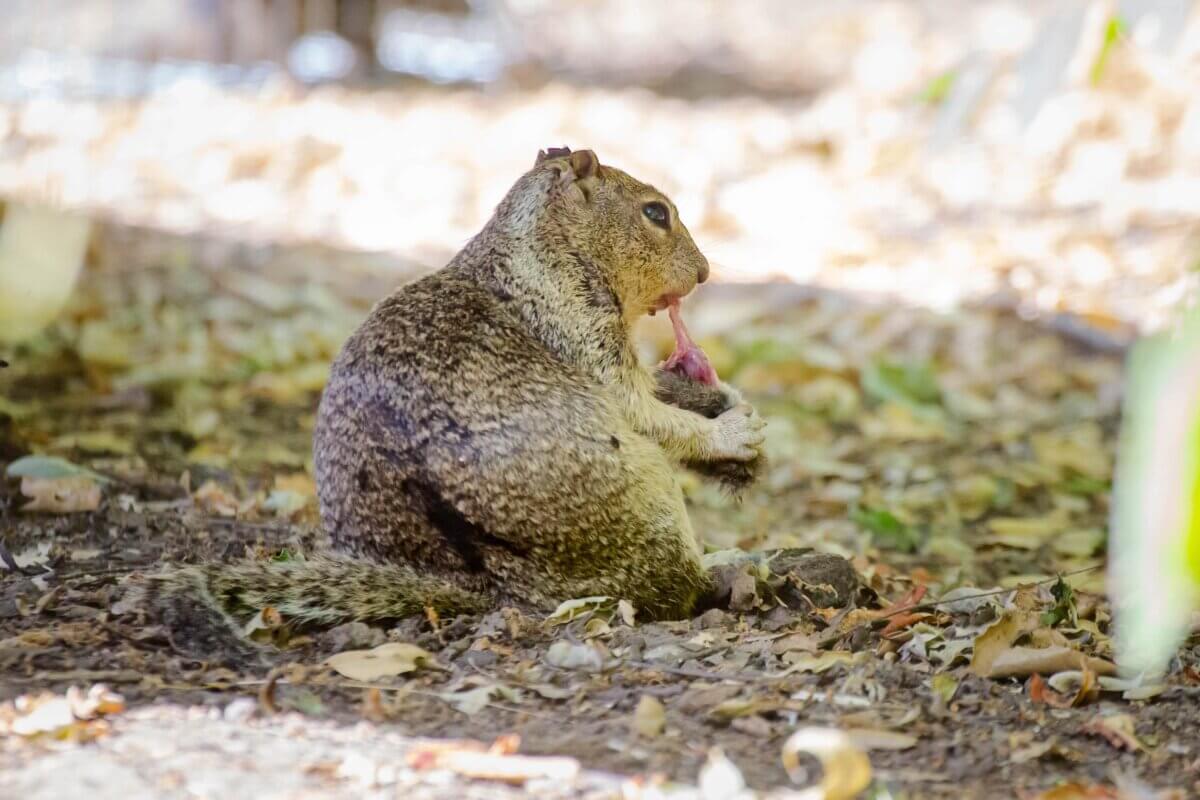
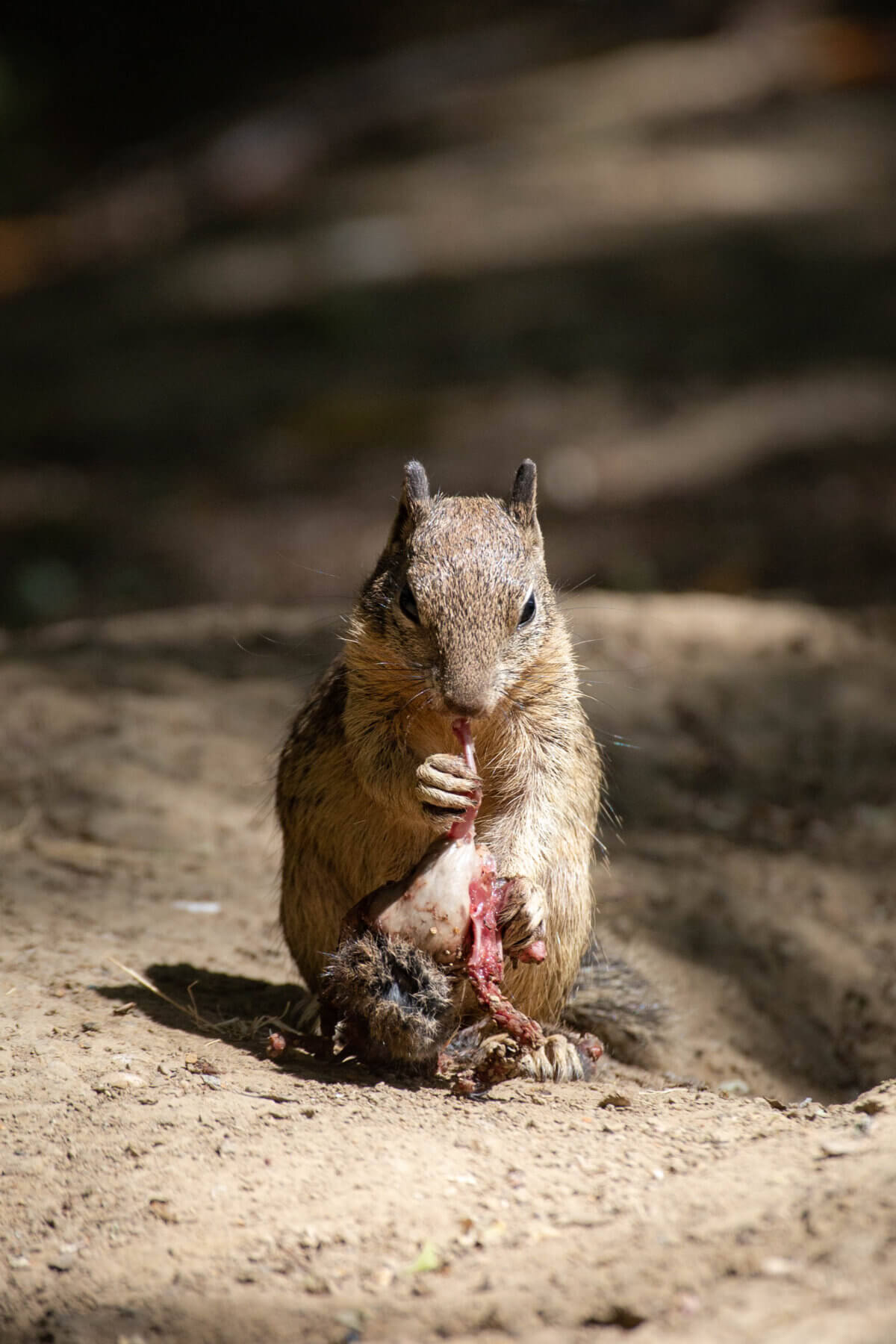
A California ground squirrel dines on a vole it hunted in a Bay Area regional park. (Credit: Sonja Wild, UC Davis)
‘I could barely believe my eyes’: Scientists stunned by behavior captured on camera
DAVIS, Calif. — Evolution works in mysterious ways. Sometimes, it creates specialized carnivores with sharp teeth and claws; other times, it turns seemingly peaceful plant-eaters into opportunistic hunters. Scientists have just documented the latter in action, discovering that California ground squirrels – those supposedly harmless seed-gatherers – have developed a taste for meat and the skills to obtain it.
In the eye-opening study, researchers observed the squirrels actively hunting and eating other mammals, specifically California voles. It marks the first evidence that these supposedly vegetarian animals regularly engage in predatory behavior.
“This was shocking,” said lead author Jennifer E. Smith, an associate professor of biology at University of Wisconsin-Eau Claire, in a statement. Smith leads the long-term ground squirrels project with Sonja Wild of the University of California, Davis.
“We had never seen this behavior before,” Smith continues. “Squirrels are one of the most familiar animals to people. We see them right outside our windows; we interact with them regularly. Yet here’s this never-before-encountered-in-science behavior that sheds light on the fact that there’s so much more to learn about the natural history of the world around us.”
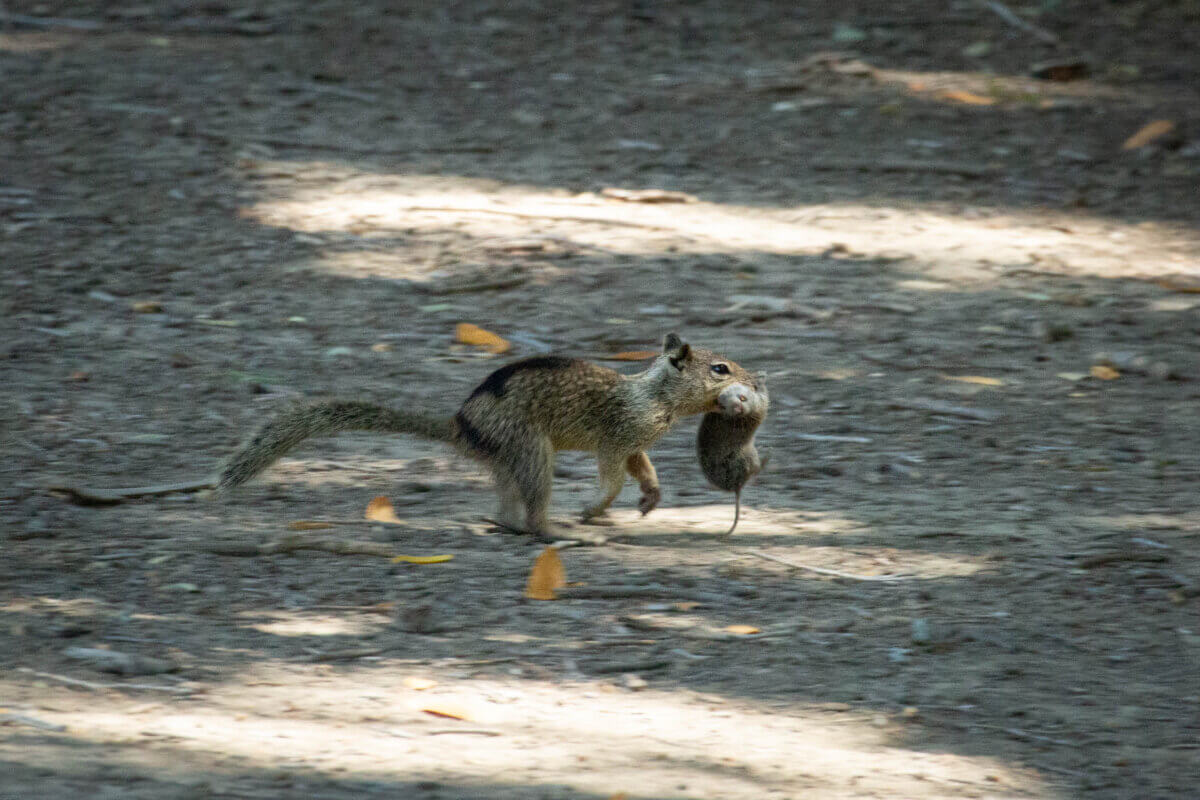
For over a decade, scientists had been studying a population of California ground squirrels at Briones Regional Park in California’s Contra Costa County. These squirrels were known primarily as peaceful vegetarians, munching on seeds, grasses, and occasional insects. However, in 2024 — the 12th year of their long-term study — something remarkable happened. The researchers observed 74 separate instances of the squirrels actively hunting, killing, and consuming adult voles.
Even the researchers were initially skeptical of what they were seeing. When undergraduate students first reported the hunting behavior, postdoctoral research fellow Sonja Wild from UC Davis’s Environmental Science and Policy department was dubious. “I could barely believe my eyes,” said Wild. “From then, we saw that behavior almost every day. Once we started looking, we saw it everywhere.”
The sudden emergence of this hunting behavior coincided with an unprecedented surge in the local vole population. Analysis of data from the citizen science platform iNaturalist revealed that vole sightings in 2024 dramatically exceeded all records from the previous decade, reaching levels never before documented in the area. This remarkable abundance of potential prey appeared to trigger new foraging behaviors in the squirrel population.
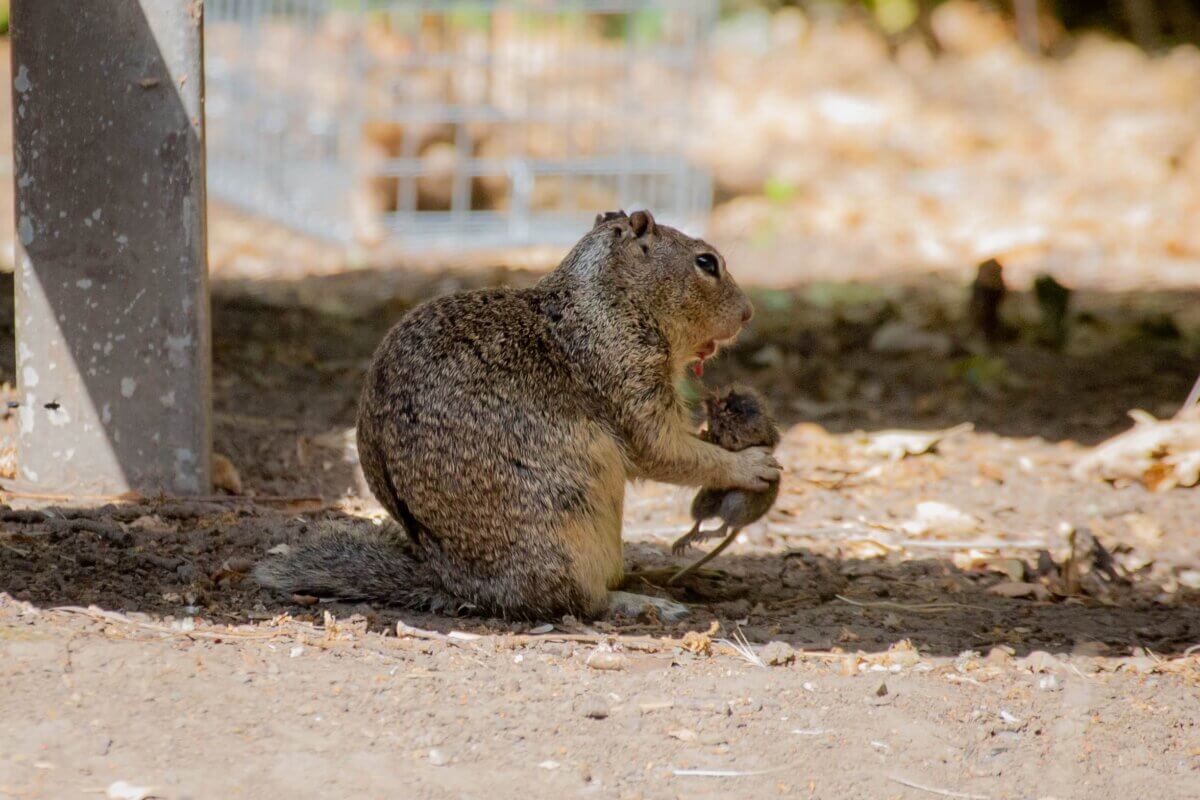
The hunting tactics employed by the squirrels were predominantly opportunistic. Rather than using sophisticated stalking techniques, these new hunters typically chased their prey over short distances in open areas across dirt substrate. In three documented cases, squirrels were observed staying low to the ground and minimizing noise before attacking. When close enough, they would pounce on their prey, using their forepaws and teeth to subdue it. The kill typically involved bites targeting the neck area, though other body parts were also targeted.
What’s particularly fascinating is the success rate of these amateur hunters. Out of 31 observed hunting attempts, 17 resulted in successful kills – a 55% success rate that would make many natural predators envious. The squirrels showed a consistent pattern in consuming their prey: they would first remove the vole’s head before either pulling meat directly from the torso or methodically stripping away fur to access the meat, organs, and cartilage underneath.
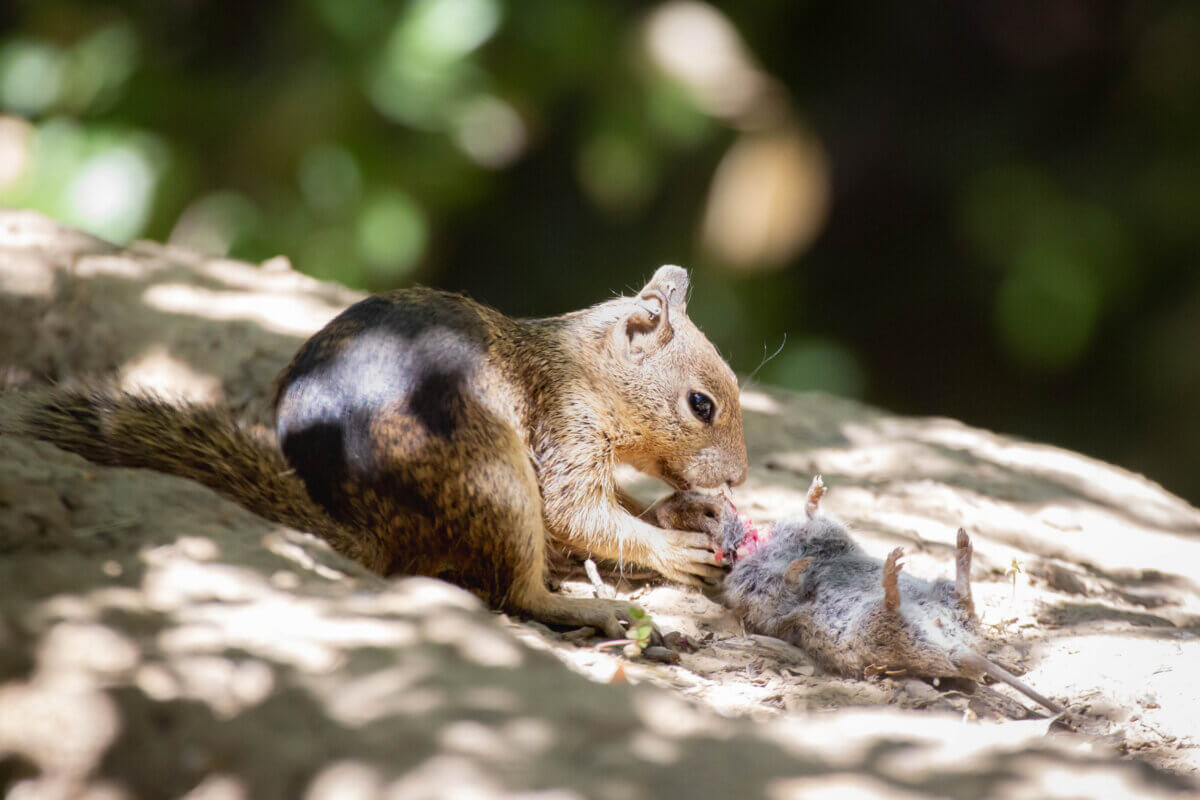
The behavior, described in a paper published in the Journal of Ethology, wasn’t limited to a few specialized individuals either. Both adult and juvenile squirrels of both sexes participated in the hunting, with no significant differences in success rates between age groups. The researchers specifically identified 2 juvenile males, 3 juvenile females, 2 adult males, and 6 adult females among the traceable hunting events, with adult females accounting for nearly half of these observations.
The discovery has broader implications for understanding how wildlife adapts to human-modified environments. “The fact that California ground squirrels are behaviorally flexible and can respond to changes in food availability might help them persist in environments rapidly changing due to the presence of humans,” Wild noted. Smith added that many species, including the California ground squirrel, are “incredible opportunists.” From raccoons and coyotes to spotted hyenas and humans, the flexibility these mammals apply to their hunting strategies help them change and adapt with the human landscape.
Study authors point out fascinating social dynamics surrounding this new hunting behavior. While squirrels typically hunted alone, the presence of a fresh kill often led to competitive interactions, with some individuals attempting to take prey from successful hunters. Yet not all interactions were aggressive – in some cases, squirrels showed surprising tolerance around food sharing. Researchers documented rare instances of adults allowing juveniles to feed on their catches, suggesting complex social dynamics around this new food source.
This discovery opens up numerous avenues for future investigation. The research team plans to explore whether this hunting behavior exists in other squirrel populations, investigate potential mechanisms for passing these skills between generations, and study how this dietary shift might affect local ecosystems. Of particular interest is whether access to this high-protein food source might influence squirrel reproduction rates in future seasons.
“Through this collaboration and the data coming in, we’re able to document this widespread behavior that we had no idea was going on,” Smith said. “Digital technology can inform the science, but there’s no replacement for going out there and witnessing the behavior because what animals are doing always surprises us.”
These findings force us to reconsider what we think we know about the animals sharing our urban and suburban spaces. Behind their cute, fuzzy appearances, ground squirrels harbor unexpected capabilities that have gone unnoticed despite decades of observation. What other secrets might our backyard wildlife be keeping? Sometimes, it seems, you just need to look at familiar things with fresh eyes.
Paper Summary
Methodology
The study was conducted over seven weeks in 2024 at Briones Regional Park, where researchers had been studying the squirrel population since 2013. They combined opportunistic observations during trapping days with formal behavioral observations conducted on 16 weekdays between June and July. Three groups of observers monitored different areas of the study site simultaneously, maintaining a distance of at least 20 meters from the squirrels to minimize disturbance. The team recorded all instances of vole hunting, killing, consumption, and related social interactions, carefully documenting the location, timing, and details of each event.
Results
The researchers documented 74 total vole-related events, with 65 occurring during formal observation days. Of these, 31 involved active hunting attempts, with a 55% success rate. The behavior was widespread across the population, with no significant differences between age or sex groups. The study identified 27 unique squirrels engaging in these behaviors, with adult females being particularly active hunters.
Limitations
The study was conducted over a relatively short period during a unusual vole population boom, so it’s unclear whether this behavior occurs during normal conditions. Additionally, while the researchers could identify many of the squirrels involved, some individuals remained unidentified during observations. The study also couldn’t determine whether this behavior was learned or innate.
Discussion and Takeaways
The findings suggest that California ground squirrels are more behaviorally flexible than previously thought, capable of adapting their foraging strategies to take advantage of abundant prey. This challenges the traditional classification of these animals as primarily herbivorous and suggests they might be better characterized as opportunistic omnivores. The study also provides insights into how animals might adapt their behavior in response to changing environmental conditions.
Funding and Disclosures
The research was supported by multiple organizations, including the Swiss National Science Foundation, the University of Wisconsin-Eau Claire, Save Mount Diablo, the American Society of Mammalogists, and the Animal Behavior Collective. The researchers declared no competing interests, and all field methods were approved by relevant animal care committees and wildlife authorities.
The study was particularly notable for its significant undergraduate participation, with several coauthors conducting field work during their undergraduate studies. Their work was partly funded by the Ronald E. McNair Postbaccalaureate Achievement Program, Diversity Mentoring Program and Summer Research Experience for Undergraduates, demonstrating the valuable role of student researchers in making groundbreaking scientific discoveries.


not a new thing at all well documented
I have known this for decades about gray squirrels. They eat eggs out of bird’s nests. And I have seen them chase down field mice in peanut fields.
At the end of the day, they are just tree rats.
If multiple pre/post grads have the time to spend on this garbage, this sort of “study” needs to be a target of DOGE.
I think most rodents are ultimately omnivores even though their “normal” diet may be herbivorous. Mice are known to eat other mice, so certainly a much larger squirrel would be tempted to try it. Squirrels are also known to eat things like pepperoni or jerkey that they scavenge (or that humans feed them deliberately) in urban environments. It just depends on what food is available. Throw plenty of seeds and vegetables around, and you will probably see the squirrels shift to their normal diet. But if the voles are the most readily available food source… well…
they eat bird Eggs up here in Canada –
the Tree brown, black, and red Squirrels
I can see this quickly becoming an issue when squirrels start hunting cats.
I’ve seen this by a chipmunk after a bird fell to the ground after hitting a window. The bird was still alive as a chipmunk jumped on it and started pulling it’s feathers out and biting into the bird. I was shocked.
Squirrels are omnivores.
Squirrels are bushy-tailed RATS.
Has to be related to environmental changes (ie feces in the streets of San Fransicko, Lost Angeles, etc). No state comes close to the hypocritical eco-triggered depravity of California
This is not new behavior.
I have seen them stalk and kill quail (I believe that I read somewhere that they eat quail eggs also).
I have also seen them eating various carrion and even dead ground squirrels on the side of the road on more than one occasion…
Ground squirrels are basically rats.
If this story was about tree squirrels, I would find that to be interesting…
In a million years or so, they’ll be standing on two legs, hunting in packs and developing primitive weapons to hunt. ????
LOL even the squirrels have figured out it is really stupid to be a vegetarian.
Looks like a solution to the rat and mouse problem.
We may need a holy handgrenade at Briones asap…
It’s an interesting situation… and a zoonotic question too. These animals attract humans for their cuteness and easy to garner food without forging. It’s possible now for them to get rabies from contaminated animals… and transfer to humans through a bite. And or virus transfers.
Vegan diets generally don’t have serious consequences, than eating other manuals that can contract a disease.
Changes the dynamics of interactions with squirrels…
This study is bologna! Watching squirrels snatch baby birds out of nests is common.
Well I never took the time to observe their hunting habits, but over 50 years ago when on walks, we’d see ground squirrels chowing on ran over ground squirrels on the hiway. Not a big step to say they wouldn’t eat some critter they could overpower.
I grew up in the mountains of Virginia in the 60s this is not new, this has been going on in squirrels since forever,,,, Gray and Fox Squirrels…You have made yourself look like a mental midget..abd I feel bad for you.
Seriously, someone who writes, “squirrels since forever,,,, Gray and Fox Squirrels…You” has the audacity to call someone else looking like a mental midget? What in the hell does FOUR COMMAS in succession mean to you, Virginia? I’ve lived in Virginia, THEY DO NOT TEACH THAT IN SCHOOL.
You should apologize for your comment. YOU look like the midget, citizen.
I hope there are plans for follow-up research. Specifically, a vole-munching squirrel or 12 needs catching and blood samples taken to establish that farm chemicals or other industry related toxins aren’t playing a role. Also, seeds and nuts from the area should be analyzed also, not just for toxins, but for nutritional content, especially protein levels.
I suspect that, in the end, it’ll be found to have been a survival response to a localized set of circumstances.
A few years back there was a small birds nest on a vine just outside my kitchen window. When I first noticed the nest there were four small fledglings in the nest. A couple of days later only two were left, as I was watching the nest a chipmunk climbed up the vine and left with one in its mouth. I never thought chipmunks were carnivores until that moment. The next day the nest was empty.
My observation did not cost the tax payer a single dollar, I wonder what the dollar cost of the aforementioned study is but somehow I believe it was us the taxpayer who funded this study.
The chemtrails have poisoned the trees. The animals are adjusting to survive because of man’s actions.