
Surprised and Confused Adult Man Looking At Smartphone (© Prostock-studio - stock.adobe.com)
NEW YORK — In the high-stakes race to build quantum computers, scientists just discovered something totally unexpected: sometimes these futuristic machines can still be beaten by the device in your pocket! Researchers from the Flatiron Institute in New York have witnessed a monumental event, watching a regular computer powering a smartphone outthink a next-gen quantum computer.
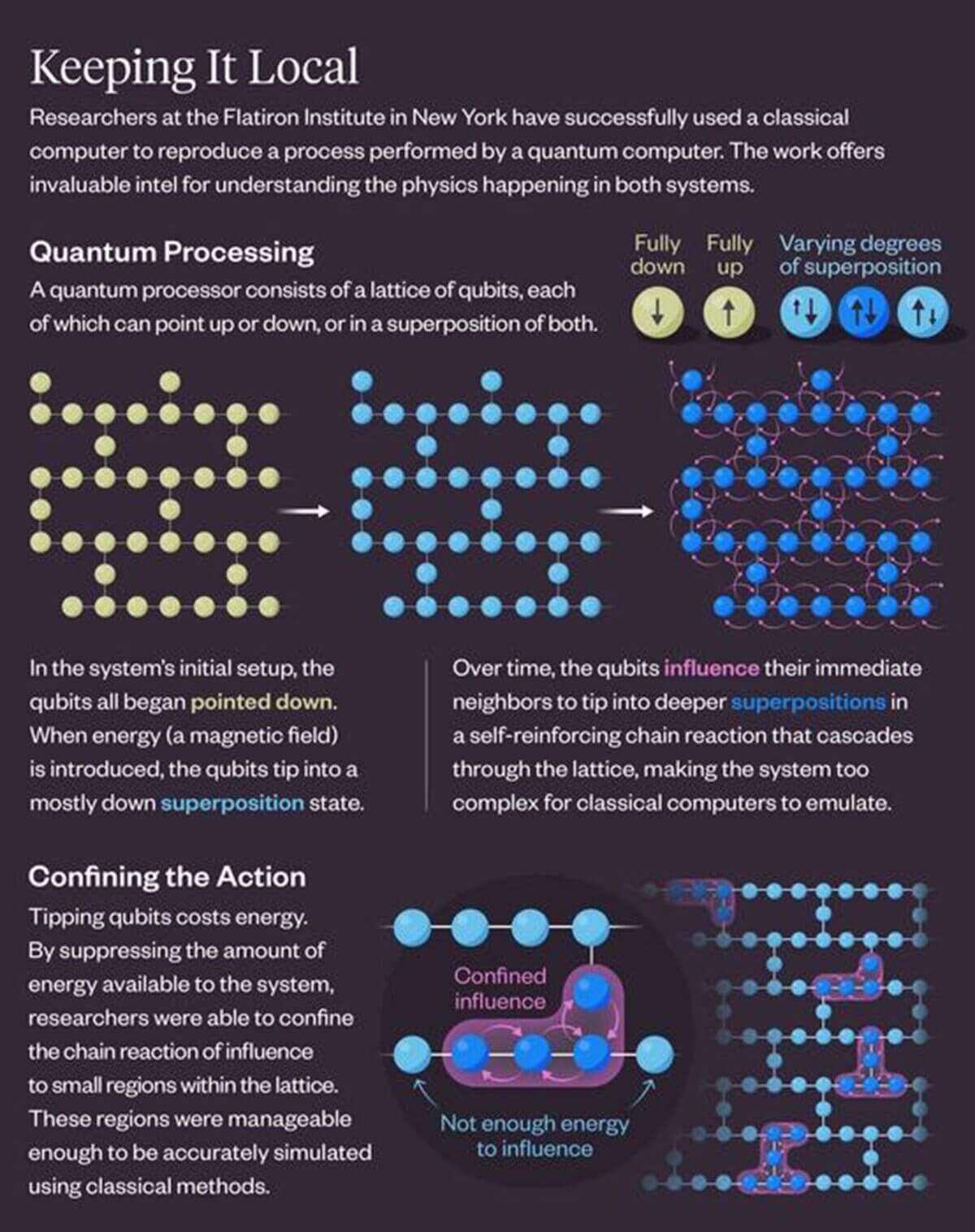
This David-versus-Goliath upset is teaching us fascinating new things about how quantum systems behave. Earlier this year, researchers at the Flatiron Institute’s Center for Computational Quantum Physics (CCQ) used ordinary computers to solve a complex quantum problem that IBM claimed could only be tackled by their sophisticated quantum computer. Even more surprisingly, the solution was so efficient it could run on a smartphone.
“We didn’t really introduce any cutting-edge techniques,” says lead researcher Joseph Tindall in a media release. “We brought a lot of ideas together in a concise and elegant way that made the problem solvable. It was a method that IBM had overlooked and was not easily implemented without well-written software and codes.”

Now, the new study published in Physical Review Letters, Tindall and his colleague Dries Sels have revealed why this quantum puzzle turned out to be surprisingly simple to crack. The answer involves a fascinating phenomenon called “confinement” that keeps quantum particles corralled like invisible sheep in a pen.
The original challenge involved simulating how an array of tiny magnets evolves over time when exposed to magnetic fields. These quantum magnets can exist in multiple states simultaneously – pointing both up and down at once, unlike regular magnets on your refrigerator. Typically, such quantum systems quickly become extremely complex as the magnets become “entangled” with each other, making them nearly impossible to simulate on classical computers.
“There is some boundary that separates what can be done with quantum computing and what can be done with classical computers,” Tindall explains. “At the moment, that boundary is incredibly blurry. I think our work helps clarify that boundary a bit more.”
What the researchers discovered was that the honeycomb-like arrangement of the magnets naturally creates an energy barrier that prevents large-scale entanglement from developing. Confinement essentially keeps the quantum system well-behaved and predictable, much like a playground fence keeps children from wandering too far.
“In this system, the magnets won’t just suddenly scramble up; they will actually just oscillate around their initial state, even on very long timescales,” says Tindall. “It is quite interesting from a physics perspective because that means the system remains in a state which has a very specific structure to it and isn’t just completely disordered.”
This discovery has significant implications for quantum computing. When quantum particles remain confined, they’re easier to control and simulate, which could lead to more reliable quantum computers and new ways to test quantum systems using classical computers.
Paper Summary
Methodology
The researchers used sophisticated mathematical modeling to simulate an infinite grid of quantum magnets. Their approach, called “infinite tensor network states optimized with belief propagation” (BP-iTNS), allowed them to track how the magnets behave when disturbed by magnetic fields. By identifying different types of confined particle patterns, they could predict and explain the system’s stable oscillations.
Key Results
The study revealed that quantum confinement naturally emerges in this two-dimensional system, keeping the quantum particles organized in predictable patterns. This explains why classical computers could simulate the system so effectively – the confinement prevented the explosion of complexity that usually makes quantum systems hard to simulate. The researchers developed a mathematical model that accurately predicted the system’s behavior, matching their computer simulations.
Study Limitations
While this study focuses on a specific type of quantum system arranged in a honeycomb pattern, the researchers believe their findings could apply to other two-dimensional quantum systems. However, more research is needed to confirm this broader application. The simulation methods, while highly effective for this system, may not work as well for quantum systems that don’t exhibit confinement.
Discussion & Takeaways
This research helps clarify the boundary between what classical and quantum computers can achieve. The discovery of confinement in two-dimensional quantum systems provides new tools for testing and benchmarking quantum simulations. Previously, this type of confinement had only been observed in one-dimensional quantum systems, making this finding particularly significant for the field.
Funding & Disclosures
The research was supported by the Flatiron Institute, a division of the Simons Foundation, and the Air Force Office of Scientific Research (Grant No. FA9550-21-1-0236). The researchers used the publicly available ITENSORNETWORKS.JL software package. No conflicts of interest were declared.


