
3D illustration: Quantum particle, quantum mechanics. (© Peter Jurik - stock.adobe.com)
VIENNA, Austria — Imagine trying to photograph the exact moment a soap bubble pops. Now imagine something happening a trillion-trillion times faster. For decades, scientists thought certain quantum events were simply “instantaneous” – like an electron suddenly jumping from an atom when struck by light, or particles mysteriously becoming “quantum entangled.” But what if we could watch these events unfold in slow motion?
In a game-changing study published in Physical Review Letters, an international team of researchers has developed sophisticated computer simulations that reveal the birth of quantum entanglement – what Einstein famously called “spooky action at a distance” – by tracking events that happen in mere attoseconds, or billionths of a billionth of a second.
“You could say that the particles have no individual properties, they only have common properties. From a mathematical point of view, they belong firmly together, even if they are in two completely different places,” explains Professor Joachim Burgdörfer from the Vienna University of Technology (TU Wien), in a media release.
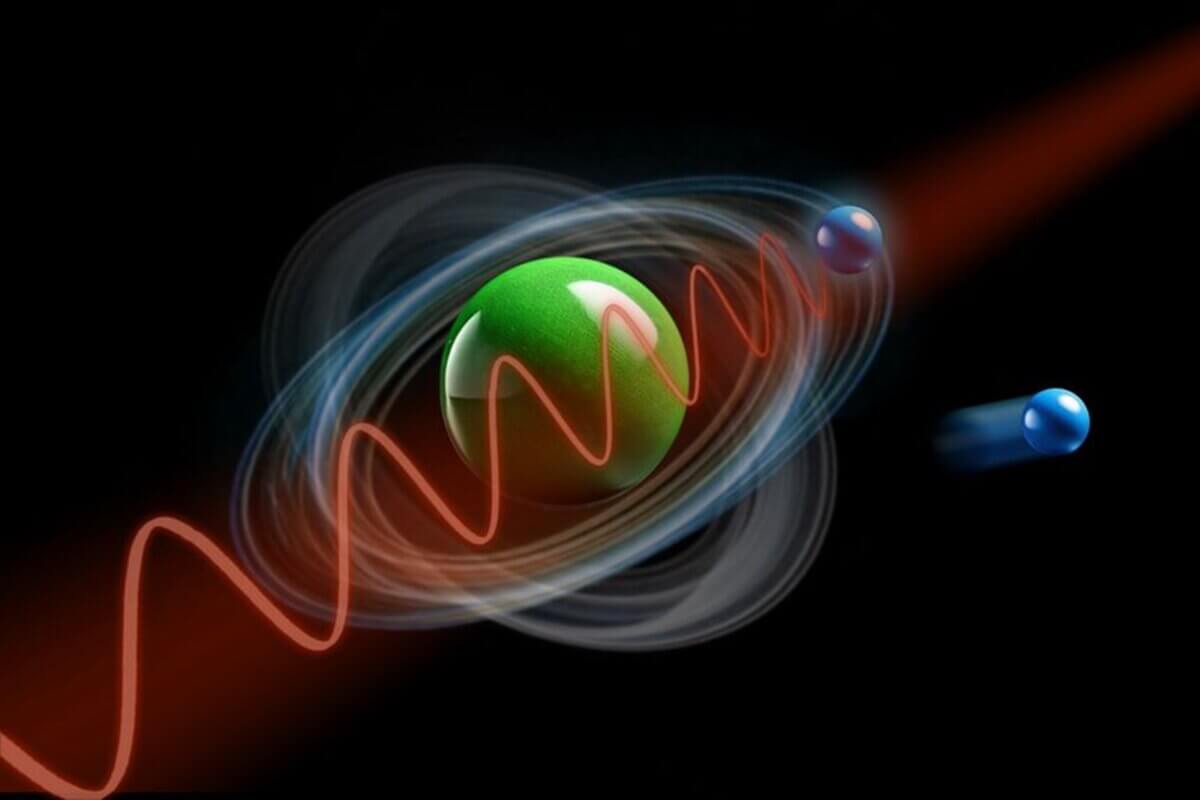
The research team, including scientists from China and Austria, focused their study on what happens when atoms are struck by powerful laser pulses. When hit with sufficiently intense light, one electron gets torn away from the atom while another electron remains behind but jumps to a higher energy state. What makes this remarkable is that these two electrons become quantum entangled – their properties become so interconnected that you can’t describe one without the other.
Perhaps most mind-bending is what the team discovered about the timing of when electrons leave their atoms.
“This means that the birth time of the electron that flies away is not known in principle. You could say that the electron itself doesn’t know when it left the atom,” says Burgdörfer.
It exists in a quantum superposition of having left at both earlier and later times – on average, separated by about 232 attoseconds.
“The electron doesn’t just jump out of the atom. It is a wave that spills out of the atom, so to speak – and that takes a certain amount of time,” adds Professor Iva Březinová, another author of the study. “It is precisely during this phase that the entanglement occurs, the effect of which can then be precisely measured later by observing the two electrons.”
Paper Summary
Methodology
The researchers used a combination of intense extreme ultraviolet laser pulses and infrared light to study how electrons behave when torn from helium atoms. Using powerful computer simulations, they tracked the quantum dance between the escaping electron and its partner left behind. The technique, called “attosecond streaking,” works like an ultra-precise stopwatch that can measure events lasting just a few attoseconds.
Key Results
The study revealed that the timing of electron emission is intrinsically uncertain and quantum entangled with the state of the electron left behind. If the remaining electron is excited to a higher energy state, the departing electron likely left earlier; if the remaining electron stays in a lower energy state, the departing electron probably left later. These timing differences, though only hundreds of attoseconds apart, provide crucial insights into quantum behavior.
Study Limitations
While the current study relies primarily on computer simulations and theoretical models, the researchers are already in discussions with experimental teams who want to prove these ultrafast entanglements in real-world settings. Current technology is approaching the capability to create the precise light pulses needed for such measurements.
Discussion & Takeaways
This research fundamentally changes our understanding of quantum processes by showing they’re not truly instantaneous but unfold over extremely brief time periods. Understanding these quantum dynamics could advance fields like quantum computing and cryptography, where maintaining quantum entanglement is crucial. The ability to track the formation of quantum entanglement in real-time opens new possibilities for controlling and utilizing quantum effects.
Funding & Disclosures
The research was supported by multiple organizations, including the National Natural Science Foundation of China, the Guangdong Basic and Applied Basic Research Foundation, the Austrian Science Fund, the International Max Planck Research School for Advanced Photon Science, and the COST action AttoChem. The study represents a collaboration between multiple institutions across China and Austria, with no reported conflicts of interest.


