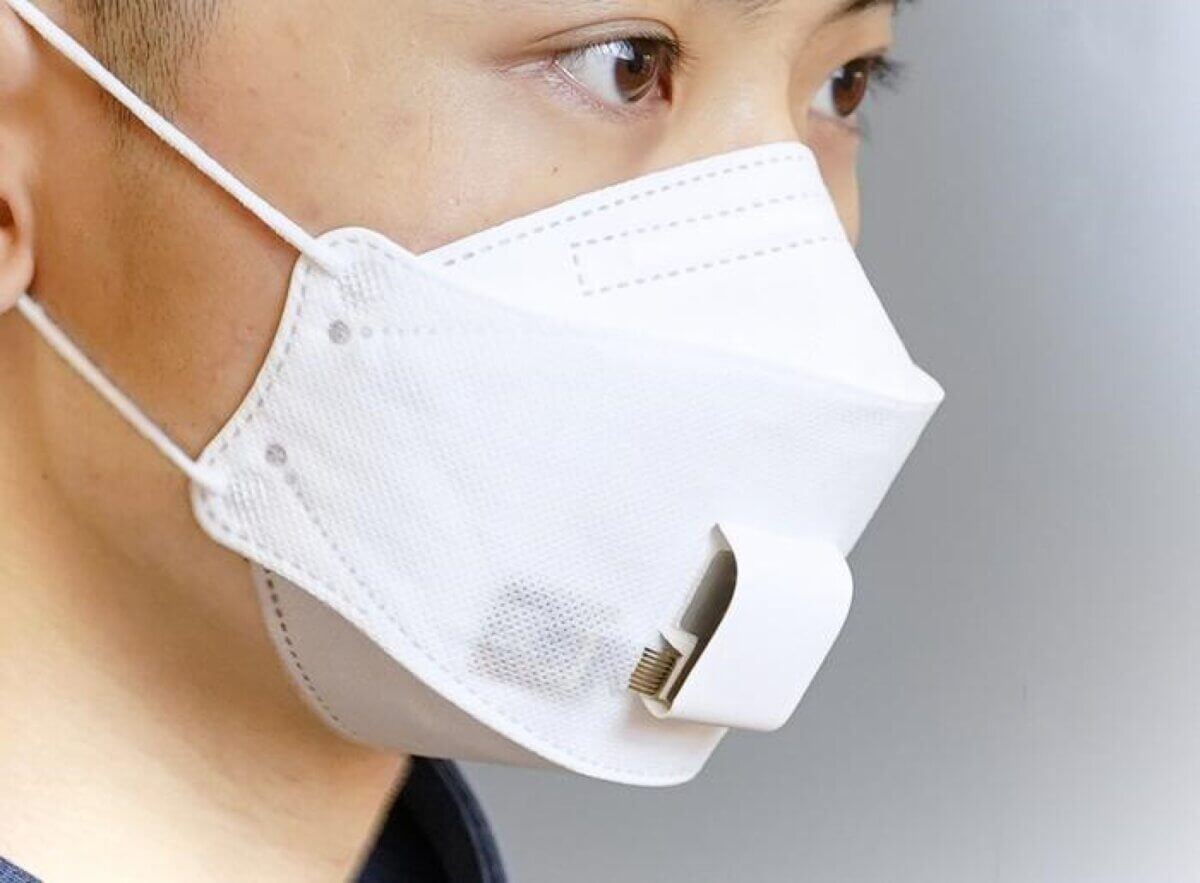
The EBCare mask can analyze the chemicals in one's breath in real-time. (Credit: Caltech/Wei Gao and Wenzheng Heng)
PASADENA, Calif. — Welcome to the future of personalized medicine, where your exhaled breath becomes a window into your well-being. Scientists at the California Institute of Technology have unveiled a groundbreaking smart mask that doesn’t just protect you from germs; it analyzes your breath to keep tabs on your health.
The EBCare mask, short for “exhaled breath condensate analysis and respiratory evaluation,” is the brainchild of Wei Gao, a professor of medical engineering at Caltech, and his team. This isn’t your average face covering. While other smart masks in development focus on physical factors like breath rate or temperature, EBCare dives deeper, examining the very molecules you exhale.
The innovative mask, detailed in a recent study published in Science, goes beyond traditional face coverings by incorporating advanced technology to collect and analyze exhaled breath condensate (EBC). EBC is the liquid that forms when we exhale, containing a variety of molecules that can indicate different aspects of our health. Think of it as a window into your body’s inner workings, accessible through your breath.
What sets EBCare apart is its ability to continuously monitor multiple health markers in real-time as you go about your day. The mask uses a clever cooling system to condense your breath, then employs tiny sensors to detect various substances in the resulting liquid. It’s like having a mini-laboratory right on your face, working tirelessly to keep tabs on your health.
“Since COVID-19, people are wearing masks more. We can leverage this increased mask use for remote personalized monitoring to get real-time feedback about our own health in our home or office,” Gao says in a statement. “For instance, we could use this information to assess how well a medical treatment may be working.”
The potential applications of this technology are vast. EBCare could help monitor chronic conditions like asthma or chronic obstructive pulmonary disease (COPD), track metabolic health, or even detect early signs of respiratory infections. Imagine being able to adjust your medication or lifestyle in real time based on what your breath is telling you or catch an illness before symptoms even appear.
To test their creation, the researchers conducted several studies with both healthy individuals and patients with various conditions. In one experiment, a healthy participant wore the mask for 14 hours, tracking changes in their breath composition throughout daily activities like eating, exercising, and napping. The mask successfully detected fluctuations in ammonia levels related to protein intake and spikes in alcohol concentration after drinking.
The team also tested EBCare on patients with asthma, COPD, and those recovering from COVID-19. They found that the mask could detect higher levels of nitrite, a marker of inflammation, in the breath of these patients compared to healthy individuals. This demonstrates EBCare’s potential for monitoring respiratory conditions and guiding treatment decisions.

“The mask represents a new paradigm for respiratory and metabolic disease management and precise medicine,” says Wenzheng Heng, lead author of the study and a graduate student at Caltech. “The breath condensate contains soluble gases as well as nonvolatile substances in the form of aerosols or droplets, such as metabolic substances, inflammatory indicators, and pathogens.”
One particularly interesting finding was the mask’s ability to estimate blood alcohol levels by measuring alcohol in the breath condensate. This could provide a more convenient and continuous method for monitoring alcohol consumption compared to traditional breathalyzer tests.
“These first studies are a proof of concept,” Gao explains. “We want to expand this technology to incorporate different markers related to various health conditions. This is a foundation for creating a mask that functions as a versatile general health–monitoring platform.”
The EBCare mask is a marvel of miniaturization and clever engineering. Its cooling system uses a combination of evaporation and special materials that reflect sunlight and emit heat, allowing it to work efficiently both indoors and outdoors. The mask’s inner surface is designed with microscopic structures inspired by plants, which help guide the collected breath condensate to the sensors automatically – even when you’re lying down.
Despite its sophisticated technology, the EBCare mask is designed with practicality in mind. The team estimates that the materials for each mask would cost only about $1, making it a potentially accessible option for widespread use. Moreover, participants in the studies reported that the masks were comfortable to wear, even those with breathing difficulties.
While the technology is still in the research phase, it’s not hard to imagine a future where smart masks like EBCare become commonplace. They could be used in healthcare settings to monitor patients more closely or by individuals to take a more proactive approach to their health.
Paper Summary
Methodology
The researchers developed EBCare using a combination of innovative technologies. They created a cooling system using hydrogels and special heat-reflecting materials to efficiently condense breath in various environments. The mask’s inner surface was designed with microscopic structures to guide the collected liquid to sensors automatically. The team integrated multiple electrochemical sensors to detect various substances in the breath condensate, including nitrite, ammonia, pH, and alcohol.
They also developed a wireless system to transmit the data to a smartphone app in real-time. The mask was tested in laboratory settings and on human participants, including healthy individuals and patients with respiratory conditions, to evaluate its performance in real-world scenarios.
Key Results
EBCare demonstrated the ability to continuously monitor multiple breath markers in real time during various daily activities. In healthy participants, the mask detected changes in ammonia levels related to protein intake and spikes in alcohol levels after drinking. In patients with respiratory conditions like asthma and COPD, EBCare measured higher levels of nitrite, indicating inflammation.
The mask also showed a strong correlation between breath alcohol levels and blood alcohol concentration. The device performed consistently in both indoor and outdoor environments, maintaining its cooling and sensing capabilities over extended periods.
Study Limitations
While promising, the study has several limitations. The sample size for patient testing was relatively small, and more extensive clinical trials would be needed to validate the mask’s effectiveness across diverse populations. The current design may not be suitable for all face shapes or sizes, and its comfort during extended wear needs further evaluation.
Additionally, the accuracy and reliability of the sensors over long-term use in real-world conditions require further investigation. The researchers also noted that certain activities, like coughing, could temporarily affect the measurements, though the mask’s design helps mitigate these effects.
Discussion & Takeaways
EBCare represents a significant advancement in wearable health monitoring technology, offering the potential for continuous, non-invasive tracking of various health markers. The mask’s ability to detect markers of inflammation and metabolic activity could be particularly valuable for managing chronic respiratory conditions and monitoring overall health.
The integration of this technology into everyday face masks could lead to more proactive and personalized health management. However, further research is needed to refine the technology, expand its capabilities, and ensure its reliability in diverse real-world settings. The researchers suggest that future iterations could potentially monitor additional biomarkers or be tailored for specific medical conditions.
Funding & Disclosures
The study was funded by several organizations, including the National Institutes of Health, the National Science Foundation, the Office of Naval Research, the Army Research Office, the American Cancer Society, and the Tobacco Related Disease Research Program. One of the researchers, Dr. Harry B. Rossiter, disclosed affiliations with the University of Leeds and involvement in contracted clinical research with various pharmaceutical companies. These relationships were transparently reported and do not appear to have influenced the study’s conduct or findings.


