
The European space probe Solar Orbiter delivers images of the sun, including observations of what is, from our perspective, its far side. (Credit: ESA / AOES, Copyright Holder: ETH Zurich)
In A Nutshell
- Marathon Solar Surveillance: Scientists tracked a single active region on the Sun for 94 days using two spacecraft, far beyond the typical two-week observation limit imposed by solar rotation.
- Nearly 1,000 Flares Unleashed: The region produced 969 solar flares over three months, including 38 powerful X-class eruptions capable of disrupting Earth’s technology and communications.
- Magnetic Complexity Predicts Violence: Researchers found strong correlations between twisted, complex magnetic fields and increased flare activity, providing new insights for space weather prediction.
- Game-Changing Observation Method: This breakthrough demonstrates how coordinated spacecraft can provide continuous solar monitoring, potentially revolutionizing our ability to forecast dangerous space weather events.
For decades solar scientists have had to make do with no more than brief glimpses of active regions on our Sun before they rotate out of view. Now, for the first time, researchers managed to track a single solar region continuously for 94 days and watch it unleash an incredible 969 flares.
This unprecedented achievement, published in Astronomy & Astrophysics, represents a breakthrough in our ability to monitor the Sun’s most violent outbursts. Using coordinated observations from two spacecraft providing far-side and Earth-side viewpoints, scientists followed one exceptionally active region as it completed three full rotations around the Sun – far beyond the typical two-week observation windows that have limited solar research for generations.
Between April 16 and July 18, 2024, this single region designated NOAA 13664 (and its subsequent identifiers 13697 and 13723) produced 969 flares of all sizes: 38 powerful X-class flares, 146 M-class events, 527 C-class flares, and 258 smaller B-class eruptions. To put this in perspective, most active regions are visible from Earth for only about two weeks before solar rotation carries them around to the far side of the Sun, giving scientists just a brief snapshot of their behavior.
Tracking a Solar Powerhouse
The breakthrough came through an unlikely partnership between two spacecraft: NASA’s Solar Dynamics Observatory (SDO), which has been watching the Sun from Earth’s perspective since 2010, and the European Space Agency’s Solar Orbiter, launched in 2020 and currently positioned to observe the Sun’s far side.
“Multi-vantage-point observations offer valuable insights into the dynamics of flux emergence and decay, beyond the two-week limit imposed by solar rotation,” the research team from ETH Zurich and international collaborators noted in their study. This combination allowed them to maintain nearly continuous surveillance as the active region rotated around the Sun.
When the region disappeared from SDO’s Earth-facing view, Solar Orbiter’s instruments picked up the watch from the far side. This tag-team approach enabled scientists to follow the region through three complete 27-day solar rotations, witnessing its full lifecycle from emergence to decay.
The technical achievement required precise coordination between Solar Orbiter’s PHI Full-Disk Telescope and EUI imaging instruments, and SDO’s Helioseismic and Magnetic Imager and Atmospheric Imaging Assembly. Together, these instruments tracked both the magnetic field changes in the Sun’s surface and the explosive flares in its corona.
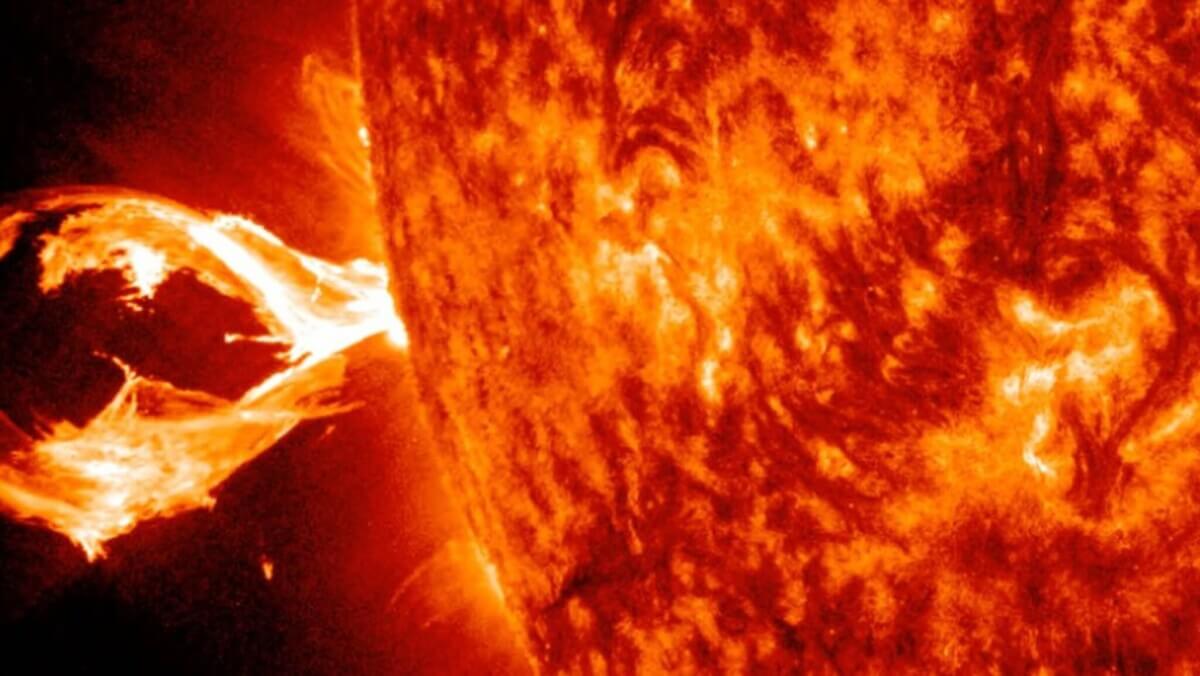
When the Sun Throws a Tantrum
The peak of this solar region’s fury came on May 20, 2024, when it unleashed an X16.5-class flare. But this wasn’t an isolated event. According to the research data, 63% of the region’s X-class flares occurred before this massive eruption, showing that the region was building toward this climactic moment.
X-class flares represent the most powerful category of solar eruptions, capable of causing widespread radio blackouts on Earth and posing risks to satellites and astronauts in space. The fact that this single region produced 38 such events over three months demonstrates just how extraordinarily active it was.
The flare activity wasn’t random, either. The researchers found strong correlations between the complexity of the region’s magnetic field and its tendency to produce flares. Using a measure called the Spearman rank correlation, they discovered that regions with more twisted and complex magnetic field lines were significantly more likely to erupt.
The data showed Spearman rank correlation coefficients as high as 0.76 between certain magnetic field measurements and daily flare activity, providing some of the strongest evidence yet for the relationship between magnetic complexity and solar eruptions.
A New Way to Watch the Sun
What makes this achievement particularly remarkable is how it overcomes one of the fundamental limitations of solar observation. The Sun rotates roughly every 27 days, which means that active regions typically remain visible from Earth for only about two weeks before disappearing around the far side.
“The combined SDO/HMI and SO/PHI dataset facilitates the study of the long-term evolution of the non-potentiality of active regions, not only for exploratory purposes, but also for operational flare and CME-prediction ones,” the researchers explained. This extended view reveals patterns and behaviors that shorter observations simply can’t capture.
The magnetic field measurements showed that this region maintained its complex, flare-producing characteristics throughout all three rotations. Previous studies, limited to single rotations, might have concluded that such regions quickly decay after their initial appearance. Instead, this extended tracking revealed that some regions can remain dangerously active for months.
The observations also revealed how the region evolved over time, with new magnetic flux continuing to emerge from the Sun’s interior even as older magnetic structures decayed. This continuous renewal helped explain why the region remained so prolific in producing flares across its extended lifetime.

What the Long View Reveals
The three-month surveillance provided insights that would have been impossible with traditional observation methods. The researchers found that the region’s magnetic complexity – measured through parameters like total unsigned magnetic flux and the length of magnetic polarity inversion lines – showed predictable relationships with flare production.
During periods when new magnetic flux emerged from the Sun’s interior, flare activity increased. When the magnetic field became more twisted and complex, larger flares became more likely. These patterns only became clear through extended observation that captured the region’s full evolutionary cycle.
The extended tracking revealed how the region evolved over its full lifecycle across the three observed rotations. This lifecycle information could prove valuable for predicting how long newly emerged active regions might remain dangerous.
Importantly, the researchers acknowledge that their results may not apply to all solar active regions. This particular region was exceptionally complex and long-lived. Most active regions are smaller and decay more quickly, though the new observation capabilities demonstrated here could help scientists identify which regions are likely to become long-term threats.
There were some limitations to even this extended observation campaign. Data gaps occurred when the region moved outside the field of view of both instruments, particularly between April 26-29, 2024. Additionally, the different spatial resolutions of the two spacecraft’s instruments required careful calibration to ensure consistent measurements.
The implications of this work extend beyond pure scientific curiosity. Space weather – the effects of solar activity on Earth’s technology and infrastructure – has become increasingly important as our society grows more dependent on satellites, GPS systems, and electrical grids. The ability to track active regions for their full lifetimes could significantly improve our ability to forecast dangerous space weather events.
While this study focused on just one active region, it demonstrates the potential for a new era of solar monitoring. As Solar Orbiter continues its mission and future spacecraft join the fleet, the prospect of routine long-term tracking of multiple active regions simultaneously comes closer to reality.
For space weather enthusiasts and astronomy fans, this research offers a tantalizing glimpse of what continuous solar surveillance might reveal. Rather than catching fleeting glimpses of the Sun’s activity, we may soon be able to watch the complete stories of solar regions unfold – from their violent births in the Sun’s interior to their eventual decay, capturing every explosive chapter along the way.
The 969 flares witnessed during this 94-day marathon represent just the beginning of what extended solar observation might teach us about our nearest star’s most dramatic and potentially dangerous behavior.
Paper Notes
Limitations
The study highlights specific constraints concerning observational coverage and instrument resolution. Methodological difficulties arose from data gaps when the active region moved outside the field of view of both the Solar Orbiter and SDO instruments, particularly between 26 and 29 April 2024. Additionally, the analysis was limited by the lower spatial resolution of the Solar Orbiter PHI-FDT compared to SDO/HMI; this necessitated down-sampling and introduced smoothing, which may have affected the accuracy of small-scale magnetic measurements.
Funding and Disclosures
This work was supported by the European Space Agency (ESA), NASA, and the German BMWi via DLR. Additional funding came from MPG central funds, Spanish AEI/MCIN, and the European Union NextGenerationEU/PRTR (grants RTI2018-096886-C5, PID2021-125325OB-C5, PCI2022-135009-2, PCI2022-135029-2), along with ERDF and Severo Ochoa Center of Excellence awards. The authors also acknowledge support from a Ramón y Cajal fellowship, the French CNES, and the STIX consortium. No competing interests were reported.
Publication Details
Kontogiannis, I., et al. “Near‑continuous tracking of solar active region NOAA 13664 over three solar rotations.” Astronomy & Astrophysics, EDP Sciences, 2025. DOI: https://doi.org/10.1051/0004-6361/202556136. The analysis utilized data from Solar Orbiter (PHI-FDT, EUI, STIX) and SDO (HMI, AIA) instruments, alongside GOES X-ray flare catalogs. The active region NOAA 13664 (later NOAA 13697 and 13723) was tracked for 94 days from 16 April to 18 July 2024.
I. Kontogiannis, Y. Zhu, M. Z. Stiefel, H. Collier, and L. K. Harra are affiliated with ETH Zürich, Switzerland; Stiefel and Collier are also with the University of Applied Sciences and Arts Northwestern Switzerland, and Harra with PMOD/WRC. K. Barczynski is affiliated with PMOD/WRC. J. McKevitt represents University College London and the University of Vienna. J. S. Castellanos Durán is with the Max Planck Institute for Solar System Research, Germany, and S. Berdyugina with Istituto Ricerche Solari Aldo e Cele Daccò and Università Svizzera Italiana.


