
(heller/Shutterstock)
In A Nutshell
- An estimated 6.7 million U.S. children live in a home with at least one gun that is both loaded and unlocked.
- Parents in homes with only teenagers were more likely to store firearms unsafely than those with younger children.
- Gun owners who had recently carried a loaded handgun outside the home were more than three times as likely to keep an unsecured firearm at home.
- Despite decades of safety recommendations, the number of children exposed to loaded, unlocked guns has grown since 2015.
About one in five children living in a gun-owning home in the United States has access to a firearm that is both loaded and unlocked. A new national study puts a number on it, and it is a large one.
A nationally representative survey conducted in December 2024 estimates that roughly 32.3 million children under 18 in the United States live in a household with a firearm. Of those, an estimated 6.7 million live in a home where at least one gun is loaded and unlocked, the least safe storage situation researchers measured.
The study, published in JAMA Network Open, draws on responses from 879 adult gun owners who lived with at least one child under 18. Only about a third stored all their firearms in the safest way possible: unloaded and locked. The rest left at least one gun somewhere in between, or worse.
The Teenage Blind Spot in Gun Storage
The study’s most unsettling finding involves where parents’ guard drops the most: in homes with teenagers. Gun-owning adults in homes where all children were between 13 and 17 stored at least one firearm loaded and unlocked at a rate of about 26%. That compares to roughly 17% among those whose children were all under 13.
This pattern runs contrary to the actual risk. Adolescents are far more likely to die by firearm suicide than younger children, not less. Teenagers can also more easily locate and access a stored gun, regardless of how well it’s hidden. Yet many parents of teens appear to relax their guard, possibly operating under the mistaken belief that older kids are more responsible, or that a locked-up gun would somehow fail them in an emergency.
Researchers suggest this gap may also reflect misplaced confidence among parents, specifically an overestimation of their ability to recognize a crisis in their child before it turns deadly, or a belief that their teenager simply wouldn’t touch the household guns independently.
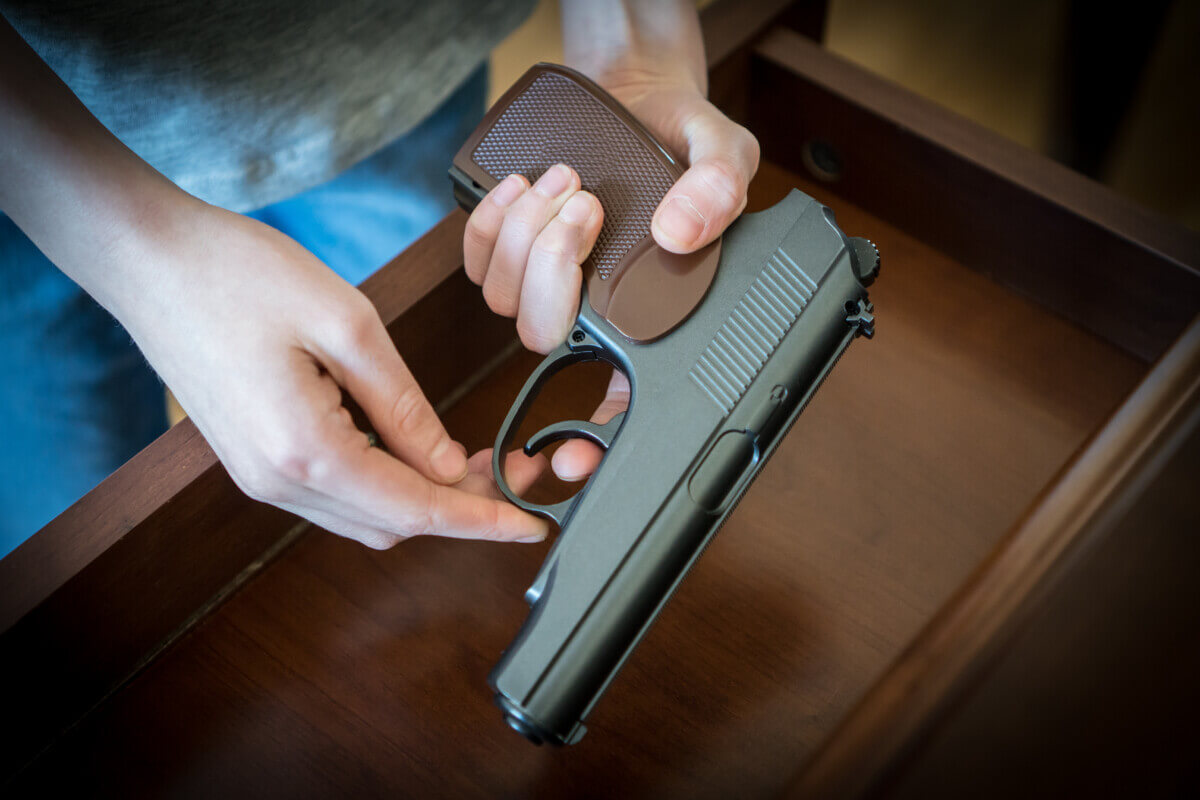
A Loaded Habit That Follows Gun Carriers Home
One other factor stood out clearly: whether the gun owner had recently carried a loaded handgun outside the house. Among gun owners who had done so in the past 30 days, about 41% stored at least one firearm at home in the least safe way. Among those who hadn’t carried recently, that figure dropped to roughly 12%.
The more often someone carried, the worse their home storage tended to be. Those who carried every day were the most likely to have a loaded, unlocked gun somewhere in the home. Researchers stopped short of claiming they know exactly why, but they suggest it may reflect a worldview in which danger feels constant, making quick access to a firearm feel more pressing than locking it away. A simpler explanation may also apply: unloading and securing a handgun every time someone returns home from carrying is an extra step, and many people skip it.
Decades of Warnings, Little Progress on Safe Gun Storage
This is not a new problem. The American Academy of Pediatrics has been urging doctors to counsel families on safe gun storage since 1992. Storage practices do not appear to have improved, and may have gotten worse, though the authors caution that older surveys used different methods.
Surveys from the mid-1990s and early 2000s estimated that between 7% and 11% of gun-owning households with children had at least one firearm that was both loaded and unlocked. The new study puts that figure at about 21%. Even accounting for differences in methodology between older phone surveys and today’s online panels, the data do not paint a picture of progress.
While the rate of unsafe storage may have held relatively steady over the past decade, the share of households with children containing firearms has grown, from an estimated 34% in 2015 to 40% today. That means the raw number of children living alongside loaded, unlocked guns has risen from approximately 4.5 million in 2015 to 6.7 million today.
A Follow-Up Question Changed the Numbers
Researchers at Northeastern University and Harvard ran the survey from December 18 through December 25, 2024, using an established online panel of roughly 60,000 U.S. adults recruited through address-based sampling. Invitations went to 21,907 panel members; 12,909 responded. The final analysis focused on the 879 respondents who personally owned a gun, lived with at least one child under 18, and answered all storage questions.
Respondents were asked how many guns they owned, what types, and exactly how each was stored. A follow-up question asked about the gun the respondent could reach most quickly. When that question was included, the share of gun owners reporting at least one loaded and unlocked firearm jumped from 15% to 21%, suggesting detailed questioning surfaces unsafe practices that simpler surveys miss.
Among the 879 respondents, about 65% were between 18 and 44 years old, about 64% were male, and about 70% lived with children between the ages of 0 and 12. Survey weights were applied so the results could represent the full U.S. population.
With 6.7 million children living in homes with a loaded, unlocked gun, the gap between what researchers know and what families practice remains dangerously wide.
Paper Notes
Limitations
The study’s authors note several important limitations. Because people tend to give more socially acceptable answers when asked about sensitive behaviors, the true number of children living with unsafe firearm storage is likely even higher than what the survey captured. Additionally, in households with more than one gun owner, the survey only collected storage information from one person, which means the least safe storage practice in that home may not have been reported. Comparing findings to older surveys from the 1990s and early 2000s also requires caution, because those earlier surveys used different methods, including phone-based calling rather than online panels, and often collected storage information from household members who didn’t personally own guns, a practice that has been shown to push estimates of unsafe storage artificially lower.
Funding and Disclosures
Funding for this study was provided by the Joyce Foundation, the Fund for a Safer Future, and the Robert Wood Johnson Foundation. The funders had no role in the design or conduct of the study, the collection or analysis of data, or the decision to publish. The authors reported no conflicts of interest.
Publication Details
Authors: Matthew Miller, MD, MPH, ScD; Samuel Fischer, MEd; Eliot Nelson, MD; Deborah Azrael, PhD | Affiliations: Bouvé College of Health Sciences, Department of Public Health and Health Sciences, Northeastern University, Boston, Massachusetts (Miller); Harvard Injury Control Research Center, Harvard T.H. Chan School of Public Health, Boston, Massachusetts (Miller, Fischer, Azrael); Department of Pediatrics, Larner College of Medicine, University of Vermont, Burlington (Nelson). | Journal: JAMA Network Open, Volume 9, Issue 5 | Paper Title: “Firearm Storage in Households With Children” | Published: May 12, 2026 | DOI: 10.1001/jamanetworkopen.2026.12191 | This is an open-access article published under the CC-BY-NC-ND License.


