
(Photo by Miguel Alcântara from Unsplash)
CHICAGO — In the beginning, there was water. Now, scientists believe that water — specifically rain — may have been instrumental in creating the first cells on Earth. A new study reveals how raindrops could have stabilized early protocells, setting the stage for life as we know it.
Conducted by a team of scientists from the University of Chicago and the University of Houston, the study uncovers a potential solution to one of the most perplexing mysteries in the origin of life: how did the first cells form their protective walls?
For decades, researchers have been captivated by coacervate droplets – naturally occurring compartments of complex molecules like proteins, lipids, and RNA. These droplets, which behave like tiny beads of oil in water, have long been considered potential precursors to the first cells. However, there was a significant problem with this theory.
These protocells were too good at exchanging their contents, swapping RNA and other molecules so rapidly that any unique mutations or characteristics would be lost within minutes. This hyper-communication posed a major roadblock to evolution, as there could be no competition or differentiation between protocells.
“If molecules continually exchange between droplets or between cells, then all the cells after a short while will look alike, and there will be no evolution because you are ending up with identical clones,” explains Aman Agrawal, the lead author of the study and a postdoctoral researcher at the University of Chicago’s Pritzker School of Molecular Engineering, in a media release.
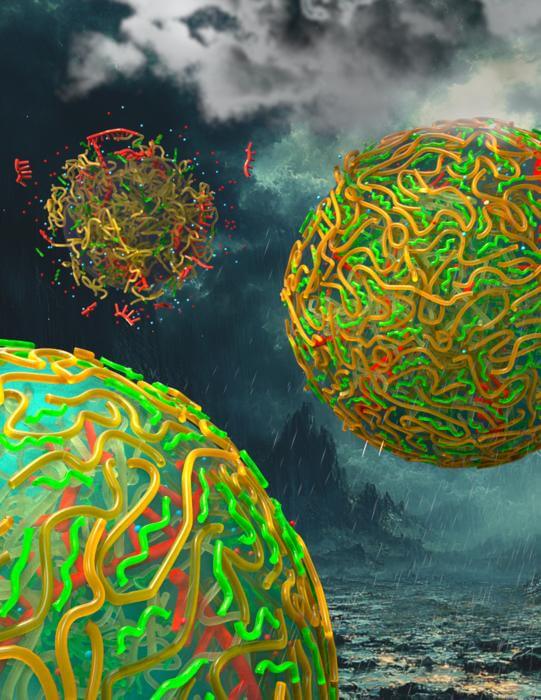
The research team, which included Nobel Prize-winning biologist Jack Szostak, made a surprising discovery when they transferred these coacervate droplets into distilled water. The droplets developed what the researchers describe as a “tough skin” – a meshy wall that significantly slowed down the exchange of RNA between protocells. This simple act of transferring the droplets into pure water extended the timescale of RNA exchange from minutes to several days, providing enough time for mutations to occur and evolution to take place.
How does this relate to the primordial Earth?
The key lies in the most basic of weather phenomena: rain. When asked where distilled water could have come from in a prebiotic world, both Matthew Tirrell, Dean Emeritus of the Pritzker School of Molecular Engineering, and Jack Szostak independently arrived at the same answer: rain.
To test this theory, the team went beyond laboratory-grade distilled water. They collected actual rainwater from Houston and tested their protocells in it. The results held up, demonstrating that even in real-world conditions, the meshy walls could form around the protocells, creating the perfect environment for early evolution.
This stabilization, the researchers propose, occurs because the sudden exposure to pure water causes the formation of a kind of “skin” around each droplet. This skin is created by electrostatic interactions between molecules at the droplet’s surface. It’s as if each droplet develops a thin, flexible membrane that keeps it separate from its neighbors.
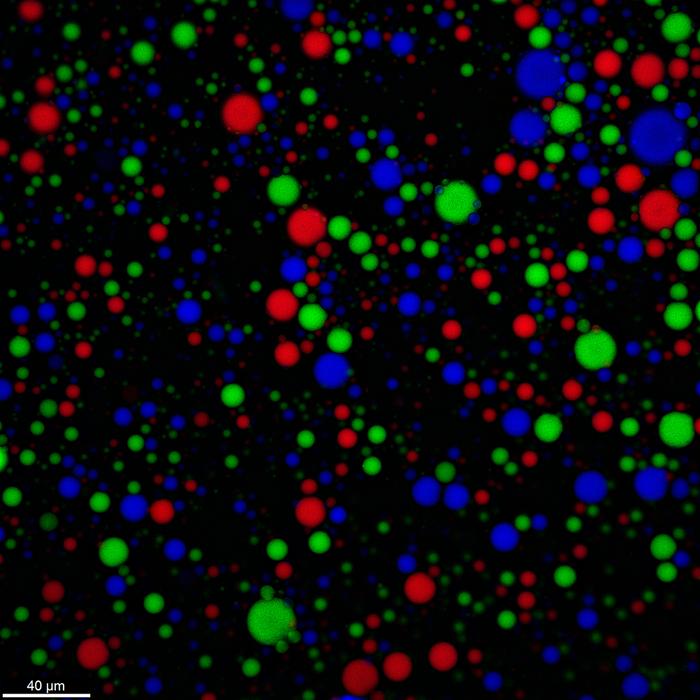
One of the most intriguing aspects of these stabilized droplets is their selective permeability. While small molecules and short RNA sequences (6-8 nucleotides long) could still pass through the droplets relatively quickly, longer RNA sequences (35 nucleotides or more) remained compartmentalized for days. This property is crucial because it allows for the retention of genetic material — a fundamental requirement for evolution — while still permitting the entry of smaller molecules that could serve as building blocks or energy sources.
The researchers also demonstrated that these stabilized protocells could perform simple chemical reactions. They created droplets containing different enzymes and showed that the droplets could exchange small molecules to carry out a two-step reaction, mimicking basic cellular metabolism.
The study, published in Science Advances, provides a plausible mechanism for how the first cells might have developed their distinctive boundaries, a critical step in the journey from simple molecular assemblies to the complex life forms we see today. It bridges a crucial gap in our understanding of how life could have evolved from a soup of organic molecules to organized, self-replicating entities capable of Darwinian evolution.
The implications of this research extend far beyond the realm of theoretical biology. By understanding the conditions that allowed for the emergence of cellular life, we gain insights that could inform fields ranging from medicine to artificial life.
While this research doesn’t definitively solve the mystery of life’s origins, it provides a compelling new piece of the puzzle. It demonstrates how relatively simple physical and chemical processes could have laid the groundwork for the emergence of cellular life, bridging the gap between non-living chemistry and the complex biological systems we see today.
Paper Summary
Methodology
The researchers created coacervate droplets by mixing solutions of poly(diallyldimethylammonium chloride) (PDDA) and adenosine triphosphate (ATP) in water. They added fluorescently labeled proteins or RNA to these droplets to track their behavior. To stabilize the droplets, they transferred a small amount of the coacervate mixture into distilled water and gently mixed it.
They then used advanced microscopy techniques to observe how the droplets behaved over time, measuring whether they fused together and how quickly molecules moved between them. The team also tested the droplets’ stability in various conditions, including different salt concentrations, pH levels, and temperatures. They even collected real rainwater to verify their findings in more natural conditions.
Key Results
The study yielded several significant findings that shed light on the potential role of rainwater in stabilizing early protocells. When coacervate droplets were transferred to distilled water or rainwater, they exhibited remarkable stability against fusion, maintaining their integrity for months rather than the mere minutes observed in unstabilized droplets. This enhanced stability was accompanied by a selective permeability that allowed for interesting molecular dynamics. Short RNA sequences, consisting of 6-8 nucleotides, could still move between droplets relatively quickly, potentially facilitating the exchange of simple building blocks.
In contrast, longer RNA sequences of 35 nucleotides or more remained compartmentalized within individual droplets for days, a crucial feature that could allow for the retention and evolution of genetic information. Importantly, these stabilized droplets were not inert; they demonstrated the ability to perform simple enzymatic reactions while maintaining their separation, hinting at the possibility of early metabolic processes. The robustness of these protocells was further evidenced by their stability at moderately elevated temperatures, up to 50°C, suggesting they could withstand varying environmental conditions.
Perhaps most intriguingly, the stabilizing effect was observed not only in laboratory-grade distilled water but also in actual rainwater collected in Houston, lending credence to the potential relevance of this mechanism in prebiotic Earth conditions.
Study Limitations
The specific molecules used (PDDA and ATP) are not prebiotically plausible, though they serve as models for similar compounds that might have existed. The research also doesn’t address how these protocells might have grown or divided, which are crucial aspects of life.
Additionally, while the use of real rainwater adds credibility to the findings, the chemical composition of modern rain differs from that of the early Earth. The study provides a proof of concept, but further research is needed to identify more prebiotically relevant molecules that could exhibit similar behavior.
Discussion & Takeaways
This research provides a novel perspective on how life might have originated, suggesting that simple environmental factors like rainfall could have played a crucial role in stabilizing early protocells. The ability of these stabilized droplets to selectively retain longer RNA molecules while allowing smaller molecules to pass through is particularly significant, as it could allow for the evolution of more complex genetic systems.
The study demonstrates how these protocells could perform basic chemical reactions, hinting at how early metabolic processes might have developed. These findings open up new avenues for research into the origin of life and highlight the importance of interdisciplinary collaboration in tackling complex scientific questions.
“When we’re looking at something like the origin of life, it’s so complicated and there are so many parts that we need people to get involved who have any kind of relevant experience,” Szostak notes.
Funding and Disclosures
The study was funded by several organizations, including the Houston Endowment Fellowship, the Welch Foundation, the U.S. Department of Energy, and the Howard Hughes Medical Institute. The authors declared no competing interests.
The research was a collaborative effort between the University of Chicago’s Pritzker School of Molecular Engineering, the University of Houston’s Chemical Engineering Department, and biologists from the University of Chicago’s Chemistry Department, demonstrating the interdisciplinary nature of origin of life research.


