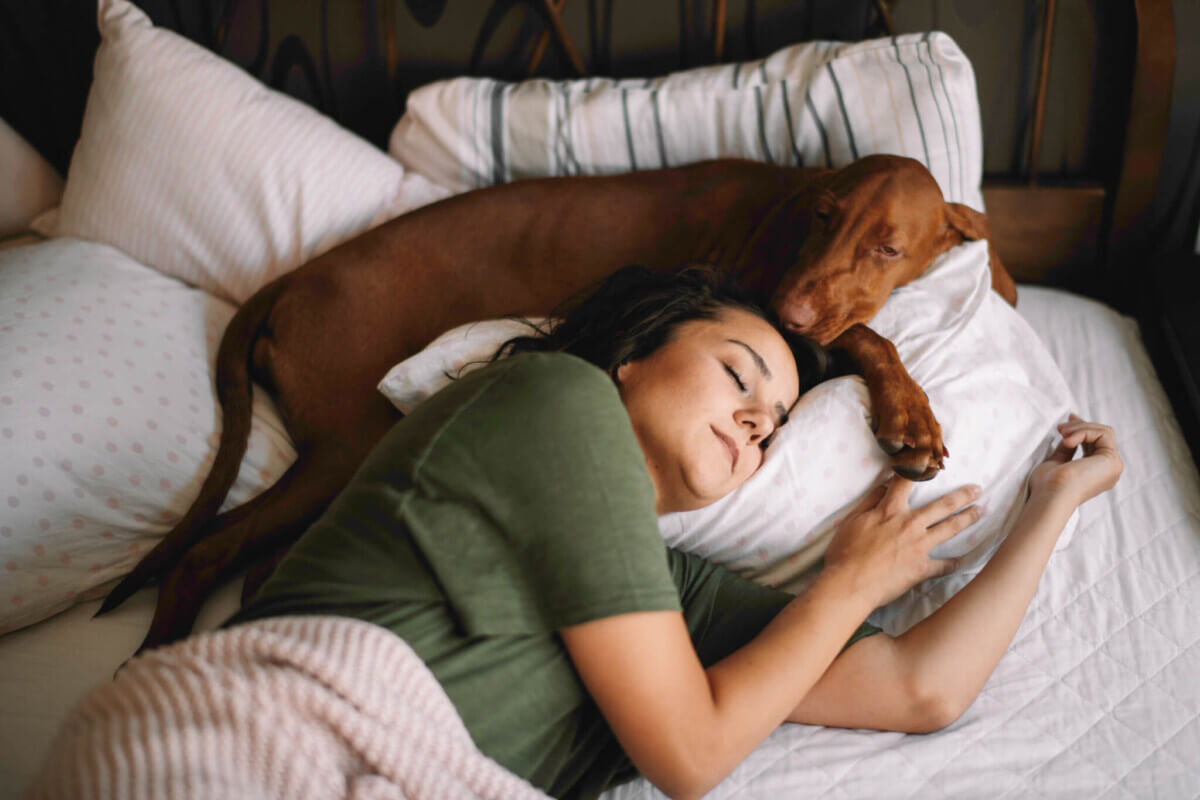
(© JustLife - stock.adobe.com)
Dogs Get Blamed For Restless Nights, But Owners Often Move First
In A Nutshell
- Owners often moved before their dogs, though timing does not prove cause.
- Bed sharing did not significantly change owners’ measured sleep.
- Owners with multiple dogs rated their sleep worse, but sensors showed no gap.
- Small study: 25 owners, 38 dogs, COVID-19 lockdowns.
Anyone who blames a dog for a rough night may be only half right. Sensor data from 25 dog owners and their 38 huskies and malamutes showed that people and dogs stir in step overnight, and each can set the other off. Even so, sharing a bed with a dog did not significantly change how long or how well owners slept.
Researchers from the University of Toronto and Duke University had owners wear motion sensors on their wrists and fitted matching sensors to dog collars for about four weeks. A clear link showed up in 22 of the 36 human-dog pairs analyzed. Within those linked pairs, the person moved first in 45% and the dog in 18%, while the remaining 36% moved within the same minute, too close together to tell who started it. The results appeared in PLOS One.
A questionnaire told a different story for owners with more than one dog, and timing is not proof of cause. The sensors cannot show whether one sleeper actually woke the other or how rested either one felt.
Dog Owners Moved Before Their Dogs More Often Than the Reverse
Participants were adults living in or near Ontario, 21 women and four men, averaging about 39 years old. To keep breed differences from muddying the results, researchers enrolled only huskies and malamutes between ages 2 and 12, and left out dogs with owner-reported medical problems that might affect how much they move.
Between early November and early December 2021, during COVID-19 lockdowns, each person wore a sensor similar to a fitness tracker, and each dog wore one on a collar. The devices logged movement minute by minute, and researchers compared owners and dogs only during each owner’s sleep hours. Dog sensors have not been validated for telling sleep from waking, so any detected movement, even a twitch, counted as activity. Owners also completed the Pittsburgh Sleep Quality Index, a well-known survey asking people to rate their own sleep over the past month.
Usable data covered 36 human-dog pairs. Nights with more owner movement tended to be nights with more dog movement, though the connection was small. In 14 pairs, minute-by-minute timing showed no clear connection at all.
Two earlier studies had pointed the other way, with dogs more often setting off human movement. The authors offer one possible reason for the reversal: lockdown stress. A restless, stressed person may have tossed and turned, disturbing a dog sleeping nearby.
Where dogs slept offered a hint, though the numbers were tiny. In all four pairs where the dog moved first, the dog did not sleep on the bed. Of three linked pairs that always shared a bed, two had the person moving first and one moved within the same minute. Far too few pairs to draw firm conclusions.

Dogs in Bed Did Not Change Dog Owners’ Measured Sleep
Of the 25 owners, four always shared a bed with a dog, 10 did sometimes, and 11 never did. Whether a person slept with a dog, with another human, or with both, the trackers found no significant difference in total sleep time or sleep efficiency, the share of time in bed actually spent asleep. Owners averaged about 6.2 hours of sleep a night, with sleep efficiency near 79%. Likewise, nothing the researchers checked, including where the dog slept, significantly changed how much dogs moved at night.
Owners’ own impressions were mixed. About half, 12 of 25, said a dog had interrupted their sleep. Even so, most said barking (88%) or noise from dog movement (84%) did not disturb them, and 14 reported zero dog-caused wake-ups.
Dog Owners With Two or More Dogs Rated Their Sleep Worse, but Trackers Showed No Gap
Thirteen owners lived with more than one dog, and their survey scores pointed to poorer sleep than those of the 12 owners with a single dog. On this survey, higher scores mean worse sleep, and the average across all participants was 6.84, above the score of 5 the authors cite as a sign of poor sleep. Yet the sensors recorded no significant difference in how long or how efficiently multiple-dog owners slept.
A caution applies. Only 25 people took part, the result barely cleared the usual bar for statistical significance, and the survey results as a whole did not significantly beat a model with none of the household factors in it. A larger group would need to confirm the pattern. Gaps between how sleep feels and what sensors measure are widely reported in sleep research, according to the paper.
Dogs get blamed for bad nights, and the sensors say owners often stir first. Neither side is cleared, though. In the authors’ words, “Both humans and their dogs impact the nighttime activity of one another.”
Disclaimer: This article is for informational purposes only and does not constitute medical advice. It summarizes a single study and should not replace guidance from a qualified health professional. Consult a doctor with any questions about sleep or health.
Paper Notes
Limitations
Findings come from a small group of 25 people in southern Ontario, 21 of them women, so results may not apply to other groups. Data collection took place during COVID-19 lockdowns, which changed daily routines and stress levels, and the team did not account for other people in the household. Only huskies and malamutes were studied, and activity patterns can differ by breed. All participants owned dogs, so the study had no comparison group of people without dogs and cannot say whether having a dog at all changes human sleep. Sensors recorded movement in one-minute intervals, so about 36% of linked pairs could not be sequenced. The dog sensors have not been validated for telling whether a dog is asleep, and any detected movement counted as activity, which may have overestimated dog activity, including twitches during dreaming. Without video or sound recording, the team could not identify causes such as snoring, bathroom trips, or a dog shifting position. The sensor setting used for human sleep was not the one validated against laboratory sleep tests, though the authors believe within-group comparisons remain sound. Owners completed the questionnaire only once, at the end of the study, which may have introduced recall bias. The multiple-dog result (p=0.042, 25 participants) came from a model that was not significantly better than a baseline model (p=0.116). The study measured timing and association, not cause.
Funding and Disclosures
The work was supported by Discovery Grants from the Natural Sciences and Engineering Research Council of Canada (RGPIN-2020-04159 to L. Schroeder and RGPIN-2020-05942 to D. R. Samson). The funders played no role in the study design, data collection and analysis, decision to publish, or preparation of the manuscript. The authors declared no competing interests. All data and code are publicly available on OSF (osf.io/7dt3c/).
Publication Details
The study, titled “Who is disrupting whom? Examining the nighttime activity patterns of humans and their dogs,” was written by Ming Fei Li (Department of Anthropology, University of Toronto, and Department of Evolutionary Anthropology, Duke University), Lavania Nagendran, Christopher Kiru, Lauren Schroeder, and David R. Samson (all Department of Anthropology, University of Toronto Mississauga). Li and Nagendran contributed equally. It was published October 7, 2026, in PLOS One, volume 21, issue 10, article e0358453, after acceptance on September 1, 2026. Editor: Stanley Chinedu Eneh, The University of Texas at El Paso. DOI: https://doi.org/10.1371/journal.pone.0358453


