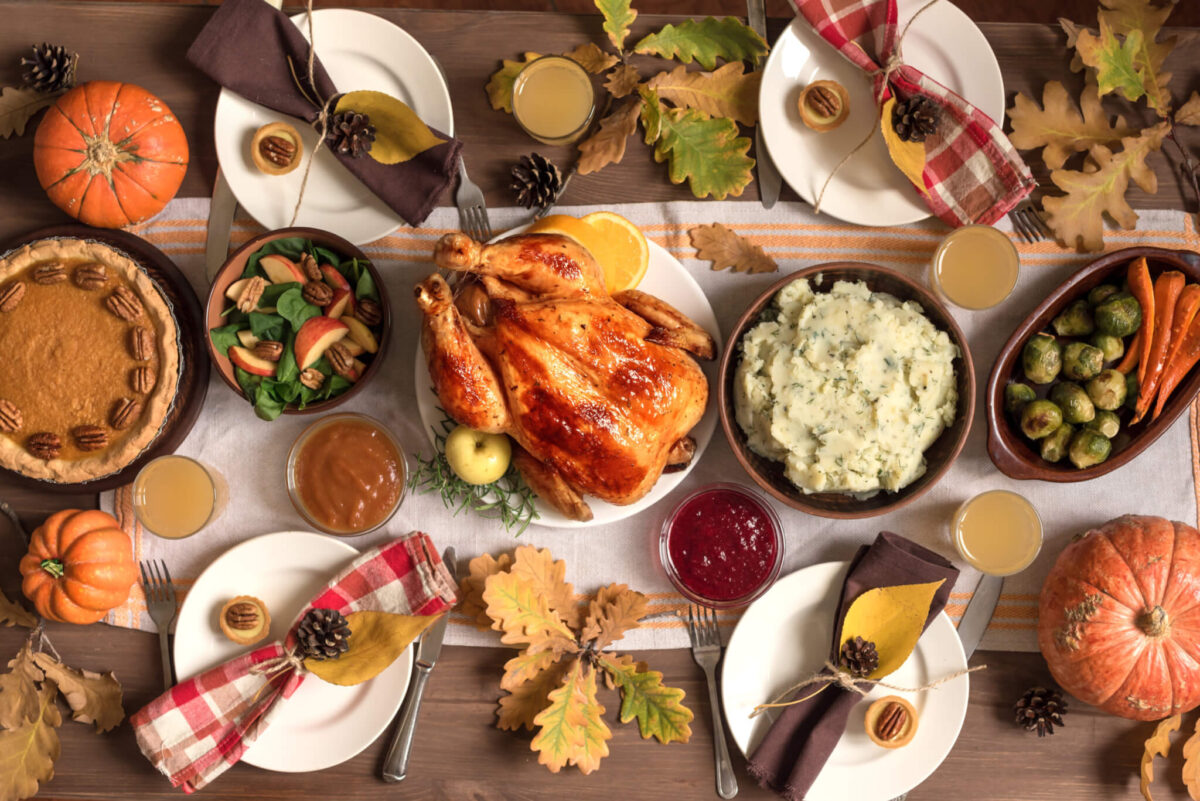
A grand Thanksgiving feast. (Credit: © mizina - stock.adobe.com)
In a Nutshell
- Households that hosted a Thanksgiving meal threw out 78% more once-edible food than those who neither hosted nor attended; households that did both wasted 140% more.
- About 74% of holiday cooks made more food than needed, and uncertainty over how much guests would eat drove the most waste, more than a deliberate plan to keep leftovers.
- Nearly 1 in 5 cooks tossed food just to clear refrigerator space for the turkey, meaning some waste starts days before the meal is cooked.
That satisfying Thanksgiving spread has a quieter afterlife in the garbage can. Households that hosted a holiday meal threw out 78% more once-edible food during Thanksgiving week than households that sat the celebration out, according to a new study, and the ones that both hosted and attended wasted a staggering 140% more.
Researchers tracked self-reported food discards from a national online sample of American home cooks, first during Thanksgiving week of 2025 and again during an ordinary week in December. Their analysis, published in the journal Waste, offers one of the first close looks at how a single holiday reshapes what families scrape into the bin.
Deeper involvement in the meal meant a bigger pile of wasted food. People who only attended a gathering discarded 59% more than the uninvolved group, and those who both hosted and attended wasted 140% more. Measured in raw amounts, households that stayed home wasted about 356 grams of food per person that week, while hosts and guests combined topped 800 grams.
How Hosting Drives Thanksgiving Food Waste
Food waste scaled with the intensity of the celebration, not with who was at the table. After accounting for age, income, education, household size and other factors, hosting and attending still stood out as the behaviors tied to heavier discards. Belonging to a particular age group or income bracket did not explain the gap.
Hosting and attending appear to stack. Households that both hosted a gathering and attended one elsewhere reported roughly twice the extra waste compared with uninvolved homes, and more than those that did just one. The authors write that “holiday meal involvement is strongly associated with waste.”
Not every food category landed in the trash equally. Produce made up the largest raw amount of wasted food, but meat and fish accounted for the largest share respondents blamed directly on the holiday meal (39%), followed by grains and starches (29%) and drinks (23%).
Cooking Far More Than the Table Needs
Over-preparation sat at the heart of the problem. About 74% of people who cooked for a Thanksgiving meal admitted to making more food than they needed. Their reasons varied: 37% deliberately cooked extra for leftovers, 25% were unsure how much their guests would eat, and 12% cited a family tradition of piling the table high.
Each reason came with a real cost. Compared with cooks who made just enough, those who guessed wrong about guest appetites wasted the most, about 363 grams more food per person for the week. Uncertainty, in other words, proved more wasteful than a deliberate plan to keep leftovers.
Leftovers themselves were not the villain. Most hosts found a use for them: 49% folded extra food into breakfast or brunch, 28% built sandwiches and wraps, and 26% cooked entirely new meals. About 37% of hosts sent guests home with a container, a small act that quietly moved food off their own waste pile. Barely 1% donated anything to a food bank.

Making Room For the Turkey
One source of waste had nothing to do with leftovers and everything to do with the calendar. Roughly 19% of people preparing holiday food reported tossing items simply to clear space in the refrigerator for the turkey and other provisions. Those households reported about 438 grams more food waste per person than comparable cooks who left the fridge alone, more than an uninvolved home throws out across an entire week.
Timing is the part worth acting on. Because the waste happens before the meal is even cooked, the researchers point to “pre-game” fixes, such as recipes that use up perishable items in the days before the big grocery run. Clearing the fridge by eating down what is already there, rather than throwing it out, could head off a chunk of holiday waste before the holiday starts.
Counting the National Cost of Thanksgiving Food Waste
Scaling the survey to the whole country paints a costly picture. Among the 437 households tracked across both weeks, per-person waste ran 39% higher by weight and 40% higher by value during Thanksgiving week than during the December comparison week. Projecting those survey figures onto the U.S. population, the researchers estimated that Americans discarded roughly 166,500 metric tons of food during Thanksgiving week, worth about $3.0 billion, against an estimated 122,400 metric tons in an ordinary December week.
Sinks and garbage disposals felt the strain too. Food sent down the drain or disposal nearly doubled during Thanksgiving week, a 98% jump that helps explain why cities issue warnings about grease and clogged pipes every November.
Both estimates likely run low. People tend to under-report how much food they throw away, sometimes by half, so the real holiday total is probably larger. For a season built around abundance, the research lays out a short list of places where a little planning could spare a lot of food, starting with the fridge, well before the first guest arrives.
Paper Notes
Limitations
Several caveats temper the results. All waste figures come from self-reports rather than physical measurements of what households actually threw out, and prior research shows surveys can undercount real waste by as much as 50%, so the national totals are best read as lower bounds. Coverage extends only to once-edible food and says nothing about inedible scraps like bones and peels. Participants came from an opt-in online panel rather than a random national sample, and households that reported a second week in December were not randomly chosen, which could bias the week-to-week comparison. Per-person estimates also rest on each home’s usual size rather than the number of people actually present at a given meal.
Funding and Disclosures
Funding came from the National Science Foundation (Grant #2115405, Multiscale RECIPES) and two U.S. Department of Agriculture awards through USDA NIFA (#OHO01546) and USDA-OCE (#58-0111-23-001). Authors Li and Roe declared no conflicts of interest, and the funders had no role in the study’s design, analysis, or decision to publish. Ohio State University’s Institutional Review Board approved the protocol (2024E0001).
Publication Details
Paper Title: “Talking Turkey: Residential Food Waste and Thanksgiving”
Authors: Ran Li (Department of Agricultural Economics, Sociology, and Education, Pennsylvania State University) and Brian E. Roe (Department of Agricultural, Environmental, and Development Economics, Ohio State University). Corresponding author Brian E. Roe can be reached at [email protected].
Journal: Waste, October 16, 2026, (volume 4, article 36)
DOI: 10.3390/waste4040036


