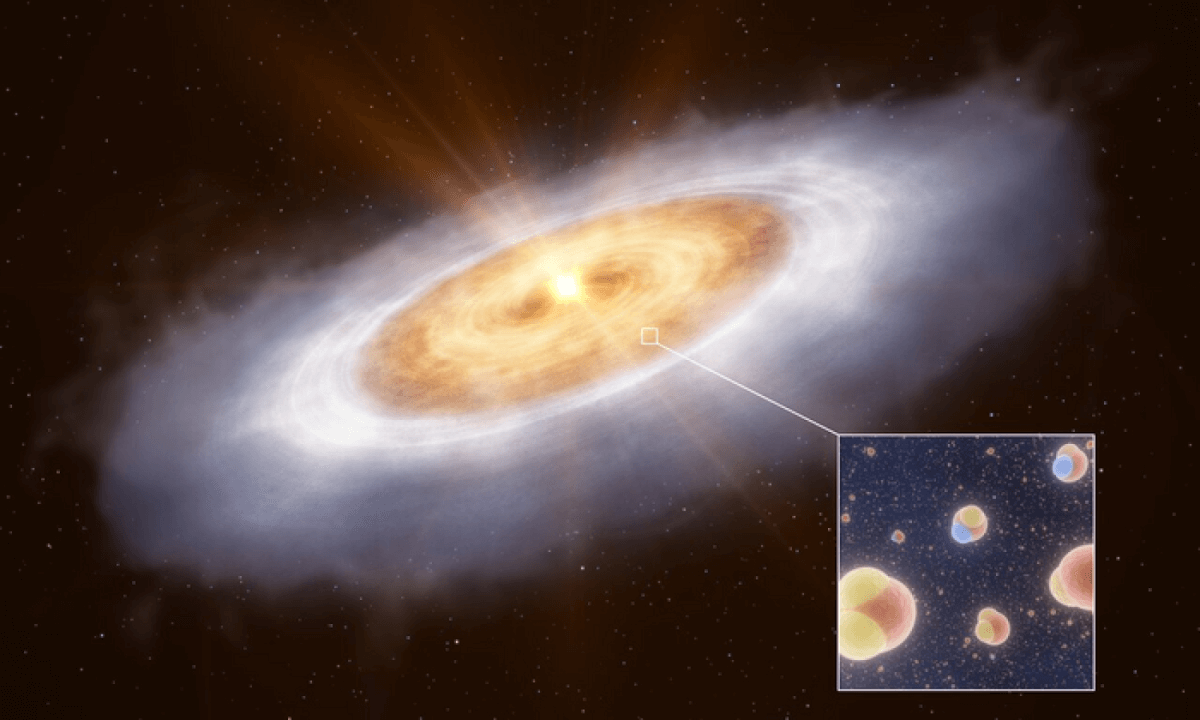
This artist’s impression shows the planet-forming disc around the star V883 Orionis. In the outermost part of the disc water is frozen out as ice and therefore can’t be easily detected. An outburst of energy from the star heats the inner disc to a temperature where water is gaseous, enabling astronomers to detect it. The inset image shows the two kinds of water molecules studied in this disc: normal water, with one oxygen atom and two hydrogen atoms, and a heavier version where one hydrogen atom is replaced with deuterium, a heavy isotope of hydrogen. CREDIT: L. Calçada/European Southern Observatory
SANTIAGO, Chile — Astronomers have traced the source of Earth’s oceans, rivers, and lakes back to a stellar nursery located 1,300 light years away. They’re describing this finding as the “missing link” in the evolution of life as we know it.
“We can now trace the origins of water in our Solar System to before the formation of the Sun,” says lead author Dr. John Tobin of the National Radio Astronomy Observatory.
The international team discovered gaseous water in a substantial planet-forming disc around the star V883 Orionis. This star, located in the Orion constellation in the southwestern sky, was studied using the ALMA (Atacama Large Millimeter/submillimeter Array) telescope in Chile. Upon examination, researchers found that the disc contained at least 1,200 times the quantity of water found in all of Earth’s oceans. This discovery could potentially aid researchers in identifying planets or moons that are most likely to harbor extraterrestrial life.
Scientists have previously observed the transfer of water from clouds to young stars, and subsequently from comets to planets. However, the connection between young stars and comets has remained elusive, until now.
“V883 Orionis is the missing link in this case,” affirms Dr. Tobin in a media release. “The composition of the water in the disc is very similar to that of comets in our own Solar System. This is confirmation of the idea that the water in planetary systems formed billions of years ago, before the Sun, in interstellar space, and has been inherited by both comets and Earth, relatively unchanged.”
Observing the water was a challenging task, as the movement of molecules is restricted when they are in a frozen state.
“Most of the water in planet-forming discs is frozen out as ice, thus usually hidden from our view,” explains Margot Leemker, a co-author of the study and a Ph.D. student at Leiden Observatory in the Netherlands.
Detecting gaseous water is possible due to the radiation emitted by molecules as they spin and vibrate. It is typically found near the center of the discs, close to the star, where temperatures are higher. Unfortunately, these central regions are concealed by dust and are too minuscule to be imaged with our telescopes.
The disc around V883 Orionis, however, is anomalously hot due to a significant energy outburst from the star. This raises the disc’s temperature to a point where water transitions from ice to gas, enabling detection.
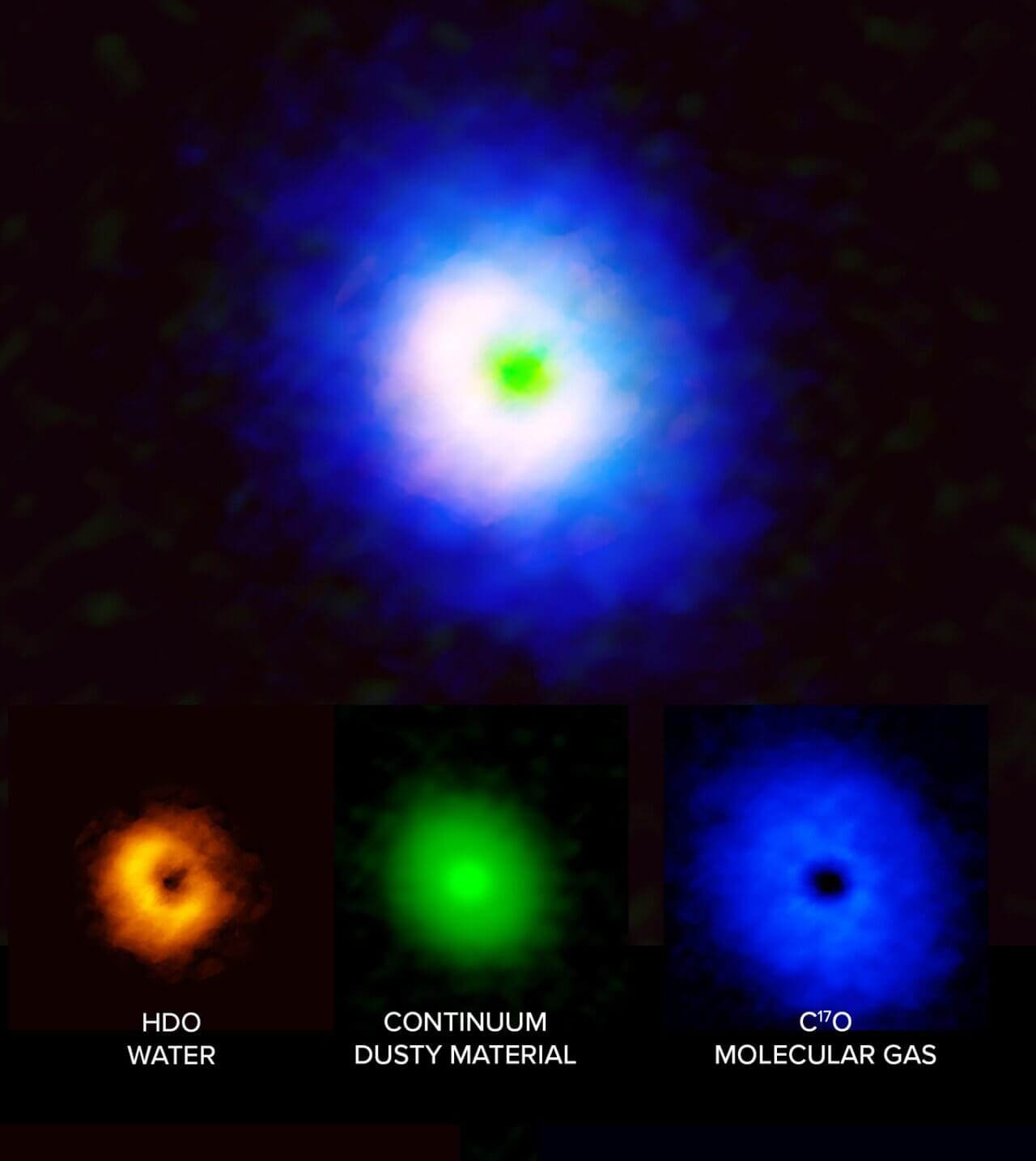
The sensitivity of ALMA and its ability to discern small details even allowed the researchers to map the water within the disc. With the forthcoming Extremely Large Telescope, they hope to track the journey of water from star-forming clouds to solar systems.
“This will provide us with a much more comprehensive view of the ice and gas in planet-forming discs,” Leemker concludes.
The study is published in the journal Nature.
You might also be interested in:
South West News Service writer Mark Waghorn contributed to this report.


