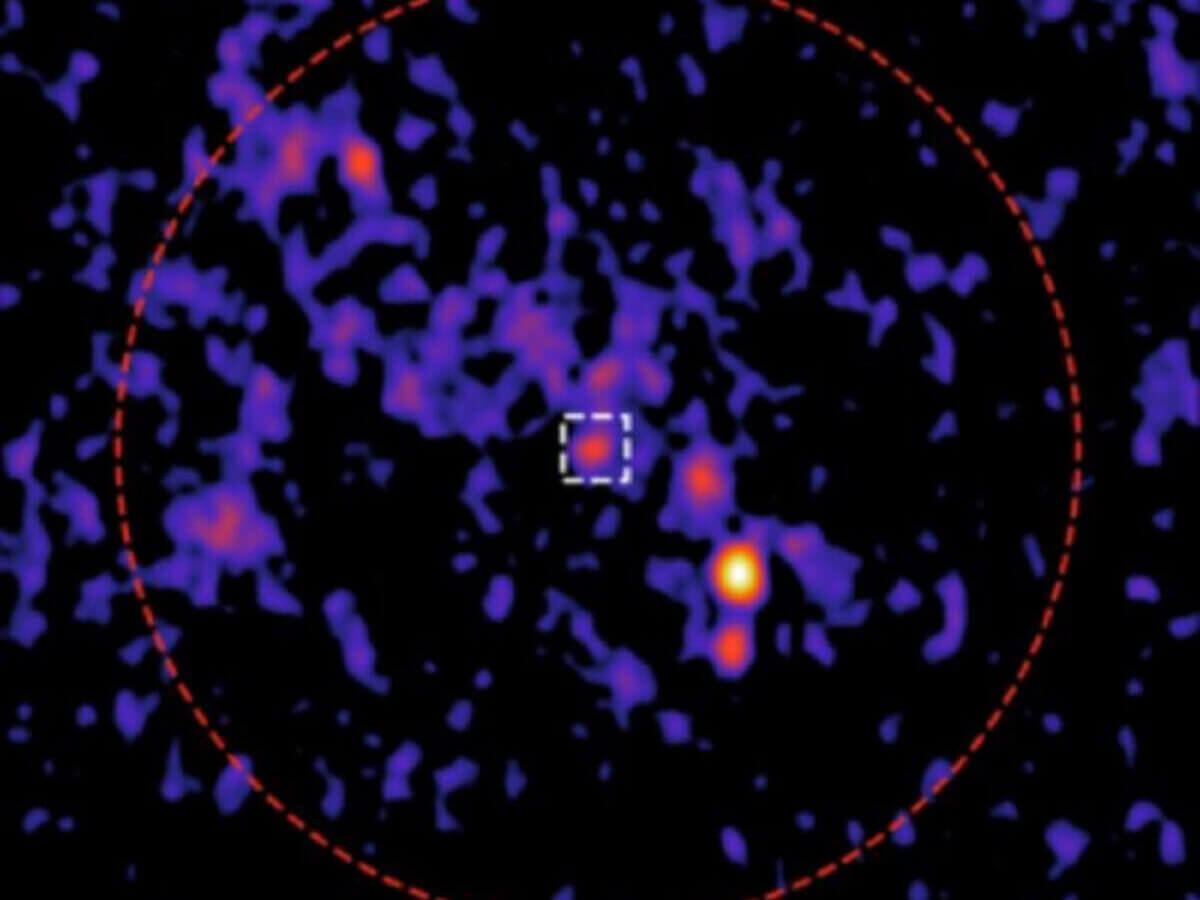
The team identified a new radio source (white square) in the center of the cluster (red circle). (Credit: Paduano et al.)
????What To Know:
- The signal is coming from the center of 47 Tucanae
- The star cluster is visible to the naked eye and was first spotted in the 1700s
- The signal may be coming from a black hole or a pulsar
PERTH, Australia — A new radio signal coming from the center of an ancient star cluster has been discovered, scientists say. This signal emerges from the center of 47 Tucanae, the second brightest globular cluster in the night sky.
The discovery is credited to a research team led by members of the International Centre for Radio Astronomy Research (ICRAR) at Curtin University in Australia. This team has also achieved a significant milestone by creating the most sensitive radio image ever of an ancient star cluster.
“Globular clusters are very old, giant balls of stars that we see around the Milky Way,” explains Astronomer Dr. Arash Bahramian in a media release. “They’re incredibly dense, with tens of thousands to millions of stars packed together in a sphere.”
“Our image is of 47 Tucanae, one of the most massive globular clusters in the galaxy. It has over a million stars and a very bright, very dense core.”
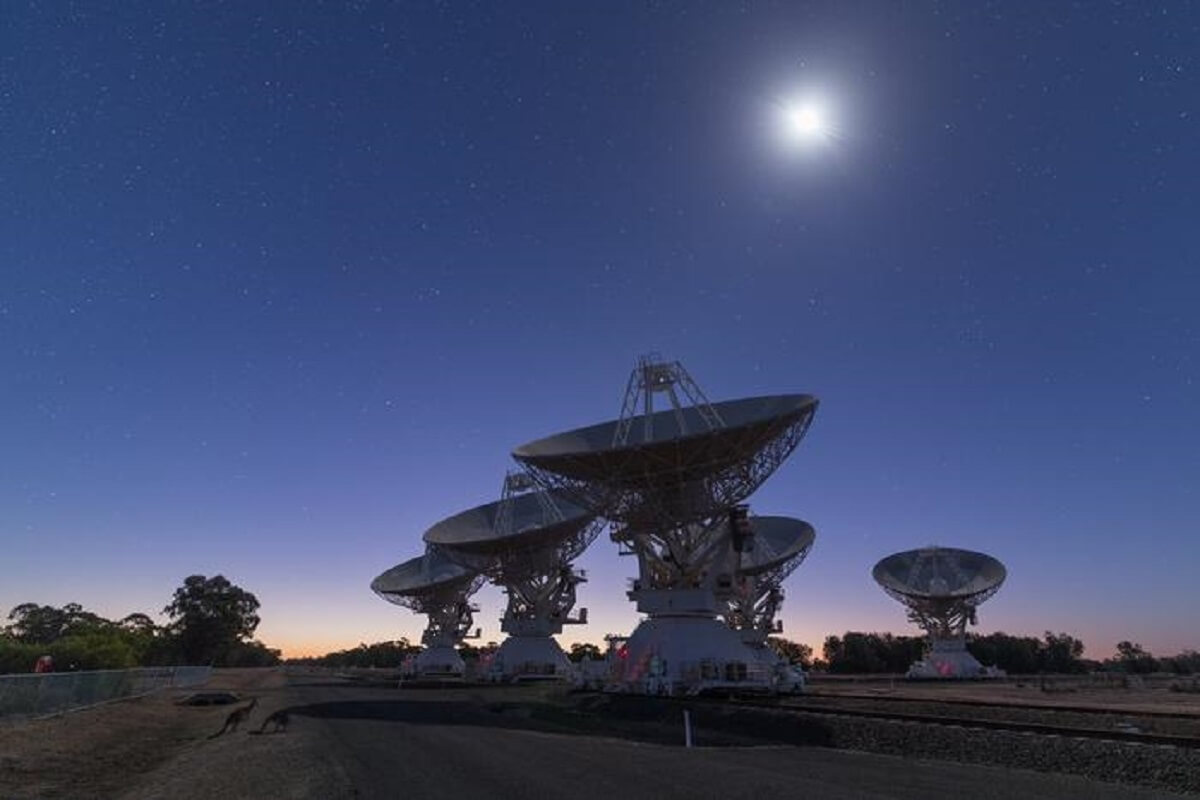
This ultra-sensitive image was produced after more than 450 hours of observations using the CSIRO’s Australia Telescope Compact Array (ATCA), marking it as the deepest and most sensitive radio image ever compiled by any Australian radio telescope.
The researchers note that 47 Tucanae, visible to the naked eye and first cataloged in the 1700s, revealed a faint radio signal at its center through detailed imaging. This signal had remained undetected until now.
“The first is that 47 Tucanae could contain a black hole with a mass somewhere between the supermassive black holes found in the centres of galaxies and the stellar black holes created by collapsed stars,” says lead author Dr. Alessandro Paduano.
“While intermediate-mass black holes are thought to exist in globular clusters, there hasn’t been a clear detection of one yet. If this signal turns out to be a black hole, it would be a highly-significant discovery and the first ever radio detection of one inside a cluster.”
The alternative explanation, according to Dr. Paduano, is a pulsar — a rotating neutron star emitting radio waves.
“A pulsar this close to a cluster center is also a scientifically interesting discovery, as it could be used to search for a central black hole that is yet to be detected.” Dr. Paduano explains.
The researchers also highlight the ultra-sensitive image as a precursor to what researchers can expect from the SKA radio telescopes. These telescopes, currently under construction in Australia and South Africa by the SKA Observatory (SKAO), will be the largest radio telescope arrays in the world. They are expected to revolutionize our understanding of the Universe and address some of the most pressing scientific questions of our era.
“This project has stretched our software to its limits, in terms of both data management and processing, and it has been really exciting to see the wealth of science that these techniques have enabled,” says co-author Dr. Tim Galvin, a research scientist with CSIRO. “Alessandro’s research represents a culmination of years of research and technological advancements, and ATCA’s ultra-deep image of 47 Tucanae represents just the beginning of the discoveries that are yet to come.”
The research is published in The Astrophysical Journal.
You might also be interested in:
- Are mysterious radio signals in space coming from aliens? Scientists believe they’re actually ‘starquakes’
- Unexpected radio signals detected in deep space may reveal hidden planets
- Universe’s First Monster? Ancient Black Hole Found Feasting on Galaxy
South West News Service writer Stephen Beech contributed to this report.


