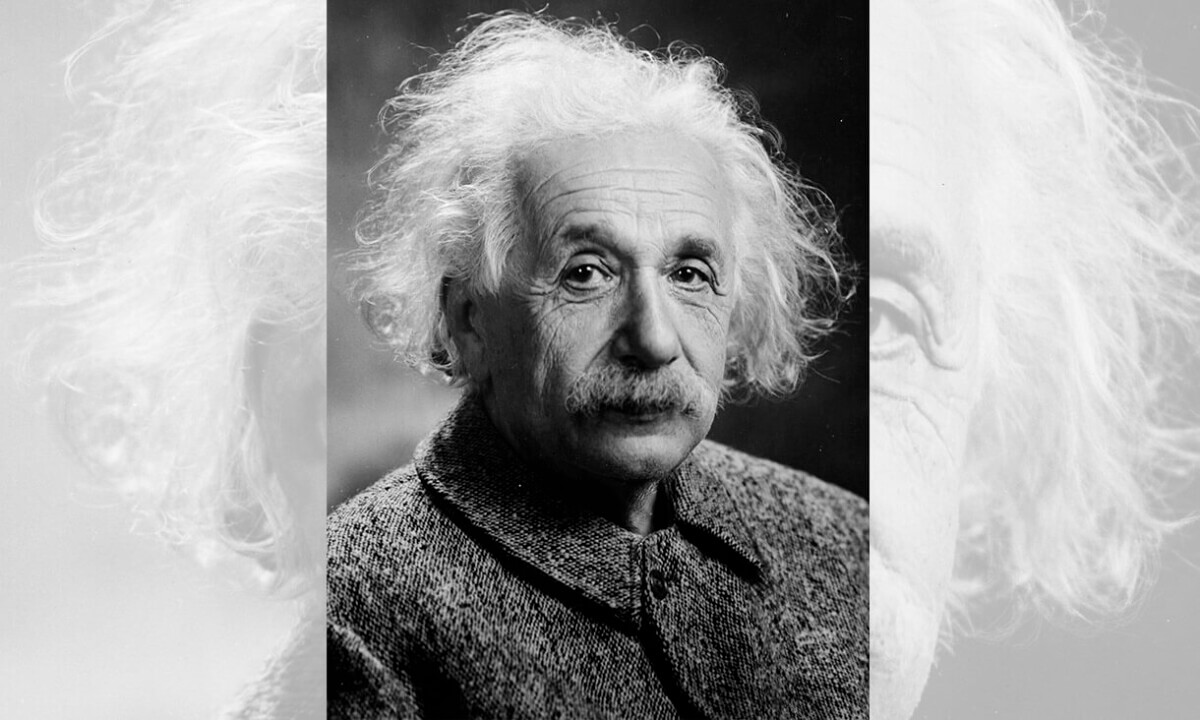
Albert Einstein. Photo: Library of Congress Prints and Photographs Division. cph.3b46036.
MOSCOW — Did Albert Einstein’s theory of relativity just get upended forever? An astrophysicist at RUDN University in Russia has developed a revolutionary new theory of gravity. This innovative premise diverges from the classic Einsteinian model by not relying on a conservation law, potentially resolving some longstanding inconsistencies in the field. It offers a fresh lens through which we can view the workings of the universe, from the smallest particles to the largest structures.
Einstein’s general theory of relativity, a cornerstone of modern physics proposed by the iconic scientist in 1915 and the current foundation of our understanding of gravity, hinges on the concept of curved space-time. General relativity tells us how massive objects like stars and planets warp the fabric of spacetime, much like how a heavy object can deform a trampoline. This warping creates what we feel as gravity.
A crucial aspect of this theory is the energy–momentum tensor, a mathematical construct, to describe how energy and momentum are distributed in space-time and interact with the gravitational field. Imagine a bustling city as a representation of the universe. Buildings, cars, people — they all represent different forms of energy and momentum (movement). The energy-momentum tensor is like a detailed ledger that accounts for all this energy and movement in every part of the city. It tells us how energy is distributed, how it flows, and how different forms of energy (like light, heat, or kinetic energy) interact with each other and with the fabric of spacetime — the ground and air of our city analogy. In simpler terms, it’s a mathematical way to keep track of all energy and motion in the universe.
Traditionally, in general relativity, this tensor is assumed to be conserved, similar to the law of conservation of energy in mechanics. This assumption has its limitations, particularly at high energy levels where non-renormalizability – a kind of mathematical incompatibility – occurs.
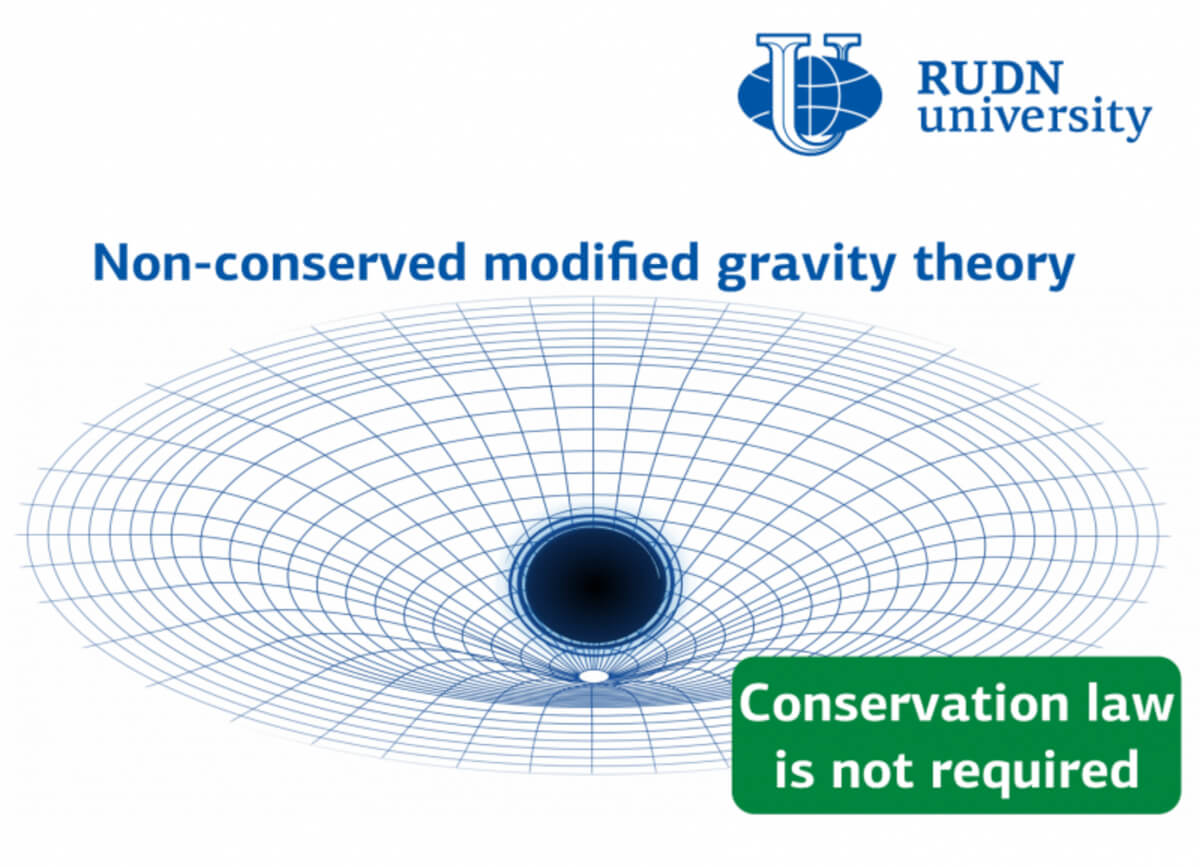
“The problem of non-renormalizability of Einstein’s gravity is well known. It has led to dozens of attempts to treat it as a low-energy theory. For example, in string theory, Einstein’s classical equation is just the first term in an infinite series of gravitational corrections,” says Hamidreza Fazlollahi, a graduate student at the Educational and Scientific Institute of Gravity and Cosmology of RUDN University who developed the new theory, in a media release. “So it is possible that at high energy and/or within the event horizon of black holes, spacetime curvature and gravity deviate from Einstein’s general theory of relativity. This can be explained in different ways. However, in any case, the law of conservation of energy-momentum can be violated at high energy levels.”
To address this, Fazlollahi developed a new gravitational model, that he calls the “Non-conserved modified gravity theory.” This introduces a radical idea: What if, in certain conditions, the energy and momentum in some parts of the universe could change over time? This concept is akin to suggesting that buildings or cars in our city could spontaneously gain or lose energy, challenging a fundamental law of physics. The theory posits that in regions of curved spacetime, the rules we thought were set in stone might not always apply.
It starts from the Gibbs-Duhem relation, an equation used in thermodynamics to describe changes in a system. The resulting equation bears a resemblance to Einstein’s classical equation but includes unique factors and constants. Notably, the new field equations incorporate two additional terms, accounting for temperature-entropy and charge-interaction dynamics.
This novel model shows promising consistency across different environments and holds potential for various applications in astrophysical and astronomical research. Fazlollahi tested the theory by analyzing two key phases of the universe’s development: the inflationary period and the phase of accelerating expansion. The findings align well with experimental observations.
“The model did not give any discrepancies regarding Einstein’s gravity for vacuum,” explains Fazlollahi.
This development represents a significant step in understanding gravity, especially in extreme conditions, and could pave the way for new insights into the universe’s mysteries. The model’s alignment with experimental data suggests it could be a valuable tool for future research in astrophysics and cosmology.
Implications for Cosmology: A Two-Fold Exploration
The implications of non-conserved modified gravity are vast and particularly significant in two critical periods of the universe’s history: the inflationary period of the early universe and the late-time universe dominated by dark energy.
-
Inflationary Period: The early universe went through a phase of rapid expansion, known as inflation. Fazlollahi’s theory suggests that during this period, the non-conservation of energy and momentum could have played a role, offering new insights into the universe’s initial moments.
-
Late-Time Universe: As we observe the accelerated expansion of the universe today, largely attributed to dark energy, this new theory could provide a fresh perspective on how this mysterious force operates.
Challenges and Opportunities in Theoretical Physics
Fazlollahi’s work is not just a new set of equations or predictions. It’s a challenge to the status quo, inviting physicists to rethink some of the most fundamental aspects of their field. This theory opens up exciting opportunities for new research and experiments. It’s a call to the scientific community to explore these uncharted territories and verify or refute the bold claims of the theory.
The journey from a theoretical proposal to an accepted part of scientific knowledge is long and rigorous. Fazlollahi’s theory needs to withstand the scrutiny of peer review, be tested against observations, and fit within the broader framework of physics. Upcoming experiments, especially in the field of astrophysics and cosmology, will play a crucial role in examining the validity of this new perspective on gravity.
His research behind the theory is published in The European Physical Journal C.
You might also be interested in:
- Physicists Find Groundbreaking Evidence Time Is Reversible Within Glass
- Einstein proven right again! Study of extreme stars confirms theory of general relativity
- Radical theory could unite Albert Einstein’s concept of gravity with quantum mechanics
- Earthshaking Discovery: Tectonic Plates Not The Driving Force That Formed Continents


