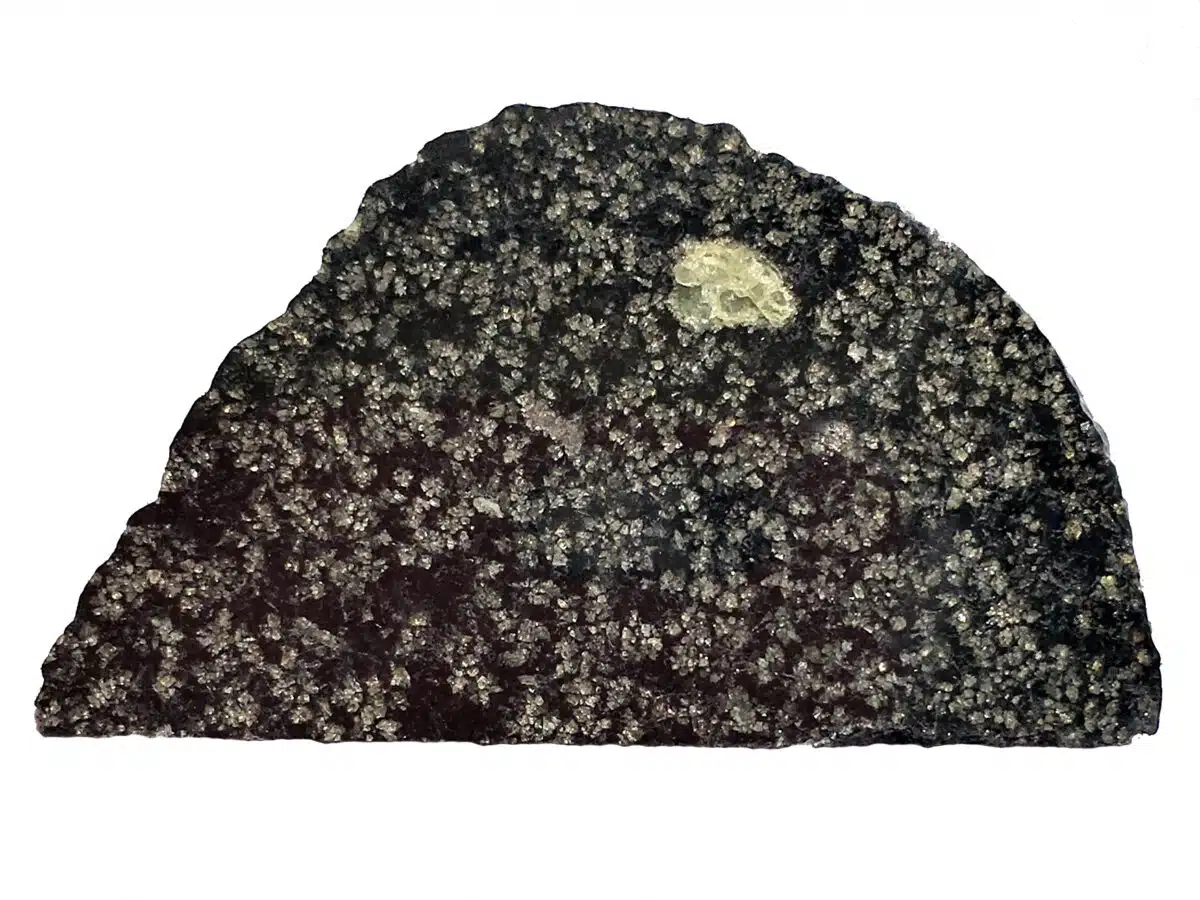
A slice of NWA 12774.The green circle is an olivine crystal, a magnesium-rich mineral. (Credit: John Kashuba)
In A Nutshell
- A meteorite recovered from the Sahara contains crystals that could only have formed deep inside a large, now-destroyed ancient planet, giving scientists their first direct physical evidence of its enormous size.
- Using a newly developed pressure-measuring tool, researchers calculated the parent body was at least 1,000 kilometers in radius, far larger than any asteroid previously linked to this class of meteorite.
- Textural clues in the crystals suggest the planet may have been Moon-sized or even larger, though that conclusion depends on assumptions about how deep the crystals originally formed.
- If confirmed, these meteorites could be our first recognized physical samples from a first-generation protoplanet, one of the original building blocks of the inner solar system.
For decades, some researchers suspected that angrite meteorites came from a much larger lost world, perhaps Moon-sized or even bigger, that was shattered early in solar system history. They had circumstantial evidence, but nothing definitive. A meteorite sitting in a desert collection has now changed that.
Researchers studying a rock called Northwest Africa 12774, recovered from the Sahara, say minerals locked inside it formed under crushing pressure deep within a large, ancient world. By building a new pressure-measuring tool and applying it to those minerals, they produced the first direct physical evidence that the so-called angrite parent body was enormous, at minimum 1,000 kilometers in radius, and possibly as large as the Moon. The findings appear in Earth and Planetary Science Letters.
Angrites are among the oldest known materials in the solar system, forming only about four million years after the first solids condensed from the cloud of gas and dust that gave birth to the sun. For years, most scientists assumed the world they came from was modest in size, roughly comparable to the asteroid Vesta. A competing idea proposed something far grander: a moon-to-Mars-sized protoplanet that formed early and was later shattered by collisions. Until now, that idea lacked hard physical proof.
This Angrite Meteorite Contains a Crystal That Only Forms Deep Inside a Large Planet
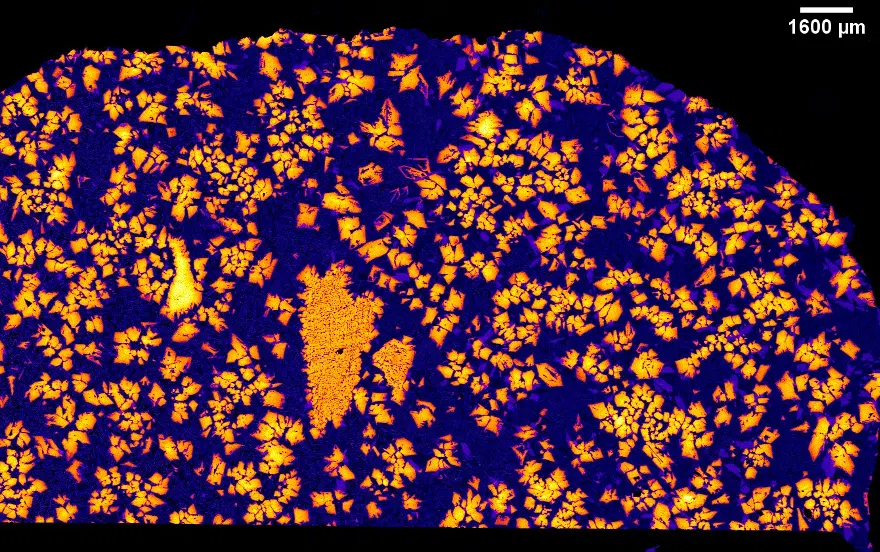
To get at the answer, researchers built what amounts to a pressure gauge for ancient rocks. Called a geobarometer, it calculates the pressure a mineral experienced when it crystallized, based on its chemical makeup. They trained it on a crystal type called clinopyroxene, which in NWA 12774 contains nearly twice the aluminum found in the same mineral from any other angrite meteorite. On Earth, that aluminum-rich variety is a hallmark of high-pressure rocks called eclogites, which develop tens of kilometers below the surface. Seeing it in this meteorite was a major clue that the crystal formed under unusually high pressure, likely deep inside a large parent body.
Crunching the chemistry of how that crystal grew from molten rock, the team arrived at a formation pressure of about 17.56 kilobars, roughly what exists more than 60 kilometers beneath Earth’s surface. A planet would need a radius of at least 1,000 kilometers to generate that kind of pressure in its deep interior, far beyond anything previously associated with this class of meteorite. The team confirmed the tool’s reliability against nine independent lab experiments before applying it to NWA 12774.
Angrite Meteorite Data Suggest the Lost Planet May Have Been Moon-Sized
That 1,000-kilometer figure is almost certainly a minimum, not the full story. Clues in the crystal texture suggest the clinopyroxene formed somewhere inside the planet rather than at its very deepest point, then got swept rapidly to the surface in rising magma and cooled quickly. If the crystals formed at relatively modest depths, the parent body could have been Moon-sized or larger. In one scenario discussed by the authors, a Moon-sized body would place the crystals roughly 275 kilometers down, and the researchers say larger-radius scenarios fit the textural evidence better.
A world that large also reshapes how scientists think about the building materials of the early solar system. Accounting for the odd chemical fingerprint of angrite meteorites may require that the parent body soaked up large quantities of rare, high-temperature materials left over from the solar system’s very first moments. A moon-sized planet would have needed an enormous stockpile of those exotic ingredients, suggesting they were far more plentiful in the young solar system than most models currently allow. Put another way, the stuff that assembled the first planets may have been far stranger than anything that makes up Earth today.
If the angrite parent body was truly that large, NWA 12774 and its relatives could represent the first recognized physical samples from what planetary scientists call a first-generation protoplanet, one of the massive early worlds that formed fast, collided violently, and ultimately provided the raw material for rocky planets like Earth. A rock pulled from a Saharan desert may be the closest we will ever get to holding a piece of that vanished world.
Paper Notes
Limitations
The new geobarometer cannot convert crystallization pressure into a definitive planetary radius, because the exact depth at which the crystals formed inside the parent body remains unknown. Temperature uncertainty in the calculations adds a pressure uncertainty of roughly plus or minus 2.0 kilobars. The study rests on a single meteorite, NWA 12774, with a companion specimen, NWA 7812, noted but unavailable for detailed analysis. The small total number of known angrite meteorites limits the broader context available for comparison.
Funding and Disclosures
This work was funded by a NASA Emerging Worlds award (80NSSC20K0342) and a NASA SSERVI Award (80NSSC23M0177, SubAward 133803-874X), both to lead author Aaron S. Bell. Bell reports financial support from NASA; the remaining authors declare no competing financial interests or personal relationships that could have influenced the work.
Publication Details
Authors: Aaron S. Bell (Department of Earth Science, University of Colorado Boulder), Laura Waters (Department of Earth and Environmental Science, New Mexico Institute of Mining and Technology), and Mark Ghiorso (OFM Research, Seattle, WA). | Title: “High-pressure clinopyroxene in Northwest Africa 12774 and new geobarometric evidence for a planetary embryo-sized angrite parent body” | Journal: Earth and Planetary Science Letters, vol. 685 (2026), article 120029. | DOI: https://doi.org/10.1016/j.epsl.2026.120029 | Received: October 1, 2025. Accepted: March 29, 2026. Available online: April 10, 2026.


