
A woman drinking water (Photo from pexels.com)
In A Nutshell
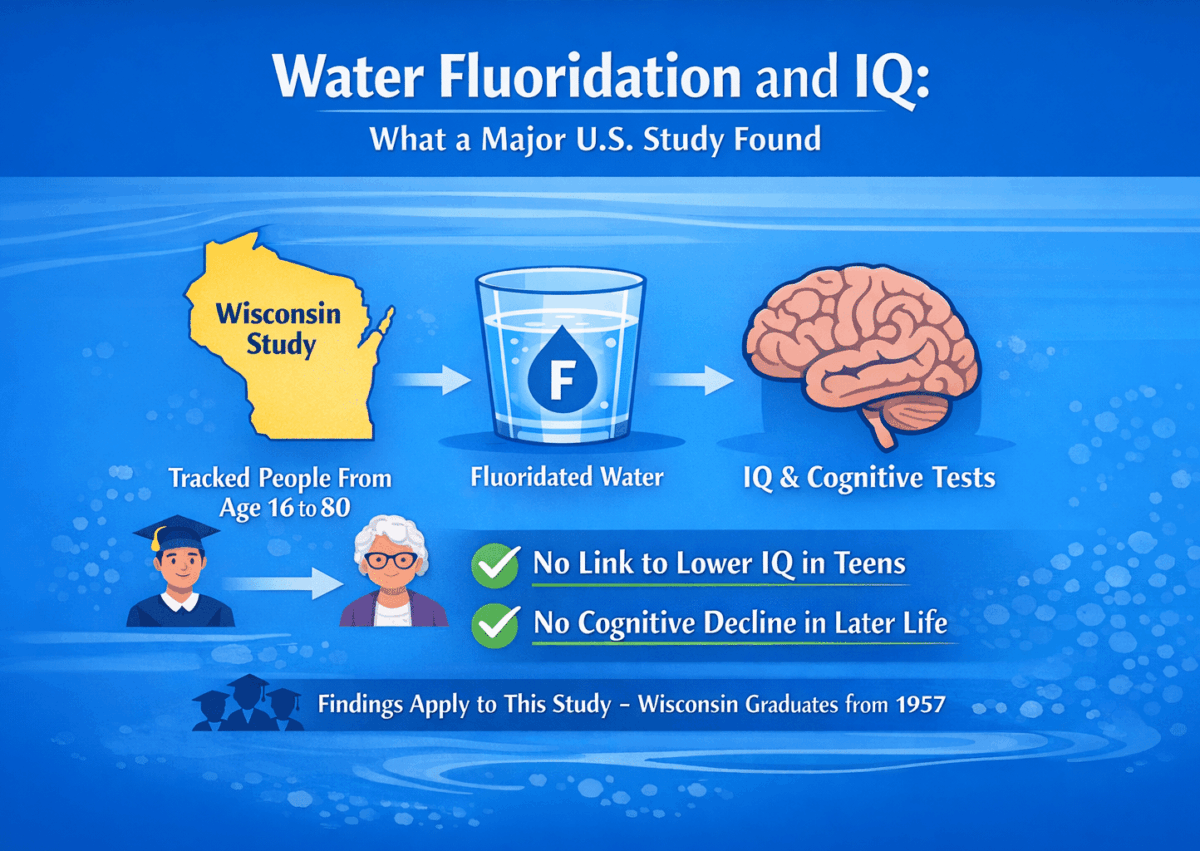
- A long-running U.S. study found no evidence that community water fluoridation was linked to lower IQ in teenagers.
- The same study also found no sign of worse cognitive performance later in life, including in older age.
- Researchers say this challenges earlier fluoride-IQ evidence that was cited in some recent policy decisions.
- The findings are important, but they still come with limits, including no direct measure of how much fluoride each person consumed.
Communities across the country have been pulling fluoride out of their water systems, driven by fears that the decades-old public health measure is quietly making kids less intelligent. Cities in Utah, Florida, and elsewhere have pointed to a widely cited analysis linking fluoride exposure to lower IQ scores in children as reason enough to end the practice. But a new study tracking thousands of people from adolescence into their 80s offers a blunt counterpoint: within this large American sample, and across every cognitive measure the researchers examined, there is no evidence that adding fluoride to community water is connected to lower IQ or diminished brainpower.
The research, published in the Proceedings of the National Academy of Sciences, draws on the Wisconsin Longitudinal Study, which has followed a representative sample of more than 10,000 Wisconsin high school graduates from the class of 1957 across their entire adult lives. By combining historical records of when communities started fluoridating their water, natural fluoride levels in local groundwater, and actual IQ test scores from when participants were teenagers, the researchers built what amounts to a decades-long natural experiment. The results were consistent and clear.
“We find no evidence that [community water fluoridation] is associated with lower adolescent IQ or cognition later in life,” the authors wrote in their paper.
That conclusion stands in sharp contrast to the study that was prominently cited in decisions to end fluoridation in parts of the United States, a review published in JAMA Pediatrics that found a negative relationship between fluoride exposure and children’s IQ. The new research takes direct aim at the weaknesses of that earlier work, noting that most of its evidence involved fluoride levels far beyond what American water systems use, none of its data came from the United States, and most of it failed to account for the fact that people living in fluoridated communities may differ in important ways from those who don’t.

Tracking Brainpower From Teenager to 80-Year-Old
The Wisconsin Longitudinal Study began with a random sample covering one-third of all Wisconsin high school seniors in 1957, a total of 10,317 people. That starting point gave the researchers something rare: a group that genuinely represents an entire population rather than a self-selected slice of volunteers. Over the following decades, participants were assessed at multiple points, creating a record of brain function stretching from age 16 all the way to age 80.
At 16, IQ was measured using a standardized test administered during high school. Later in life, reasoning ability was measured at ages 53, 64, and 72 using a well-established assessment tool. At 80, participants were screened by phone for signs of mental decline.
To figure out who had been exposed to fluoridated water and for how long, the team dug into historical records documenting when each Wisconsin community began fluoridating its water supply, along with data on naturally occurring fluoride levels in untreated well water. Participants were sorted into four groups: those never exposed to fluoridated water, those exposed from birth, those first exposed around age 8, and those first exposed around age 14. The researchers measured each person’s fluoride exposure through age 14, before the IQ tests were given, so they were looking at exposure that came before the outcome.

Why Where You Live Matters in Fluoride Research
One of the trickiest problems in this type of research is the possibility that differences in test scores between fluoridated and non-fluoridated communities reflect not the water itself, but the types of people who live in those communities. Wealthier, more urban areas tended to add fluoride to their water earlier, and wealthier families tend to produce children with higher test scores for a host of reasons that have nothing to do with what’s in the tap water.
The study’s raw data illustrated this clearly. Participants first exposed to fluoridated water in late adolescence, meaning they lived in communities that adopted the practice relatively late, actually had the highest average IQ scores. But they also came from families with higher incomes, more educated fathers, and higher-status jobs. The raw numbers appeared to favor fluoridated communities, but that advantage vanished once the researchers accounted for family background.
To deal with this, the team controlled for a range of family and school characteristics measured in 1957, including parental education, fathers’ jobs, family income, number of siblings, and community size. They also factored in school-level averages of these same measures, adding another layer of protection against hidden biases.
The study also improved on earlier research in two specific ways. A previous analysis by some of the same researchers, published in Science Advances in 2025, had examined the relationship between fluoride exposure and academic achievement rather than IQ directly. By using actual IQ scores, the new study addressed a more fundamental question about mental ability.
The second improvement involved geographic mobility. The earlier study had assumed that high school students lived their entire lives in the community where they attended school. That assumption is obviously imperfect, since families move. Because more than 90% of the Wisconsin Longitudinal Study records have been linked to U.S. Census records from both 1940 and 1950, the researchers could identify which participants were living in the same county at ages 1, 11, and 18. This allowed them to limit their analysis to people who had stayed put, giving much greater confidence that fluoride exposure was being measured accurately.
45 Tests and No Evidence of Harm From Fluoride in Drinking Water
The results were remarkably uniform. Across the full sample, and across the restricted samples of people who hadn’t moved, fluoride exposure showed no statistically meaningful negative relationship with IQ at age 16 or mental performance at ages 53, 64, 72, or 80. The researchers ran 45 tests in total. Only two produced results that stood out from the baseline, roughly what one would expect from random chance alone.
Whether a person drank fluoridated water from birth or never drank it at all, their mental trajectory over more than six decades looked the same once background factors were taken into account.
Recent decisions to end fluoridation have been driven by a high-profile analysis that, as the new study’s authors point out, drew its evidence largely from populations exposed to fluoride levels far exceeding those used in American water systems. Much of that earlier research also came from countries outside the United States and did not use population-representative samples.
None of this means the fluoride debate is permanently closed. The authors acknowledge that their research has limits. Most notably, they could not directly measure how much fluoride each participant actually consumed, for instance through biological samples. They also lacked information about participants’ dental care habits or non-water sources of fluoride exposure. And the study population, Wisconsin high school graduates from the class of 1957, limits how broadly the findings can be applied across different populations.
Still, as the longest look yet at fluoride and brain function across an entire lifespan, using real IQ data from a representative American population, the study gives policymakers something concrete to weigh: in this cohort, the fears driving fluoride bans do not appear to be supported by the data.
Disclaimer: This article is for general information and summarizes one study; it is not medical or policy advice.
Paper Notes
Limitations
The authors acknowledge several limitations. They were unable to directly measure each participant’s fluoride consumption, for example through urine samples, and instead relied on historical records of community water fluoridation practices and naturally occurring fluoride in groundwater to estimate exposure. The Wisconsin Longitudinal Study did not collect information about dental care during adolescence or about non-water sources of fluoride exposure. The study population consists entirely of Wisconsin high school graduates from the class of 1957, which limits how broadly the results can be applied across different populations. Missing values for background measures were addressed using a statistical method that generated 20 separate filled-in versions of the dataset.
Funding and Disclosures
The authors declared no competing interests. Since the 1990s, the Wisconsin Longitudinal Study has been supported mainly by the National Institute on Aging (R01AG060737 and R01AG009775), the Vilas Estate Trust, the National Science Foundation (SBR932066), and the Spencer Foundation. The researchers also benefited from NIA center grant support (P30AG017266 and P30AG066613).
Publication Details
The paper, titled “Municipal water fluoridation, adolescent IQ, and cognition across the life course: Evidence from the Wisconsin Longitudinal Study,” was authored by John Robert Warren, Gina Rumore, Kamil Sicinski, Pamela Herd, and Michal Engelman. Warren is affiliated with the Institute for Social Research and Data Innovation at the University of Minnesota, Minneapolis. Sicinski and Engelman are affiliated with the Center for Demography of Health and Aging at the University of Wisconsin, Madison. Herd is affiliated with the Gerald R. Ford School of Public Policy at the University of Michigan, Ann Arbor. The paper was published on April 13, 2026, in Proceedings of the National Academy of Sciences (PNAS), Volume 123, Number 16, e2536005123. DOI: 10.1073/pnas.2536005123. It was edited by Greg J. Duncan of the University of California, Irvine.


