(© vegefox.com - stock.adobe.com)
CHICAGO — Ever find yourself leaving a social gathering wondering, “Did they like me?” or “Was that joke too much?” It turns out your brain is actually performing an evolutionary marvel — one that scientists have just mapped for the first time.
In a study published in the journal Science Advances, researchers from Northwestern University and the University of Minnesota have discovered that the brain regions responsible for understanding others’ thoughts and feelings are directly connected to emotional processing centers in ways never before observed. Using ultra-high-resolution brain imaging, they’ve mapped an intricate network that links our social intelligence to some of the brain’s most ancient structures.
Think of a manager trying to gauge team morale during a tense meeting, or a teacher sensing when students are confused before they raise their hands. These everyday acts of social intuition rely on sophisticated neural networks that the research team has now mapped in unprecedented detail.
The research team found that the brain regions that help us understand others’ mental states are wired directly to specific areas of the amygdala – an almond-shaped structure deep in the brain that processes emotions, sometimes dubbed our “lizard brain.” This finding helps explain how we integrate emotional information with higher-level social thinking, enabling us to navigate complex social situations with remarkable sophistication.
“We spend a lot of time wondering, ‘What is that person feeling, thinking? Did I say something to upset them?'” says senior author Rodrigo Braga in a statement. “The parts of the brain that allow us to do this are in regions of the human brain that have expanded recently in our evolution, and that implies that it’s a recently developed process. In essence, you’re putting yourself in someone else’s mind and making inferences about what that person is thinking when you cannot really know.”
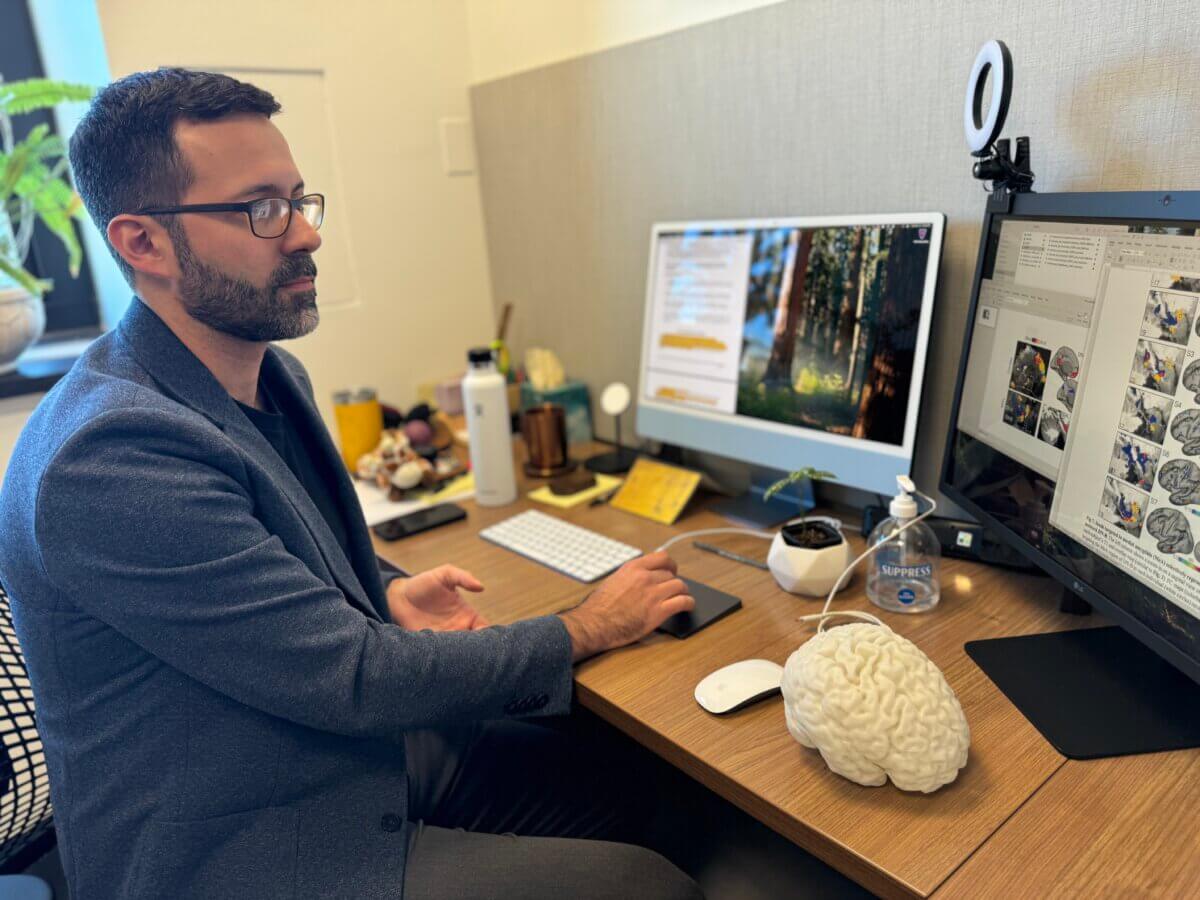
The study focused on six participants who underwent extensive brain scanning sessions, with some providing up to 35 separate scans. While this might seem like a small number of participants, each person’s brain was studied in remarkable detail, providing thousands of data points for analysis.
The researchers discovered that the brain’s social network includes specific regions within the amygdala that hadn’t been identified before. These regions are particularly active when we’re trying to understand others’ thoughts and feelings, a skill psychologists call “theory of mind.” For example, when you’re trying to figure out whether your friend is actually happy about their new job or just putting on a brave face, you’re engaging this network.
Study authors say that these social brain regions connect to two specific parts of the amygdala: the basolateral complex and the medial nucleus. The basolateral complex helps process emotional information coming in from our senses, while the medial nucleus is involved in social behaviors and emotional learning.
“One of the most exciting things is we were able to identify network regions we weren’t able to see before,” notes co-author Donnisa Edmonds, a neuroscience Ph.D. candidate in Braga’s lab at Northwestern. “That’s something that had been underappreciated before our study, and we were able to get at that because we had such high-resolution data.”
The findings have important implications for treating conditions like anxiety and depression, which involve amygdala hyperactivity. Currently, treatments targeting the amygdala require invasive surgical procedures since it’s located deep within the brain, behind the eyes.
“Through this knowledge that the amygdala is connected to other brain regions — potentially some that are closer to the skull, which is an easier region to target — that means people who do TMS could target the amygdala instead by targeting these other regions,” Edmonds explains.
The research also revealed that these social brain networks are highly consistent across different individuals, suggesting that this is a fundamental feature of human brain organization. This consistency was confirmed not only in the small group of intensively studied participants but also in a larger analysis of over 4,000 people from a separate dataset.
Just as social interaction requires multiple participants, our brains have evolved multiple interconnected regions that work together to help us navigate our social world. The discovery of these specific connections between our social thinking regions and emotional processing centers helps explain how we became such sophisticated social creatures. Who knew our ability to sense a friend’s mood or read a room relied on the same brain region that once helped our ancestors avoid becoming dinner? Evolution, it seems, is the ultimate upcycler.
Paper Summary
Methodology
The researchers used ultra-high-resolution 7T MRI scanning to examine brain activity in six participants. Each participant underwent multiple scanning sessions, during which they either rested quietly or performed specific tasks designed to engage social thinking. The researchers used sophisticated analysis techniques to map how different brain regions communicate with each other, focusing particularly on the connections between areas involved in social cognition and the amygdala. They verified their findings using multiple analysis approaches and confirmed the results in separate scanning sessions.
Key Results
The study identified specific regions within the amygdala that connect to the brain’s social cognition network. These connections were found consistently across participants and were distinct from networks involved in memory and future thinking. The researchers found that these social brain regions connected specifically to the basolateral complex and medial nucleus of the amygdala, areas known to be important for emotional processing and social behavior.
Study Limitations
The study had a relatively small sample size of six participants, though this was partially offset by the extensive amount of data collected from each person. The imaging technology, while very detailed, still has some limitations in detecting activity in deep brain structures. Additionally, some participants showed variations in the strength and location of these brain connections, suggesting individual differences that would need to be studied further.
Discussion & Takeaways
The research provides new insights into how our brains process social information by revealing specific connections between regions involved in understanding others’ thoughts and those processing emotions. This has important implications for understanding and potentially treating conditions that affect social functioning, such as autism, anxiety, and depression. The findings suggest that targeting specific parts of this network might be beneficial for therapeutic interventions.
Funding & Disclosures
The research was supported by various grants from the National Institute of Mental Health, the Alzheimer’s Disease Core Center, and the National Science Foundation. The researchers declared no competing interests. The study was conducted at Northwestern University and the University of Minnesota, with additional computational resources provided by Northwestern University’s Quest high-performance computing facility.


