(© Maridav - stock.adobe.com)
In A Nutshell
- A rocky planet 35 light-years away has a long-lived magma ocean in its interior and a sulfur-rich atmosphere being actively shaped by sunlight, according to new research.
- L 98-59 d doesn’t fit either of the two standard models for small planets: it isn’t a “gas dwarf” or a “water world,” pointing to a third formation pathway scientists hadn’t fully accounted for.
- Computer simulations show the planet was born with more than 100 times the hydrogen of early Earth’s mantle, and has been slowly shrinking for billions of years under the combined effects of stellar radiation and internal cooling.
- Its story raises a broader question for planet science: how many worlds currently classified as one type are simply in the middle of transforming into another.
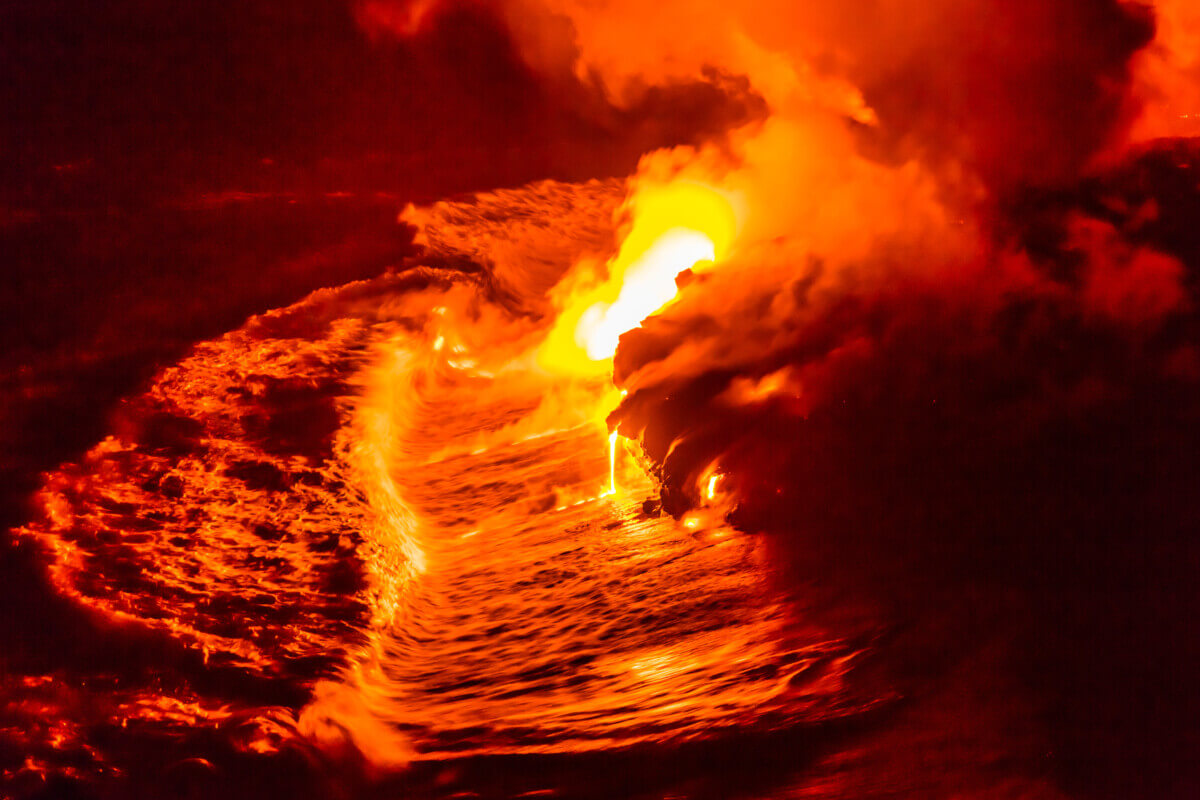
About 35 light-years from Earth, a rocky planet harbors a long-lived magma ocean deep in its interior, a churning reservoir of molten rock that researchers believe has persisted for billions of years. Its sky is laced with sulfur gases being forged by sunlight. And according to new research, it was born loaded with so much hydrogen and other lightweight gases that it makes early Earth look positively barren by comparison. L 98-59 d, a world roughly 1.6 times the size of our planet, breaks almost every rule scientists have developed for how small rocky planets are supposed to form and evolve.
For years, astronomers have sorted small rocky worlds beyond our solar system into two broad categories. Either a planet formed with a thick hydrogen-gas envelope and later lost most of it, earning the label “gas dwarf,” or it formed rich in water and goes by “water world.” L 98-59 d, detailed in new research published in the journal Nature Astronomy, fits neither box. Its chemistry points to a third kind of story: a world born saturated in volatile gases, kept perpetually molten by internal heat, and slowly transformed over billions of years into something no existing model predicted.
What brought the planet into focus was NASA’s James Webb Space Telescope (JWST), whose observations suggest an atmosphere rich in sulfur-bearing gases. Those findings sent researchers digging into how such a world could have ended up this way, and the answers proved far more layered than anyone anticipated.
How Scientists Modeled a Molten Planet’s Entire Life Story
Led by Harrison Nicholls of the University of Oxford and the University of Cambridge, the team used a computer modeling framework called PROTEUS to simulate how L 98-59 d might have evolved from birth to the present day. Rather than running a single scenario, they built a grid of 900 separate simulations, each starting with different conditions: how much hydrogen the planet began with, the ratio of sulfur to hydrogen, and the chemistry of the molten interior. Every simulation was then compared against the planet’s current bulk density and the atmospheric composition suggested by JWST.
L 98-59 d has an unusually low density for a rocky planet, far less than a pure rock-and-iron world of its mass should have. That signals it still holds a meaningful amount of lightweight gases. To reproduce that measurement, the researchers had to start the planet with more than 100 times the estimated hydrogen content of early Earth’s mantle. L 98-59 d orbits extremely close to its host star, far closer than Earth is to the Sun, which means it has spent billions of years bathed in intense radiation. High-energy starlight essentially boils the lightest gases off into space, a process called photoevaporation. As the outer atmosphere was stripped away and the hot interior gradually cooled and contracted, the planet shrank from something larger into the smaller world it is today, with both processes contributing to that transformation.
Early in its life, L 98-59 d would have been classified as a “sub-Neptune,” a category of planet slightly larger than Earth but smaller than Neptune. Its gradual shrinkage into what now looks like a super-Earth took several billion years, raising an uncomfortable question: how many worlds currently labeled sub-Neptunes are simply super-Earths in progress, still mid-transformation?

A Permanent Ocean of Molten Rock Beneath a Sulfur Sky
About 45% of L 98-59 d’s mantle is still molten today, and the researchers found this is not a temporary phase. Two forces are keeping it that way. Gravitational forces from its host star continuously squeeze and flex the planet’s interior, generating heat, while a thick atmosphere acts as a heat-trapping blanket that prevents the surface from cooling. A fully solidified mantle is strongly disfavored by the planet’s density measurements, even before factoring in the JWST data.
That subterranean sea of molten rock also drives the planet’s chemistry. Sulfur dissolves more readily into liquid rock than hydrogen does. As the planet slowly cooled over billions of years, sulfur was gradually released from the magma into the atmosphere, while hydrogen, being lighter, escaped into space. Over time, the atmosphere grew progressively more sulfur-rich.
Sulfur dioxide was the gas that really puzzled researchers. It cannot be explained by gases bubbling up directly from below, since it is too heavy to drift upward on its own. Instead, the team found that sunlight is actively manufacturing it in the upper atmosphere. Ultraviolet light splits water vapor molecules into reactive fragments, which then react with hydrogen sulfide rising from below to produce sulfur dioxide. Without that photochemical process, models show sulfur dioxide would be present only in negligible amounts. A similar sunlight-driven mechanism has been identified on a much larger hot Jupiter called WASP-39b, suggesting this kind of atmospheric chemistry may be more widespread among distant rocky planets than anyone expected.
What This Lava World Means for Planet Science
Neither standard model accounts for L 98-59 d’s history. A gas dwarf would have shed its hydrogen far too quickly. A water world requires an oxygen-rich interior chemistry that is flatly incompatible with the sulfur-heavy atmosphere JWST data suggest. Instead, this world followed a third path: born with an enormous reservoir of volatile gases, kept molten by tidal heating and atmospheric insulation, and sculpted over billions of years by processes working in a combination existing models have struggled to capture.
That has real consequences for how astronomers read the exoplanet census. A planet’s size category has long been treated as a fairly stable property. L 98-59 d suggests it can be a moving target, shaped as much by a world’s age and internal conditions as by what it was born with. Planets that look like super-Earths today may have looked like something else entirely a billion years ago.
Paper Notes
Limitations
This study relies on computer modeling rather than direct measurements of the planet’s interior. Several physical processes were not included in the simulations, among them secondary volcanic outgassing from a solidified mantle and the partitioning of volatile elements into solid mineral phases. The assumed core radius, fixed at 55% of the interior radius to match Earth’s proportions, introduces some uncertainty, though the researchers ran sensitivity tests to assess its impact. The planet’s bulk density is itself uncertain, with two recent estimates differing considerably, at 3.45 and 2.2 grams per cubic centimeter respectively; the team’s primary results used the higher figure, meaning volatile content estimates may be conservative. Atmospheric composition is inferred from JWST retrievals with competing models and weak constraints on water vapor, whose spectral signature overlaps with other molecules. Future observations would help confirm the sunlight-driven chemistry the team identified.
Funding and Disclosures
Co-author Tim Lichtenberg received support from the Netherlands eScience Center (PROTEUS project, grant no. NLESC.OEC.2023.017), the Branco Weiss Foundation, the Alfred P. Sloan Foundation (AEThER project, grant no. G-2025-25284), and NASA’s Nexus for Exoplanet System Science research coordination network (Alien Earths project, grant no. 80NSSC21K0593). Claire Marie Guimond is supported by the UK Science and Technology Facilities Council (STFC, grant no. ST/W000903/1). Raymond T. Pierrehumbert and Richard D. Chatterjee acknowledge support from the UK STFC and the AEThER project. Chatterjee additionally received support from UKRI (grant no. UKRI1191). Computational resources were provided by the Center for Information Technology of the University of Groningen via the Habrok high-performance computing cluster. No competing interests were declared.
Publication Details
Harrison Nicholls, Tim Lichtenberg, Richard D. Chatterjee, Claire Marie Guimond, Emma Postolec, and Raymond T. Pierrehumbert, “Volatile-rich evolution of molten super-Earth L 98-59 d,” Nature Astronomy, published online March 16, 2026. DOI: https://doi.org/10.1038/s41550-026-02815-8. Correspondence: [email protected].


