
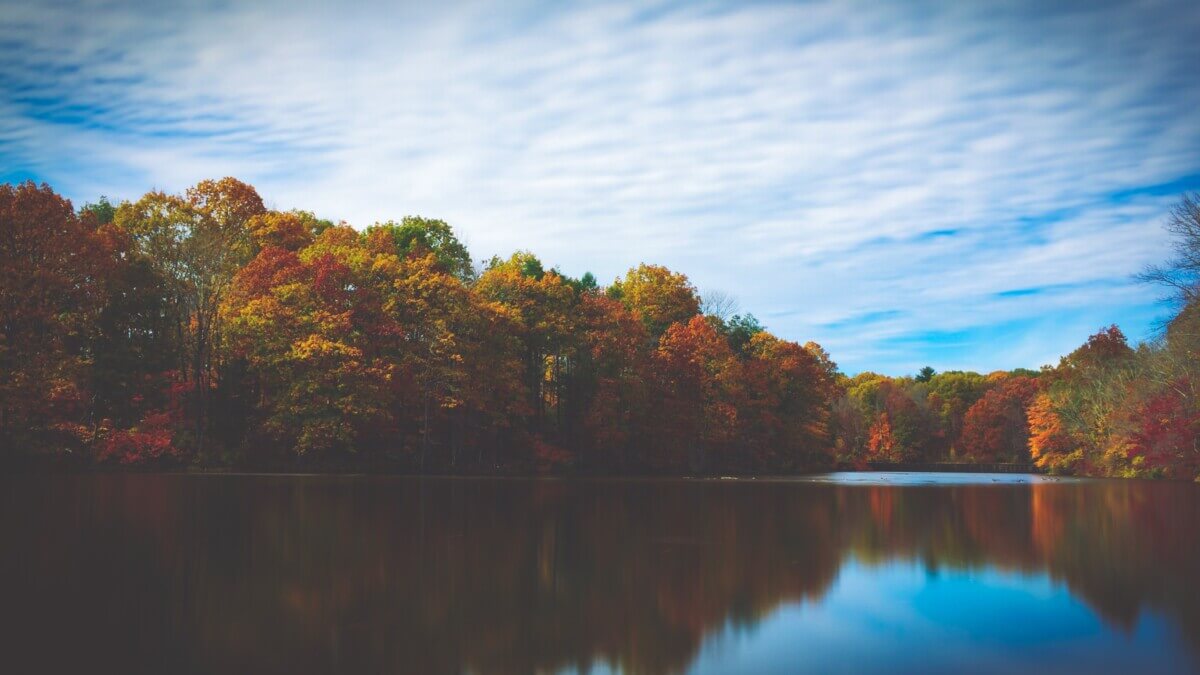
Manuchehr Kurbonali on Unsplash
Why Trees Help Some Communities Cope With Stress but Not Others
In A Nutshell
- A study of more than 40,000 U.S. adults found that living near more trees was associated with lower biological markers of chronic stress.
- Getting outside and moving more may help explain part of the link, since people in greener neighborhoods were more likely to be physically active.
- The association held for white and Hispanic participants and higher-income adults, but was not detected for Black Americans or lower-income individuals.
- Researchers suggest that discrimination and other unmeasured stressors may offset any potential benefit of trees for those groups.
Living near trees does more than make a neighborhood look pleasant. A new study of more than 40,000 American adults suggests that neighborhoods with more tree cover are linked to lower levels of a biological marker tied to chronic stress, the kind of long-term, grinding stress that quietly damages the body over years. But the benefit doesn’t appear to reach everyone the same way.
Chronic stress isn’t just a feeling. When the body is exposed to stress repeatedly over long periods, it begins to wear down, with the heart, the immune system, and the hormones all starting to show the damage. Scientists measure this accumulated biological “wear and tear” using something called allostatic load, a score built from physical readings like blood pressure, blood sugar, cholesterol, and inflammation markers. It works like a scorecard for how hard the body has had to work just to keep up with life’s demands. A new study published in The Lancet Regional Health – Americas found that people living in neighborhoods with more tree cover tended to have lower scores.
The research stands out for its scale. Previous studies on this topic typically involved a few hundred participants in a single region. This one drew on data from the National Health and Nutrition Examination Survey, a nationally representative program run by the Centers for Disease Control and Prevention, pulling together more than 40,000 adults across the United States, with detailed biological measurements and satellite-based tree cover data linked to where each person lives.
How Scientists Measured the Link Between Trees and Stress
Researchers at Michigan State University and the Medical College of Wisconsin analyzed survey data collected across seven periods between 2001 and 2018, drawing on a racially and economically diverse sample of more than 40,000 adults from across the country.
To measure tree cover, the team used a national land mapping database linked to the specific census block where each participant lived. The stress scorecard drew on nine biological measures, including blood pressure, blood sugar, cholesterol, body mass index, and C-reactive protein, a marker of inflammation. Participants already on medication for diabetes, high blood pressure, or high cholesterol received an additional point, since medication use signals the body has already experienced stress-related breakdown.
More than 80% of participants lived in neighborhoods below the recommended 30% tree canopy threshold, a benchmark from urban planning guidelines tied to equitable access to nature.
Trees, Movement, and the Stress Connection
When the researchers ran their statistical models, greater tree cover was associated with lower stress scores. Physical activity also played a role. People in greener neighborhoods were more likely to report being physically active, and physical activity itself was tied to lower stress scores. Trees appeared to be linked to lower stress burden in two ways: directly, perhaps by calming the senses or buffering noise and heat, and indirectly, by encouraging people to get outside and move.
Not Everyone Benefits the Same Way From Neighborhood Tree Cover
When researchers broke the data down by race, ethnicity, and income, the link between trees and lower stress burden did not show up evenly. For non-Hispanic white and Hispanic participants, living near more trees was clearly associated with lower stress scores. The same held true for people with higher incomes, those with at least a high school diploma, and those who were employed. For non-Hispanic Black participants, no such association was detected. Lower-income individuals showed no meaningful benefit either.
The researchers suggest one possible explanation: Black residents in more affluent, tree-rich neighborhoods may still face everyday discrimination or other stressors the study did not measure. Historical practices like redlining, which systematically denied Black families access to desirable neighborhoods for decades, have also shaped where trees exist today and who lives near them.
These results also push back against an idea that has gained traction in public health circles: that lower-income groups benefit more from access to nature than wealthier groups, potentially narrowing health gaps. In this large, nationally representative sample, that was not what the data showed.
What This Means for Cities and Neighborhood Tree Cover
Urban planners and public health officials have increasingly looked at tree-planting programs as a relatively low-cost tool for improving community health. These findings support that instinct, but with a significant qualifier: planting trees does not automatically translate into stress relief for everyone who lives nearby. For neighborhoods where residents already face compounding stressors tied to race, discrimination, and economic hardship, the authors note that those pressures may drown out whatever benefit the trees might otherwise provide.
As the largest study of its kind in the United States, these findings make clear that the relationship between nature and the human body is filtered through history, inequality, and the layered pressures of everyday life. More trees may be part of a healthier neighborhood picture for many Americans, but for those bearing the heaviest burdens, the prescription will need to go well beyond a canopy overhead.
Disclaimer: This article is based on an observational study and does not establish that trees directly cause reductions in stress. As with all research, findings should be considered alongside the study’s limitations. If you have concerns about chronic stress or related health conditions, please consult a qualified healthcare professional.
Paper Notes
Limitations
The study has several important limitations the authors openly acknowledge. Because tree canopy data was only available for 2016, there is no way to account for changes in tree cover over the long period during which participant data was collected. Researchers also could not link tree data to each participant’s exact home address due to privacy restrictions governing how federal health data is handled; instead, tree coverage was calculated for the census block where each person lived, which introduces some imprecision. Physical activity was measured through a single yes-or-no self-reported question, a relatively blunt instrument. The study also did not examine how overlapping disadvantages (for example, being both low-income and a racial minority) might compound the absence of benefit. Finally, as a cross-sectional study, this research captures a snapshot in time and cannot prove that trees cause lower stress, only that the two are associated. Residential greenness is also just one form of nature exposure, and other types of contact with nature were not available in the dataset.
Funding and Disclosures
This study received no external funding. Two of the authors, Amber L. Pearson and Kirsten M. M. Beyer, disclosed that they have received honoraria from the National Institutes of Health, the National Science Foundation, and other universities within the past three years. Beyer also disclosed payment for her role as an Associate Editor of a scientific journal. The paper carries a disclaimer stating that its findings do not necessarily represent the views of the National Center for Health Statistics Research Data Center or the Centers for Disease Control and Prevention. The authors also stated that no AI tools were used in preparing the manuscript.
Publication Details
Paper Title: Residential tree canopy and allostatic load in US adults: a population-based cross-sectional study | Authors: Amber L. Pearson, Yuhong Zhou, Bethany Canales, and Kirsten M. M. Beyer | Author Affiliations: CS Mott Department of Public Health, Michigan State University; Department of Epidemiology and Social Sciences, Medical College of Wisconsin | Journal: The Lancet Regional Health – Americas | Volume: 57 | Article Number: 101437 | Published: 2026 | DOI: https://doi.org/10.1016/j.lana.2026.101437 | License: Open access under CC BY-NC 4.0


