
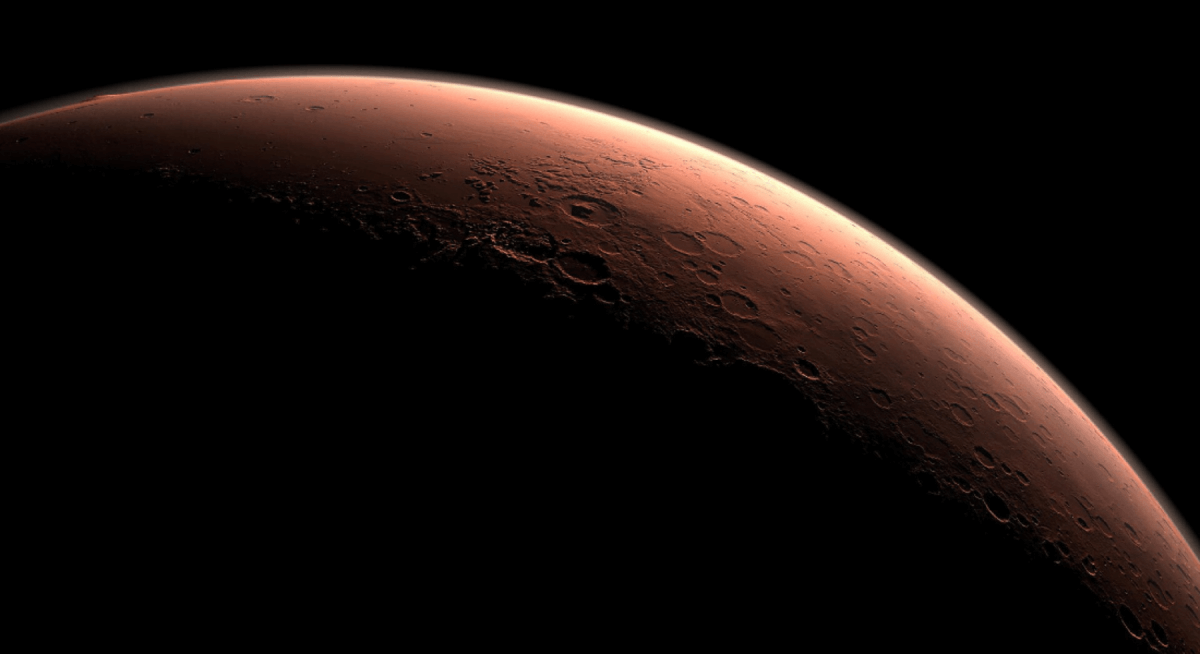
Visualization of the studied volcanic system (Pavonis fissure). Image courtesy Bartosz Pieterek.
In A Nutshell
- Mars was erupting while T. rex roamed Earth: A Martian volcano system was active between 64 and 50 million years ago, overlapping with the age of dinosaurs and early mammals on our planet.
- The volcano changed its recipe over 9 million years: Early eruptions produced fast-flowing, olivine-rich lava from deep sources. Later eruptions created thick, slow-moving, pyroxene-rich flows: evidence that magma sat cooling in underground chambers and chemically evolved before erupting.
- Scientists read Mars’s underground plumbing from space: Using infrared spectroscopy, researchers identified different minerals in lava flows, revealing how the magma system differentiated over millions of years without ever touching a rock sample.
- Mars stayed geologically active longer than expected: The findings show Mars’s interior remained hot enough to produce volcanism surprisingly recently: just 50 million years ago, which is a geological blink of an eye.
64 million years ago, a Tyrannosaurus rex is hunting in what will one day become Montana. At the exact same time, millions of miles away on Mars, a volcano is erupting, sending rivers of glowing lava across the Red Planet’s rusty surface.
This isn’t science fiction. Research published in the journal Geology shows that Mars was still volcanically active as recently as 50 million years ago, erupting lava flows while dinosaurs still roamed Earth, and continuing to do so well into the age of mammals. The last eruptions from one Martian volcanic system occurred around when early whales were just learning to swim and primates were swinging through forests on our own planet.
Interestingly, the volcano changed its personality over time. And by studying those changes, scientists have essentially figured out how to read the underground plumbing system of another planet.
A Volcano’s Chemical Makeover
Researchers Bartosz Pieterek, Valerie Payré, and Thomas Jones analyzed a volcanic system south of Pavonis Mons, one of Mars’s massive shield volcanoes. Using an infrared camera on NASA’s Mars Reconnaissance Orbiter, they discovered something unexpected. The early lava flows that erupted around 64 million years ago look completely different from the later ones that formed around 50 million years ago: not just in shape, but in chemistry.
The older flows spread out like spilled honey, traveling about 18 to 19 miles from their source in smooth, thin sheets. The younger flows typically stretched only 3 to 6 miles before stopping, and they’re thick and rough-textured.
The difference comes down to what’s in the lava. Scientists can identify minerals by looking at how they reflect infrared light, as each mineral absorbs specific colors we can’t see with our eyes but instruments can detect. The early flows are packed with olivine, a mineral that forms when really hot magma comes straight up from deep underground without stopping. The later flows are dominated by pyroxenes, minerals that form at cooler temperatures when magma sits in underground chambers and slowly cools. Based on comparisons with Martian meteorites, the olivine-rich flows likely erupted at temperatures exceeding 2,300°F, while the pyroxene-rich flows formed at around 1,800 to 2,200°F.
Nine Million Years of Underground Brewing
So what happened during those 9 million years between eruptions? The magma chamber was cooking.
When magma sits in the crust instead of erupting immediately, heavier minerals crystallize first and sink to the bottom, like sediment in a bottle of salad dressing. What’s left behind is chemically different: enriched in silica and calcium. That’s exactly what forms pyroxenes.
This process, called differentiation, explains why the later lava flows were thicker and slower. More silica makes lava stickier, like the difference between water and honey. The rough texture of the volcanic cones also hints that these later eruptions might have been mildly explosive, coughing up fragments of lava that piled up around the vent instead of flowing away smoothly.
Two nearby volcanoes that formed around the same time show the same pyroxene-rich signature and the same stubby, thick flow pattern. They likely tapped into similar evolved magma, though from separate underground chambers.
Why This Matters
This volcanic center formed during Mars’s late Amazonian period, the most recent chapter in its geologic history covering roughly the last 300 million years. Scientists knew Mars had volcanoes during this time, but most figured major volcanic activity wound down long ago as the planet’s interior cooled. These new findings show Mars was still cranking out lava 50 million years ago, which is relatively recent on a planetary timescale.
While this study does not address life directly, volcanic activity can, in principle, create heat and chemical environments that scientists consider favorable for habitability. Volcanic systems release gases, melt ice into liquid water, and create hydrothermal systems where heat and water mix. That’s exactly the kind of environment where life could emerge or persist.
Reading a Planet From Space
The whole study was done from orbit because no spacecraft has visited this volcanic field. NASA’s Mars Reconnaissance Orbiter carries a spectrometer called CRISM that measures reflected sunlight in hundreds of different wavelengths. It’s essentially reading the chemical fingerprint of rocks from 200 miles up.
Each mineral absorbs light differently, creating a unique signature. Olivine shows up as a dip in the spectrum at one wavelength, pyroxenes at another. By comparing these signatures across different lava flows, the researchers could map out how the magma evolved over millions of years without ever touching a rock.
The technique isn’t perfect. Dust can obscure minerals, and the resolution is coarse: about two football fields per pixel. But it’s powerful enough to reveal a complete magmatic story written in the rocks, from deep-sourced primitive magma to evolved, differentiated lava that spent millions of years cooling underground before erupting.
A Hot Interior, Longer Than Expected
These findings imply Mars retained enough internal heat to sustain melting far longer than its small size might suggest. Heat escapes more quickly from smaller objects, like how a cupcake cools faster than a whole cake. Yet these observations show Mars’s interior stayed hot enough to melt rock and sustain active volcanism surprisingly recently.
The Tharsis region, where this volcano sits, is massive (roughly the size of North America) and dotted with similar volcanic features. Given the widespread occurrence of similar volcanic edifices across Tharsis, the authors suggest these findings may prompt reassessment of other late Amazonian systems.
The Bigger Picture
Understanding how long Mars remained volcanically active tells us how long the planet might have been geologically dynamic. Every volcanic eruption represents a moment when the planet’s interior was still warm enough to produce molten rock. Lava flows interact with ice, creating meltwater. Underground magma chambers create long-lasting heat sources.
Mars today is cold, dry, and seemingly dead. But 50 million years ago (a blink of an eye in planetary time) it was actively erupting, with subsurface chambers full of molten rock and chemical reactions happening underground. That’s a very different Mars than the frozen desert we usually imagine.
The next steps will require either seismic monitoring (to detect any remaining magma activity) or sample return missions that can precisely date rocks and measure their chemistry in laboratories on Earth. Until then, orbital spectroscopy gives us a powerful way to read planetary stories written in stone.
Somewhere beneath Mars’s dusty surface may still be preserved a record of ancient magma evolution. Chambers that once held molten rock, now frozen in time, waiting to tell us more about when the Red Planet was geologically alive. We’re learning to read that record, one lava flow at a time.
Paper Notes
Study Limitations
The research relied entirely on orbital remote sensing data, which limits direct observation of subsurface processes. Spectral analysis can identify minerals present at the surface but cannot determine precise chemical compositions or observe internal structures. The low spatial resolution of available CRISM data (200 meters per pixel) means small-scale features and subtle variations may have been missed. Dust coatings and weathering can affect spectral signatures, potentially obscuring mineral detections or creating false signals. The researchers could not directly measure eruption temperatures, magma storage depths, or time scales of differentiation—these were inferred by comparison to Martian meteorites and terrestrial volcanic systems. Alternative interpretations involving multiple disconnected magma sources rather than evolution of a single system cannot be ruled out without additional data.
Funding and Disclosures
This research was funded by the National Science Centre, Poland, through grant number 2024/53/B/ST10/00488 awarded to Bartosz Pieterek. Thomas Jones was supported by a UK Research and Innovation Future Leaders Fellowship (MR/W009781/1). The authors declared no competing interests. Data used in the study are freely available through NASA’s Planetary Data System and the MarsSI (Mars System of Information) repository.
Publication Details
Authors: Bartosz Pieterek (Institute of Geology, Adam Mickiewicz University in Poznań, Poland), Valerie Payré (School of Earth, Environment, and Sustainability, University of Iowa, USA), and Thomas J. Jones (Lancaster Environment Centre, Lancaster University, UK). | Journal: Geology (Geological Society of America) | Publication Date: Published online January 29, 2026 | DOI: 10.1130/G53969.1 | Manuscript History: Received September 15, 2025; Revised December 18, 2025; Accepted January 13, 2026 | Citation: Pieterek, B., Payré, V., and Jones, T.J., 2026, Spectral evidence for magmatic differentiation within a martian plumbing system: Geology, https://doi.org/10.1130/G53969.1


